
How to Get Into Commercial Voice Over: The Real-Person Read

Commercials are the work most people picture when they think of voice acting. The car ad on the drive home, the supermarket spot between songs, the fifteen seconds before a video starts. It’s also one of the most competitive corners of the business, and one where a small change in how you read makes a big difference to whether you book.
This guide is for voice actors who want to start auditioning for commercial work, or who’ve been auditioning for a while and aren’t hearing back. We’ll cover what clients are listening for, how timing works, the mistakes that give a newcomer away in the first line, and a practice routine you can start tonight.
What commercial voice over covers now
“Commercial” used to mean radio and television. It still does, but the list has grown. A working commercial voice actor today records for:
- Television and radio spots, local and national
- Online video ads, the ones that play before or during a video
- Podcast and streaming audio ads
- Social media ads, often very short and cut several ways
- In-store and point-of-sale announcements
- Product and brand videos on a company’s own website
The lengths vary by where the ad runs. American Public Media’s guide to writing sponsorship spots notes that its broadcast messages “are either :10 or :15 seconds in length,” while “Podcast sponsorship messages are usually :15 or :30, and sometimes :60 seconds in length.” Online and social ads often run shorter still. Whatever the length, the job is the same: say one thing, clearly, in a voice the listener trusts, inside a fixed number of seconds.
The read that books: a real person, not an announcer
If you learn one thing about commercial voice over, make it this. The big, booming announcer voice most people do when they’re “doing a voice over” is rarely what’s being cast.
Lisa Fischoff, a New York casting director who has cast voice over for national brands, put it clearly in an interview with NYCastings:
“The natural vocalist is still very much in demand, the conversational read, the person who does not sound like a big booming announcer. That’s not in vogue anymore unless it’s a character. It’s down to earth, matter-of-fact, laid back.”
It’s the same direction you’ll find on plenty of commercial briefs today, which tend to ask for a voice that’s warm, real, relatable and “not salesy.” If you’ve ever wondered what clients mean by those words, we’ve unpacked them in what “warm, natural, conversational” actually asks of you.
There’s an exception worth knowing. Fischoff added that “Authoritative voices are also in demand for banks and pharmaceuticals, those kinds of products.” Authority here doesn’t mean deep or loud. It means credible: someone who sounds like they know what they’re talking about and have no need to push.
Stop overworking the copy
The fastest way to sound like a beginner is to try too hard. Every word gets punched, every sentence goes up at the end, and the whole thing sounds like reading rather than talking. Fischoff described it as one of the most common problems she hears:
“One of the downfalls an actor can bring to an audition is overworking copy. The microphone picks you up so intensely that a natural sound can be really gone quickly if you overwork it.”
Her test for a good read is short: “I have to believe what you are saying.” Everything else follows from that.
A few practical ways to get there:
- Talk to one person. Picture someone specific, a friend who’d actually use the product, and tell them about it. Not “the audience.” One person.
- Find the one word that matters. Most sentences in a spot have one word doing the work. Lean on that one and let the rest sit naturally. Circle it in pencil if it helps.
- Move. Fischoff is clear that this is allowed: “If you talk with your hands, that’s what you should do.” As long as the mic doesn’t hear you knocking into things, whatever helps you sound real is fair game.
- Read it out loud before you record. Silently reading copy and speaking it are different skills. The first spoken pass always finds the awkward phrase.
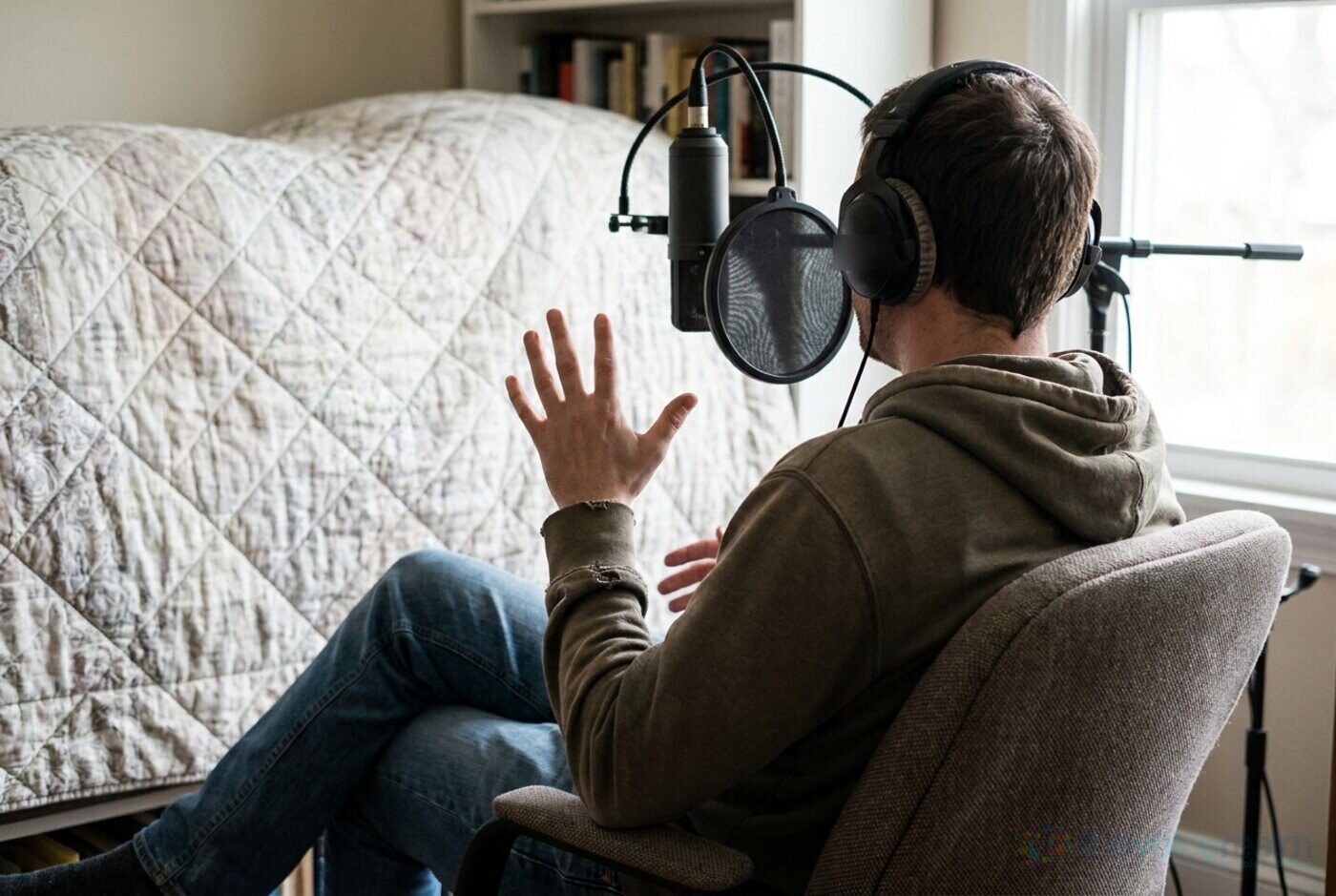
Talk to one person, not an audience. If your hands want to move, let them. © The Voice Realm
Every second is paid for, so learn to time copy
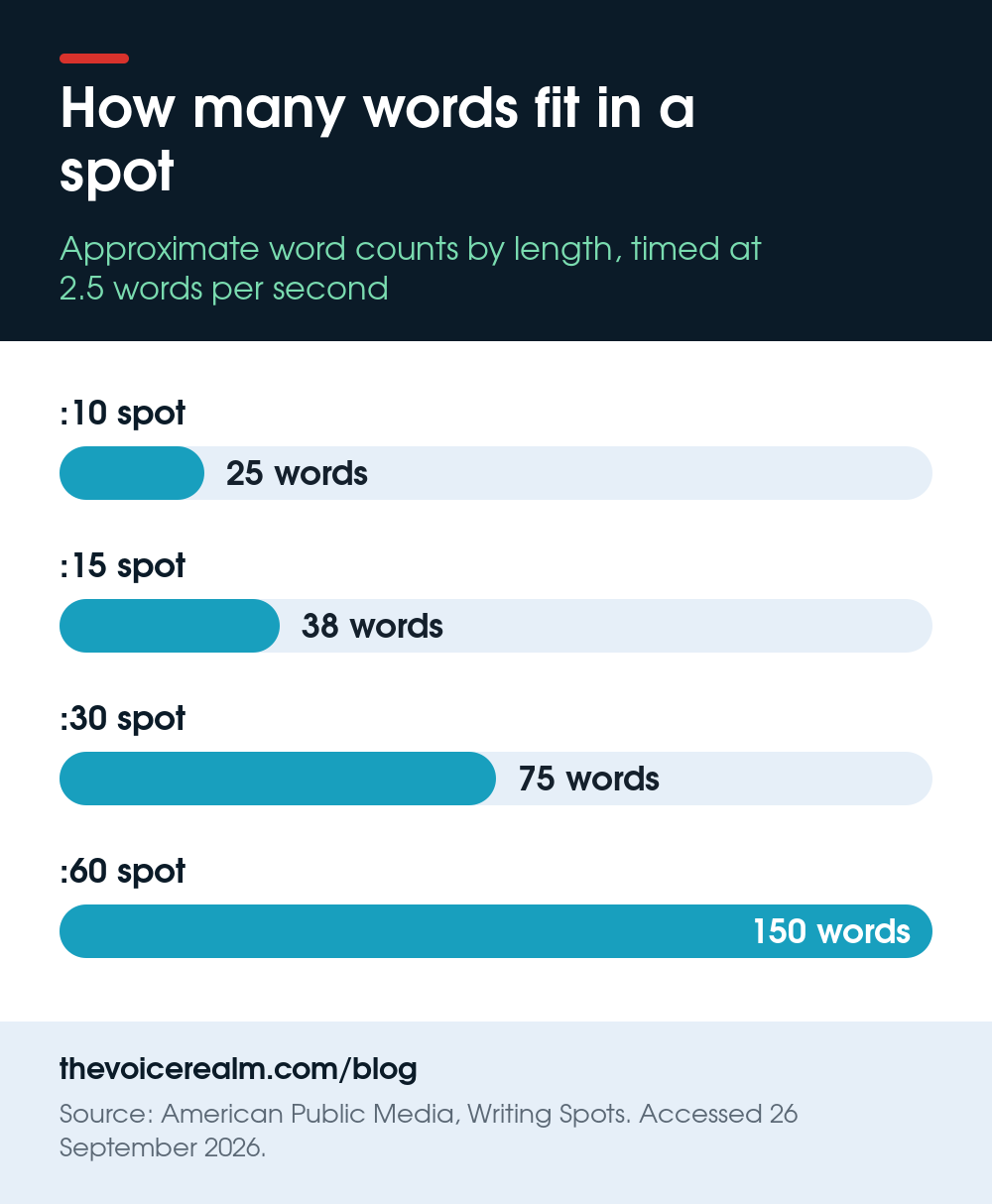
Commercial copy is written to a clock. A thirty-second spot has to finish inside thirty seconds, usually with a little room at each end, and clients notice when a read runs long or rushes to fit. American Public Media gives writers these word counts:
“A 10-second spot is approximately 25 words in length. A 15-second spot is approximately 38 words in length. A 30-second spot is approximately 75 words in length A 60-second spot is approximately 150 words in length”
The same guide says to time a finished script at “2.5 words per second.” Real copy doesn’t always follow the rule. Clients often squeeze ninety words into a thirty, especially when there’s a legal line at the end, and part of the job is fitting it in without sounding rushed.
How to practise timing:
- Take any ad you hear on the radio or before a video, write down the words, and count them.
- Read it with a stopwatch running. Note your natural time.
- Now read it again to hit exactly the length it aired at. If you’re long, don’t speed up evenly. Tighten the pauses first, then pick up the less important phrases, and leave the product name and the key line at a natural pace.
- Do the same copy as a :15 by cutting it down yourself. Clients often ask for several lengths from one session, and knowing what to drop is a skill.
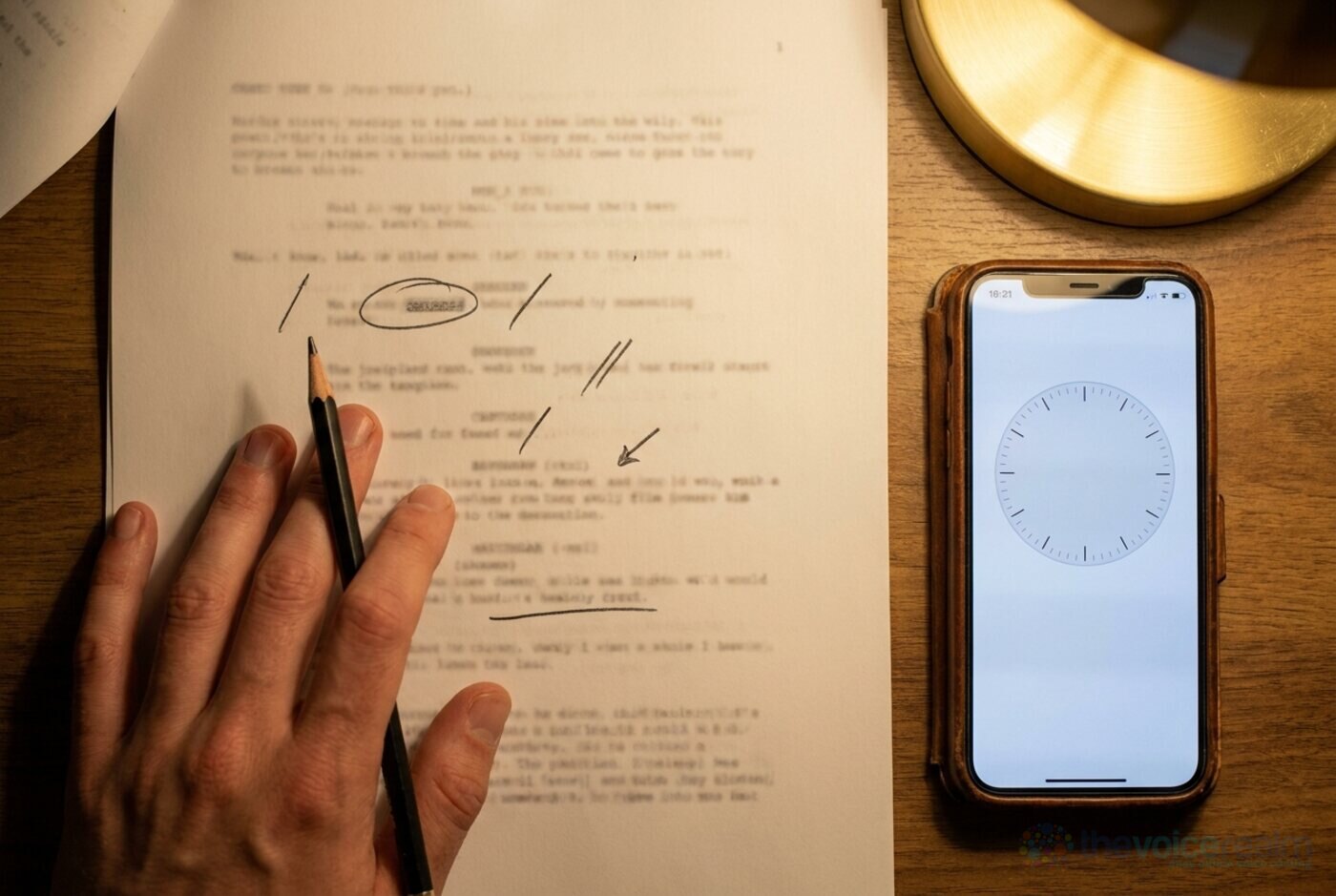
Mark the copy in pencil: the word that matters, where you'll breathe. Then time it. © The Voice Realm
© The Voice Realm
The parts of a spot, and how to read each one
Most commercials have the same shape. A hook that earns attention, a middle that says what the thing is and why it matters, and a close that tells the listener what to do. The close is often called the tag, and it’s where a lot of reads fall apart.
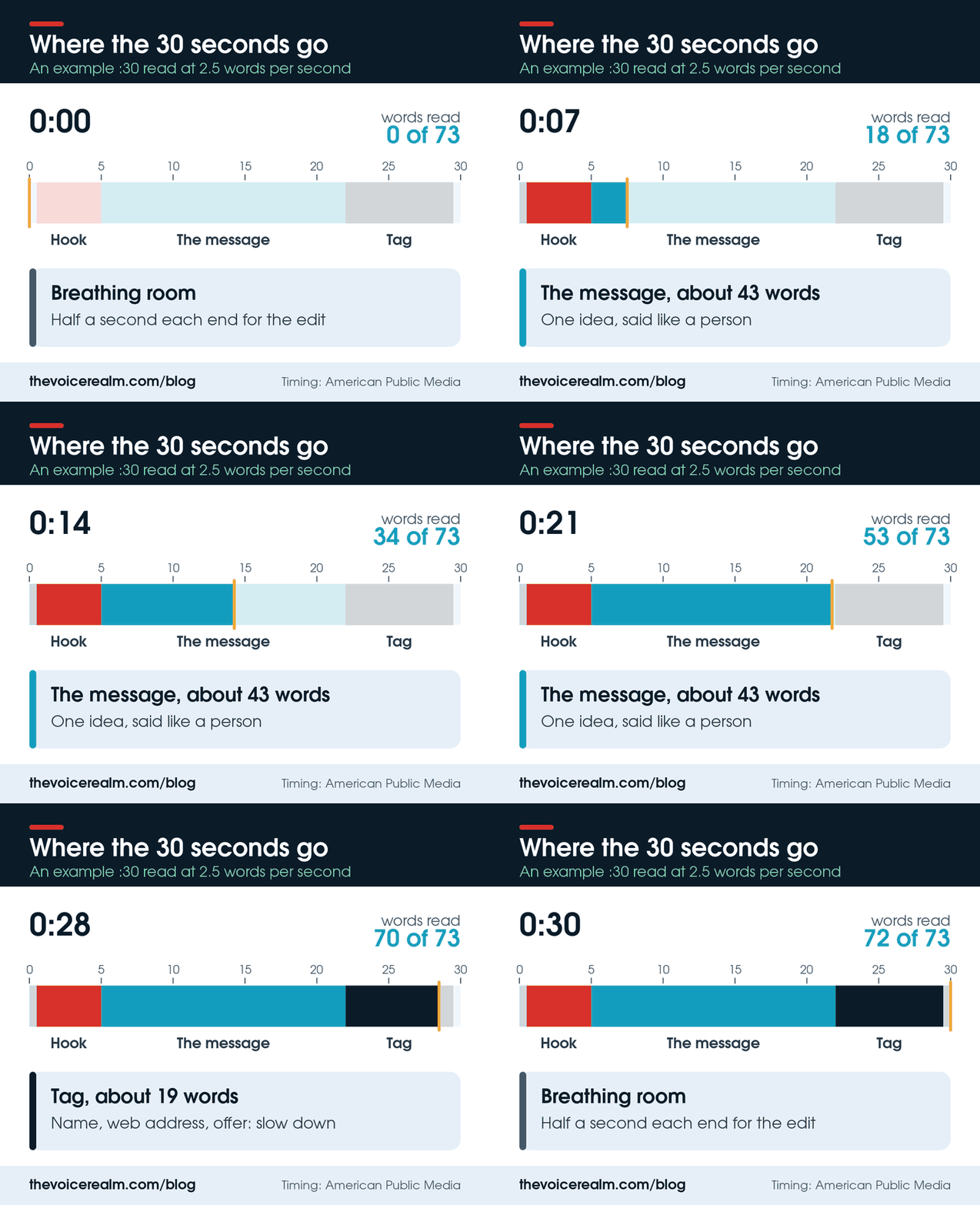
An example :30, second by second: a short hook, one message, and a tag you don't rush. © The Voice Realm
Tags carry the web address, the phone number, the offer end date, and sometimes a fast legal line. They’re easy to throw away because they come last and feel like admin. Don’t. The tag is the part the client paid for most directly.
 Voice Master AcademyFirst read to first booking.Twenty modules. The first one is free.Start free
American Public Media’s guide shows how carefully writers think about this. Web addresses are written out word by word so the announcer knows how to say them, with the ending spelled like an acronym: “Visit American Public Media dot O-R-G for more information.” Acronyms are separated with dashes “because the announcer needs to know to announce each individual letter.” When a script doesn’t do that for you, ask. How to say the brand name, whether the web address has a “www,” and whether an acronym is spelled out or said as a word are all fair questions, and clients would much rather answer them than pay for a pickup.
Why shouting doesn’t make you louder on air
New commercial voice actors often push volume to sound energetic. On television in the US, that doesn’t work, because the rules level it out.
The Federal Communications Commission explained the rule in a 2025 notice in the Federal Register. Under the CALM Act, stations and pay TV providers must follow an industry standard that “requires that the average loudness of a commercial not exceed the average loudness of the surrounding programming.” The same notice records “growing concern with the loudness of commercials on streaming services and other online platforms,” so the pressure on loudness is heading in one direction.
For a voice actor, the lesson is simple. A shouted read gets turned down to match everything else, and then it just sounds like someone shouting, only quieter. Energy in a commercial comes from intention, pace and a smile you can hear, not from volume. Record at a comfortable speaking level and let the engineer handle loudness.
Your commercial demo is your audition before the audition
Many commercial clients cast directly from demos, especially on smaller budgets. Fischoff described clients who “might book straight from a demo,” asking for a handful of voices matching a description and choosing from what they hear. “So if you don’t have a demo,” she said, “I can’t book you even if you are perfect for it.”
She was just as firm about timing. Making a demo before you’re ready is a waste, “because you really don’t get more than one shot.” Casting people who hear a weak demo rarely give the next one a fair listen.
A good commercial demo is short, opens with your strongest and most natural read, and sounds like the voice a client will actually get in a session. It should be built from spots you can reproduce on demand, not a showcase of characters you can only do once. We’ve written more about building a demo reel that stands out if you’re getting close to that point.
Auditions, takes and direction
When you audition for a commercial, give the client a choice. Fischoff said she never sends just one read: “I never give less than two takes.” Two takes that sound the same aren’t a choice, though. Make them genuinely different, for example one warm and friendly, one more straight and matter-of-fact, so the client can hear range as well as quality.
Once you book, expect direction, and expect some of it to surprise you. “You have to be open to a casting director throwing out to you an idea that isn’t on your page,” Fischoff said. The actors who get rebooked are the ones who can take a note like “less smile, more secret” and give something new straight away, without arguing for their first read.
If you’re sending auditions regularly and not hearing back, there’s a longer list of likely causes in why you’re auditioning but not booking.
Union work, non-union work and usage
In the US, a lot of national commercial work goes through the performers’ union, SAG-AFTRA, and plenty of regional, online and small-business work is non-union. You don’t have to be a member to start. Fischoff noted that “as a non-union actor you can audition for union work you just have to be prepared to join if you book a job.”
Whichever way you work, understand usage. Commercial fees are tied to where an ad runs and for how long: a local radio spot for a month is a different job from a national TV campaign for a year, even if the script is the same length. Always ask where the spot will run, in which markets and for how long before you agree a rate. Once you have those answers, the free Rate Checker at Voice Edit Suite turns them into a starting point: pick the kind of ad, the spot length, whether it runs locally, regionally, nationally or internationally, and how long it’s licensed, and it gives you a low, middle and high figure to negotiate from. It covers non-union work; union jobs are priced on their own scale. The difference between a one-off buyout and ongoing payments is explained in our piece on buyouts versus residuals.
A practice routine you can start tonight
You don’t need a booking to get better at commercial reads. You need copy, a recorder and honest ears.
- Collect ten real ads. Write down the words of ads you hear on the radio, on TV and before videos. Mix products: a bank, a snack, a car, a local business, a charity.
- Read each one three ways. As a friend recommending it, as an expert explaining it, and as yourself on a good day. Record all three.
- Time them. Hit the aired length exactly, then cut a :15 from the :30.
- Listen back the next day. Fresh ears are honest ears. Ask one question of each take: would I believe this person?
- Compare with the real ad. Not to copy the voice, but to hear what the professional did with pace, pauses and the tag.
Once your reads sound like a person talking, you’re ready to audition. Commercial castings come up on our voice over jobs board most days, and if you’d like structured coaching on the craft first, Voice Master Academy is a good place to start.
The good news about commercial voice over is that the style clients want is the one you already have. It’s the way you talk when you’re telling a friend about something you like. The work is learning to do that on purpose, on a clock, with a microphone listening.
Sources: Kelly Calabrese, “Sound Bites! Voice-over input from Casting Director Lisa Fischoff”, NYCastings; American Public Media, “Writing Spots”; Federal Communications Commission, “Implementation of the Commercial Advertisement Loudness Mitigation (CALM) Act”, Notice of Proposed Rulemaking, Federal Register, March 11, 2025. All accessed 26 September 2026. Photographs are illustrations; the timing animation is an example built on American Public Media’s word counts.