Blog
Blog
Ask ten voice actors what a SAG-AFTRA radio spot pays and you’ll get ten answers, three of them out of date and one of them from 2019. That isn’t because voice actors are bad at maths. It’s because union rates live in a stack of PDFs written for payroll departments, and none of those PDFs tells you what a job actually comes to once the pieces are added up.
So we built something that does. The SAG-AFTRA voice over rate card and calculator takes every current union minimum for voice work, asks you two or three plain questions, and hands back a receipt: session fee, use fee, the session credit, P&H, and what the producer pays. This is a look at why union rates feel so hard, and how the rate card makes them easy.
Why SAG-AFTRA rates feel impossible to read
There isn’t one SAG-AFTRA rate sheet for voice actors. There are at least seven, one for each contract that covers voice work: audio commercials, TV commercials, video games, corporate and educational work, dubbing, promos and trailers, and TV animation. Audiobooks don’t have a single sheet at all, because each publisher signs its own deal. Each sheet runs on its own dates, uses its own vocabulary and lays its numbers out its own way.
Then there’s the jargon. A rate sheet will happily tell you the 13 week Class A guarantee for an off-camera principal and assume you know what every one of those words means. Wild spots, units, cycles, holding fees, Audio Flex, Category II, Global Rule One. If you came to voice acting from theatre, radio or a bedroom booth, nobody handed you the dictionary.
And the sheets don’t do the adding up. A union commercial isn’t paid as one number. It’s a session fee for the recording, a use fee for where it runs and for how long, sometimes a credit of one against the other, and a pension and health contribution on top. The PDF gives you the ingredients. You’re left to cook.
Even SAG-AFTRA knows this. Its own voiceover page lists a few sheets and then says: “Some of the rate sheets are below, but please check with staff for details about your upcoming job.” Its online commercials calculator is built for producers budgeting a shoot, and anyone working off camera is told to “please contact the Commercials department” by phone. There is an official Audio Flex calculator for radio and online audio ads, and it’s good, but it covers that one contract, and it’s also written for the people doing the hiring.
What the SAG-AFTRA rate card does instead
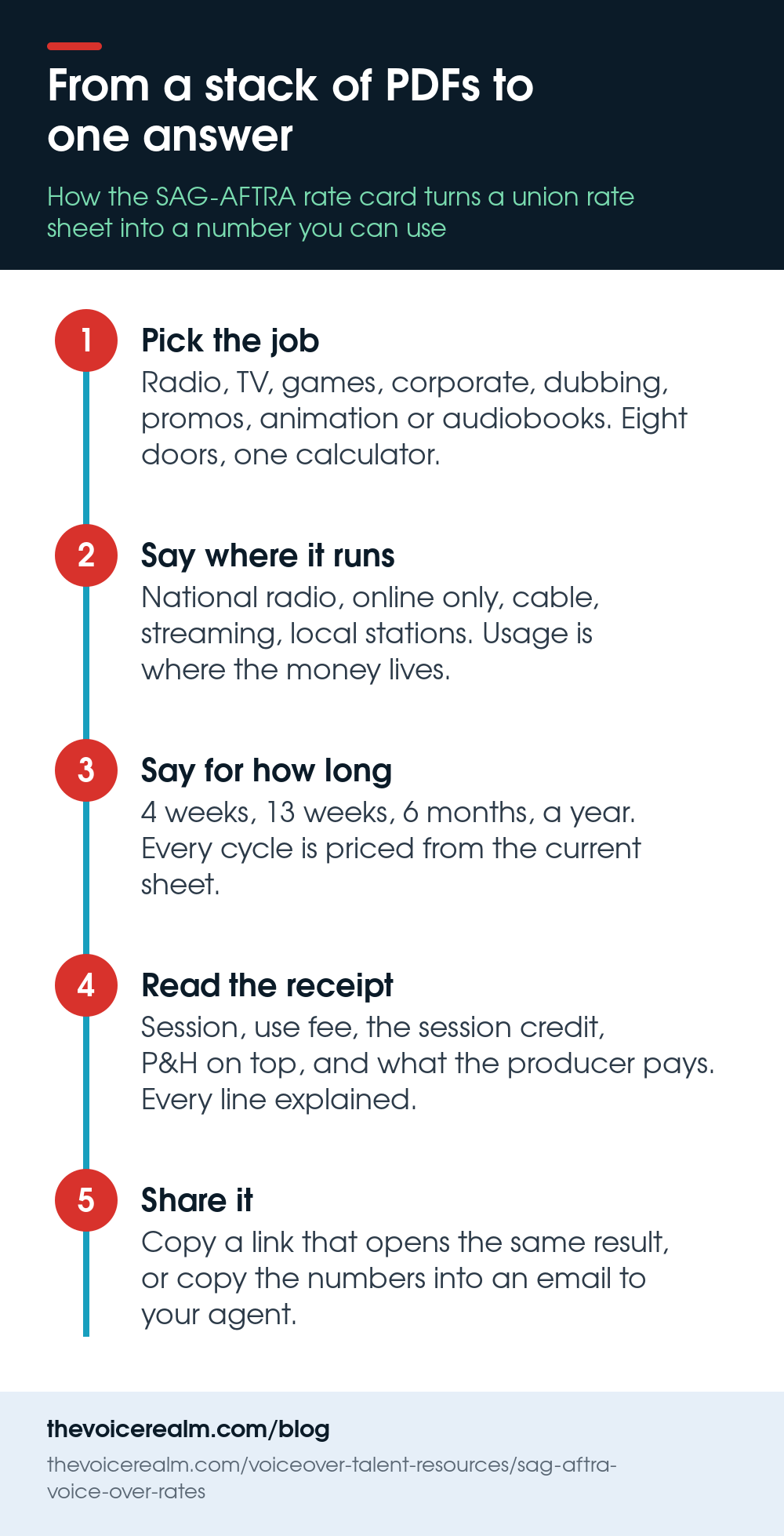
The rate card starts with the question a voice actor actually has: what kind of job is this? You pick from eight doors: radio and audio ads, TV and video ads, video games, corporate and e-learning, dubbing, promos and trailers, TV animation, or audiobooks. The calculator then asks only what that contract needs to know.
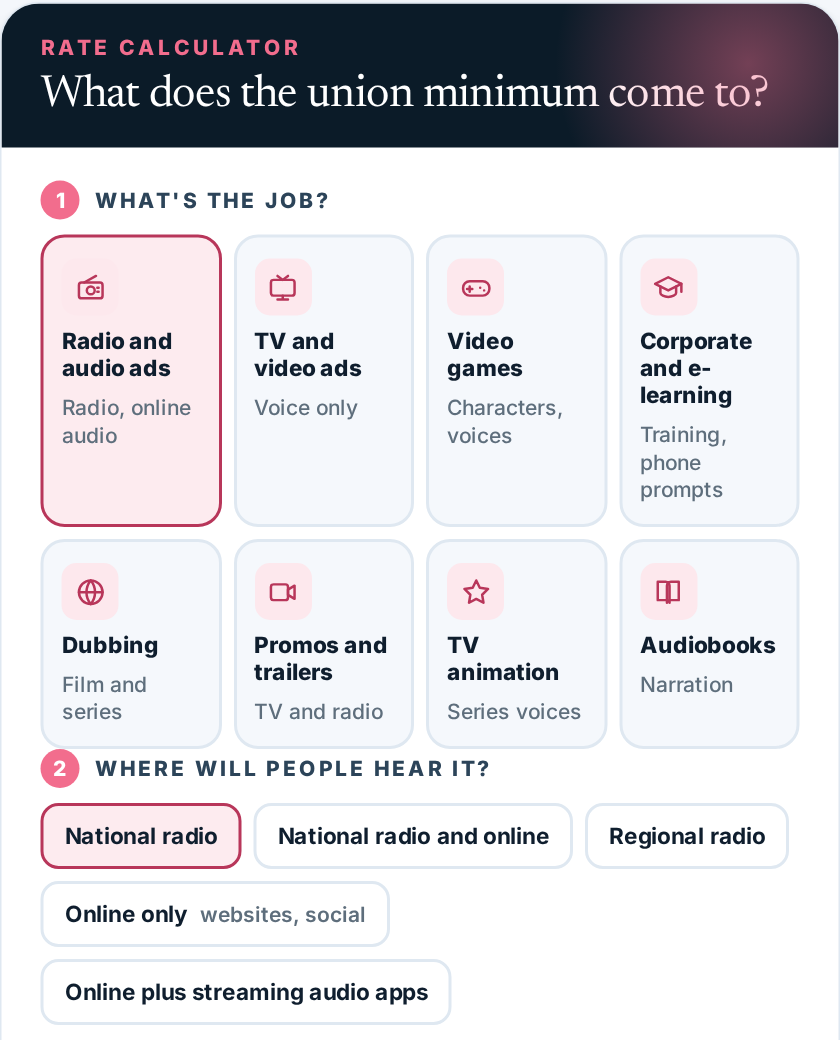
Step one on the rate card: pick the job. Each door asks only what that contract needs.
For a radio ad that’s where it will be heard and for how long: national radio, regional, online only, online plus streaming audio apps, for 4 weeks, 8 weeks, 13 weeks, 6 months or a year. For a TV spot it’s which media, ticked like a shopping list: national cable, streaming, online video, local stations, network TV. For a video game it’s a one hour session or a four hour day, and how many voices you’re doing. For corporate work, the category and how long you’re in the booth.
Every answer updates the receipt underneath straight away. No submit button, no email address, no login.
© The Voice Realm
The receipt: every line of a union fee, explained
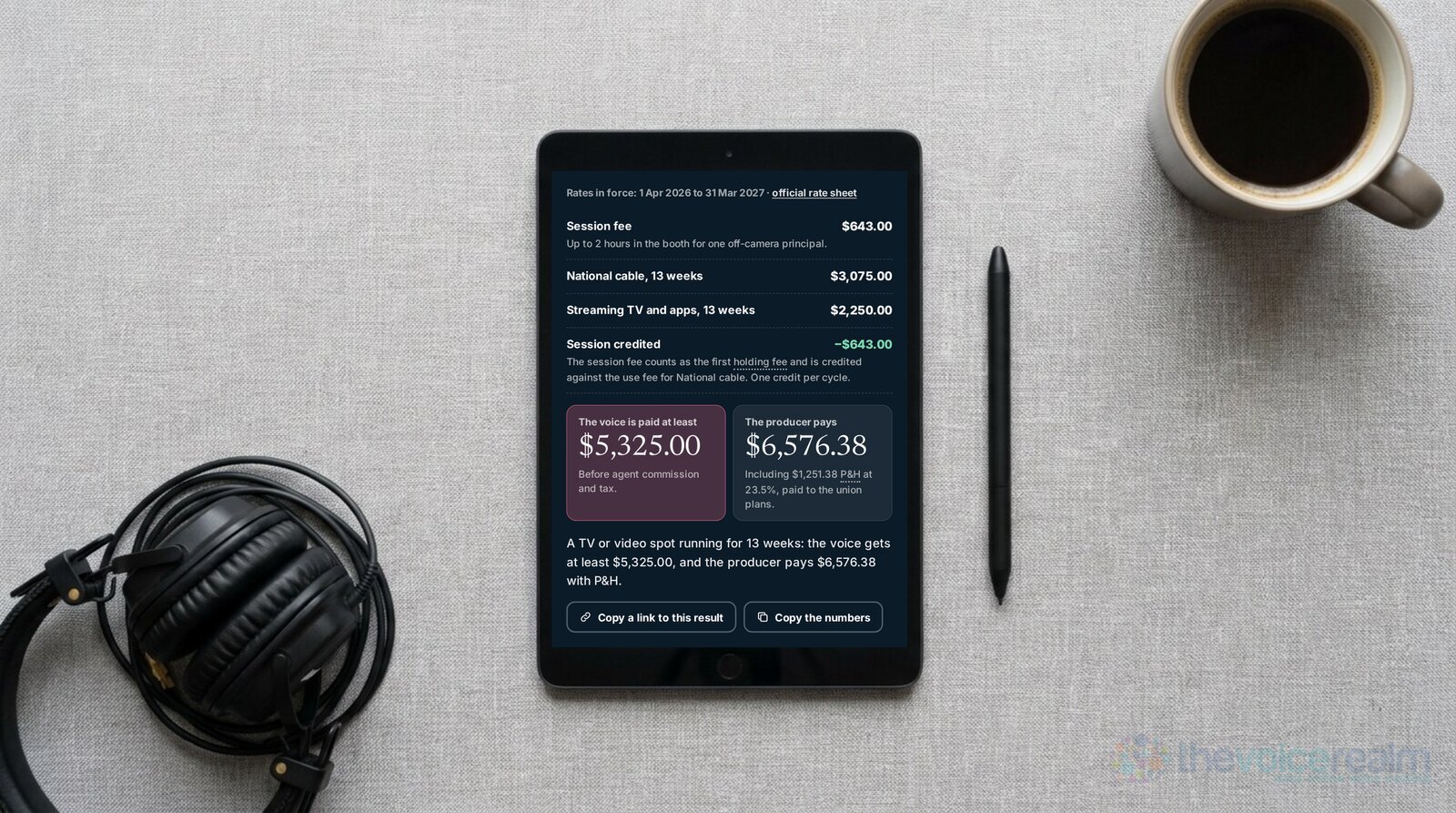
This is the part people screenshot. Pick a national cable TV commercial that also runs on streaming for 13 weeks, and the receipt lays it out line by line: a $643.00 session fee for up to two hours in the booth, $3,075.00 for national cable, $2,250.00 for streaming, then the session credited back as its own line, because under the TV contract the session counts as the first holding fee. Bottom line: the voice is paid at least $5,325.00, and the producer pays $6,576.38 once P&H at 23.5% is added.
Every one of those lines carries a sentence saying what it is. The session credit, which confuses more working actors than any other rule, is spelled out in plain English: you get the bigger of the two, not both, and only one credit per cycle. The calculator also knows the two exceptions that catch people out. On the audio contract the session is never credited against online-only use, and on the TV contract it can’t be credited against online-only use unless TV or streaming is bought too. You don’t have to remember either rule. The receipt applies them and tells you it did.
It also shows the money that never touches your bank account. P&H, the pension and health contribution, is paid by the producer to the union plans on top of your fee. It’s 23.5% on commercials, or 19.95% for producers who qualify for the discounted rate, and there’s a switch for both. Seeing “the producer pays” next to “the voice is paid at least” is the fastest lesson in union money there is.
Gives you a grid
Dozens of numbers across cycles and media, contract jargon, dates in the corner, and no total. You do the adding, the crediting and the P&H yourself.
Gives you an answer
Pick the job, say where and how long. A line-by-line receipt with every rule applied, every word explained, and a link you can send.
Video games, corporate, dubbing: the rest of the union map
Commercials get the attention because use fees can be large, but plenty of union voice work is paid differently, and the rate card handles that too.
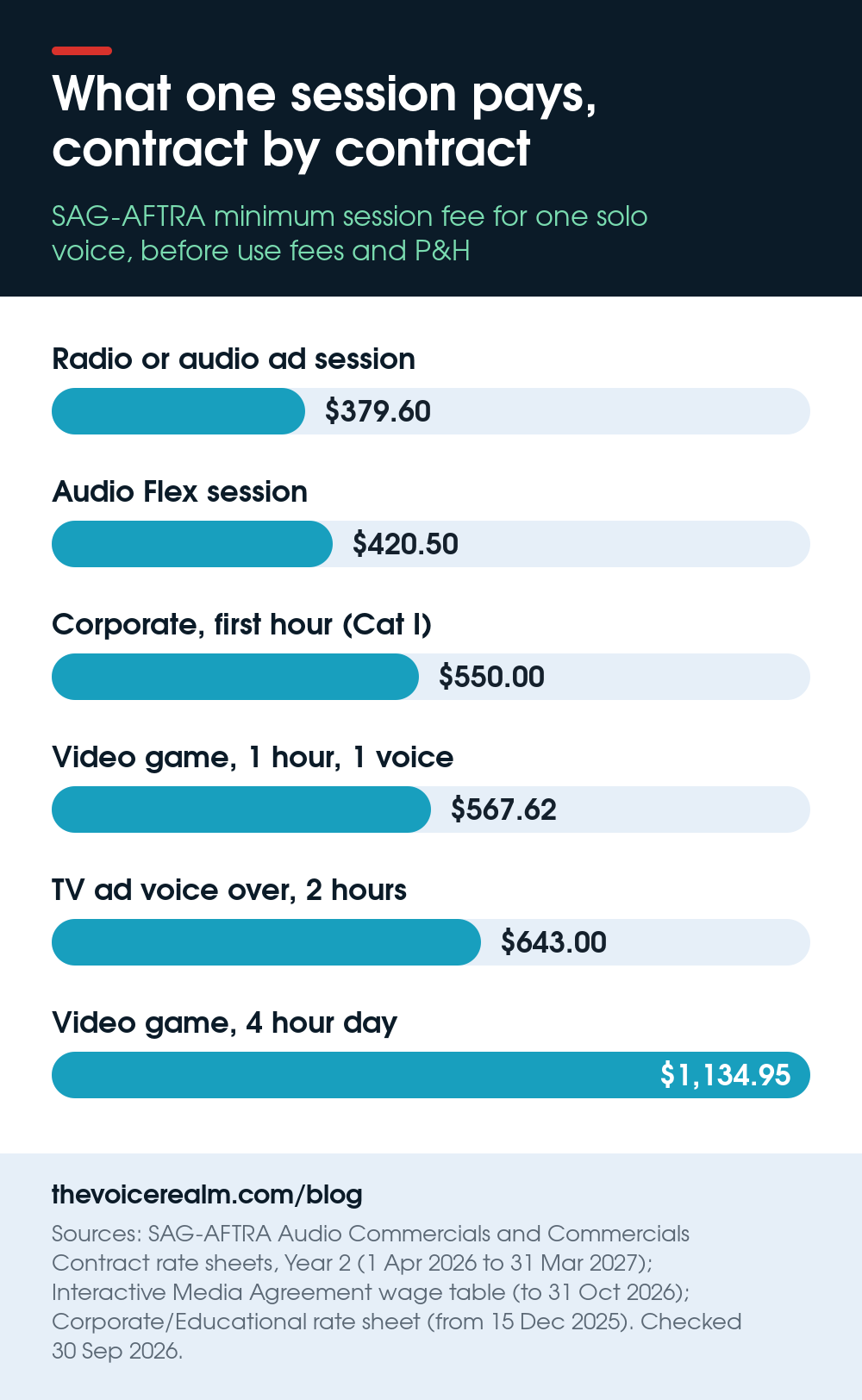
Video games run under the Interactive Media Agreement. A session is $567.62 for one hour and one voice, or $1,134.95 for a four hour day with up to three voices, and the receipt adds the additional compensation the game pays on release if your work is in the finished game, which tops out at $2,140.00 after ten sessions. P&H on games is 17% until 30 October 2026, and the calculator already holds the next period’s figures with a date switch, so the numbers won’t go stale on 1 November. If games are your thing, our guide to what video game voice work really asks of you covers the craft side.
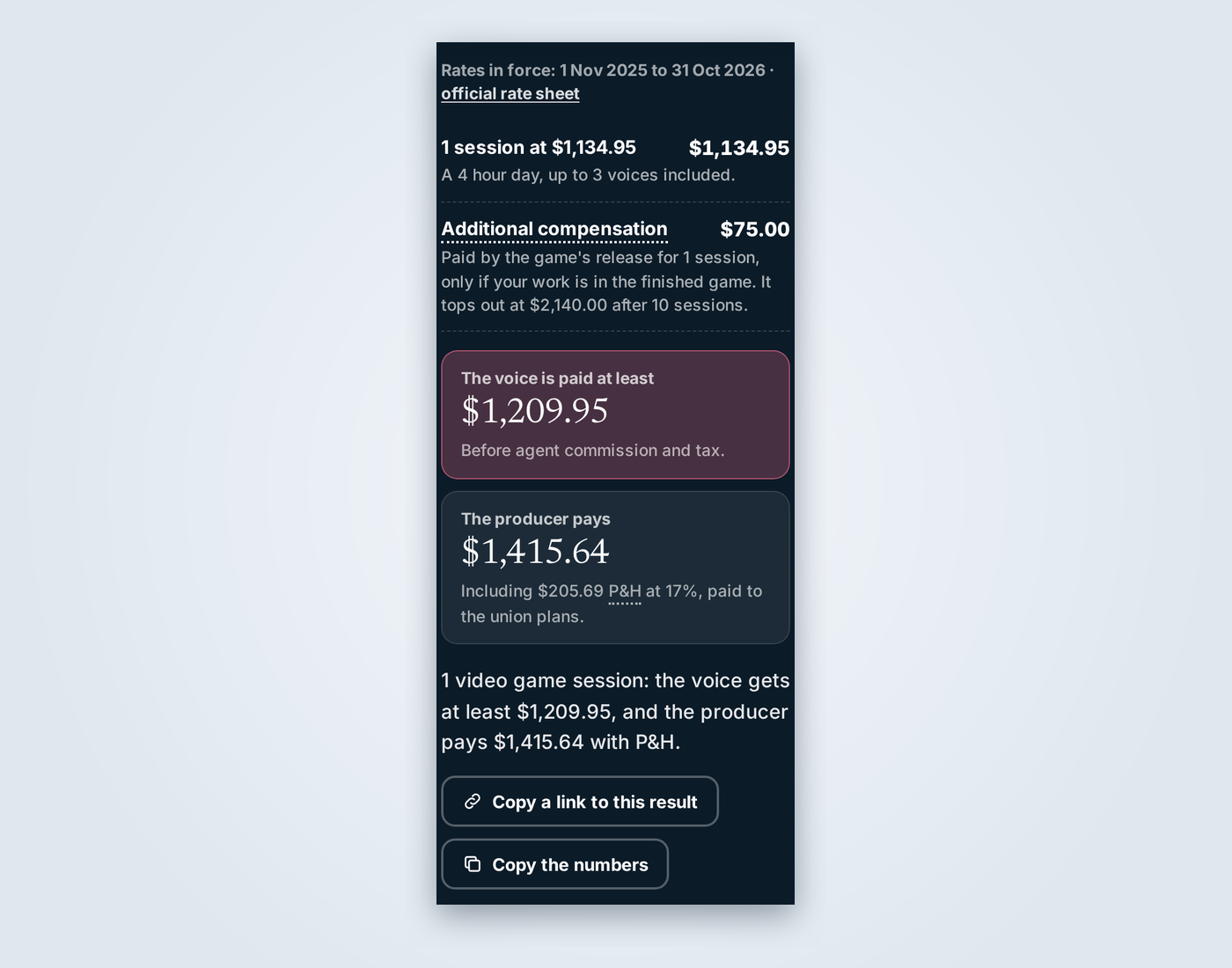
A video game day on a phone: session, additional compensation and P&H, each line explained.
Corporate and educational work, the training videos, e-learning and phone systems, is priced from the first hour in the booth and splits into Category I for training and education and Category II for wider, public-facing uses. Dubbing runs on its own Modified Dubbing Agreement, paid by the hour. Promos and trailers have their own sheet. Our piece on matching the mouth in dubbing work is a good companion if you’re heading that way.
Two doors are honest about what they can’t do. TV animation has a new deal agreed in September 2026 with rates not yet published, so the rate card shows the last published figures and says so. Audiobooks have no single union rate: SAG-AFTRA has agreements with more than 90 publishers, each with its own per finished hour minimum. Rather than invent a number, the rate card explains how audiobook pay works and points you to the union staff who hold the real figures. If narration is where you’re aiming, start with our working guide to audiobook narration.
Where it runs changes everything
The single most useful idea in union pay, and in non-union quoting too, is that usage sets the price. The rate card proves it with one chart: the same voice, the same thirty seconds, 13 weeks every time, and the only thing that changes is where the spot runs.
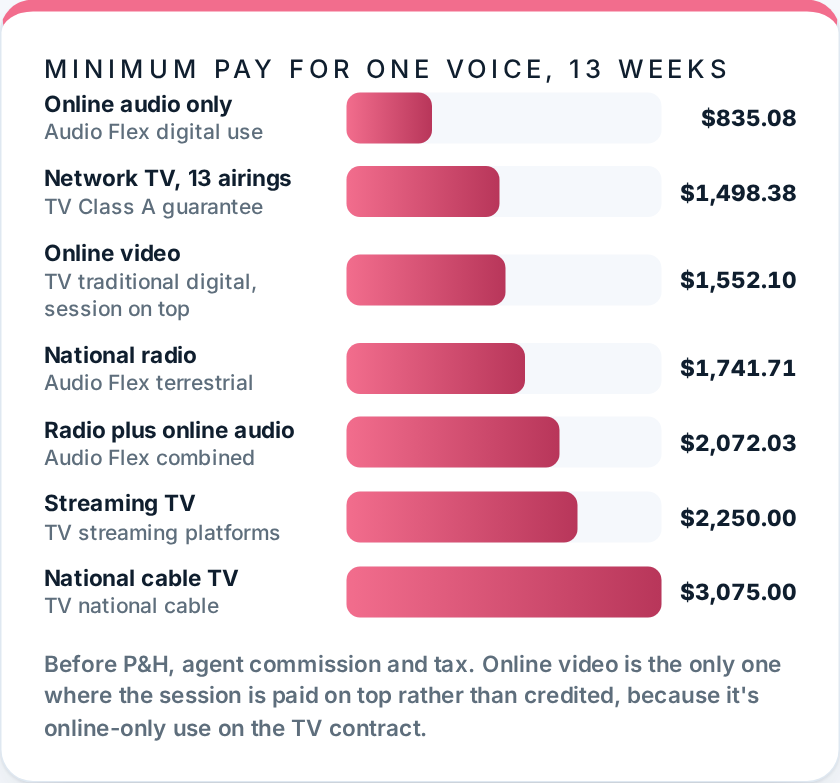
One read, seven places to run it. The chart on the rate card shows why usage sets the price.
 VOICEMASTERACADEMYLearn the craft in order.Module one is freeStart module oneTwenty modules, start to finish.
Online audio only comes to $835.08. Network TV with 13 airings, $1,498.38. National radio, $1,741.71. Streaming TV, $2,250.00. National cable TV, $3,075.00. Same read, more than three and a half times the money, because far more people hear it and the advertiser gets far more out of it. Once you’ve seen that chart, you’ll never quote a job again without asking where it’s going to play. If the difference between buyouts and paying per use is new to you, our older piece on full buyouts versus residuals is worth ten minutes.
- Current numbers. Every figure comes from the SAG-AFTRA sheet in force today, with the dates and a link to the official sheet under every result.
- One page, eight contracts. Radio, TV, games, corporate, dubbing, promos, animation and audiobooks in one place.
- Written for the performer. It answers “what am I paid”, not “what’s my budget”.
- Plain English. Tap any dotted word and its meaning pops up.
- Shareable. Every result has its own link that opens the same answer.
Tap a word, get the meaning
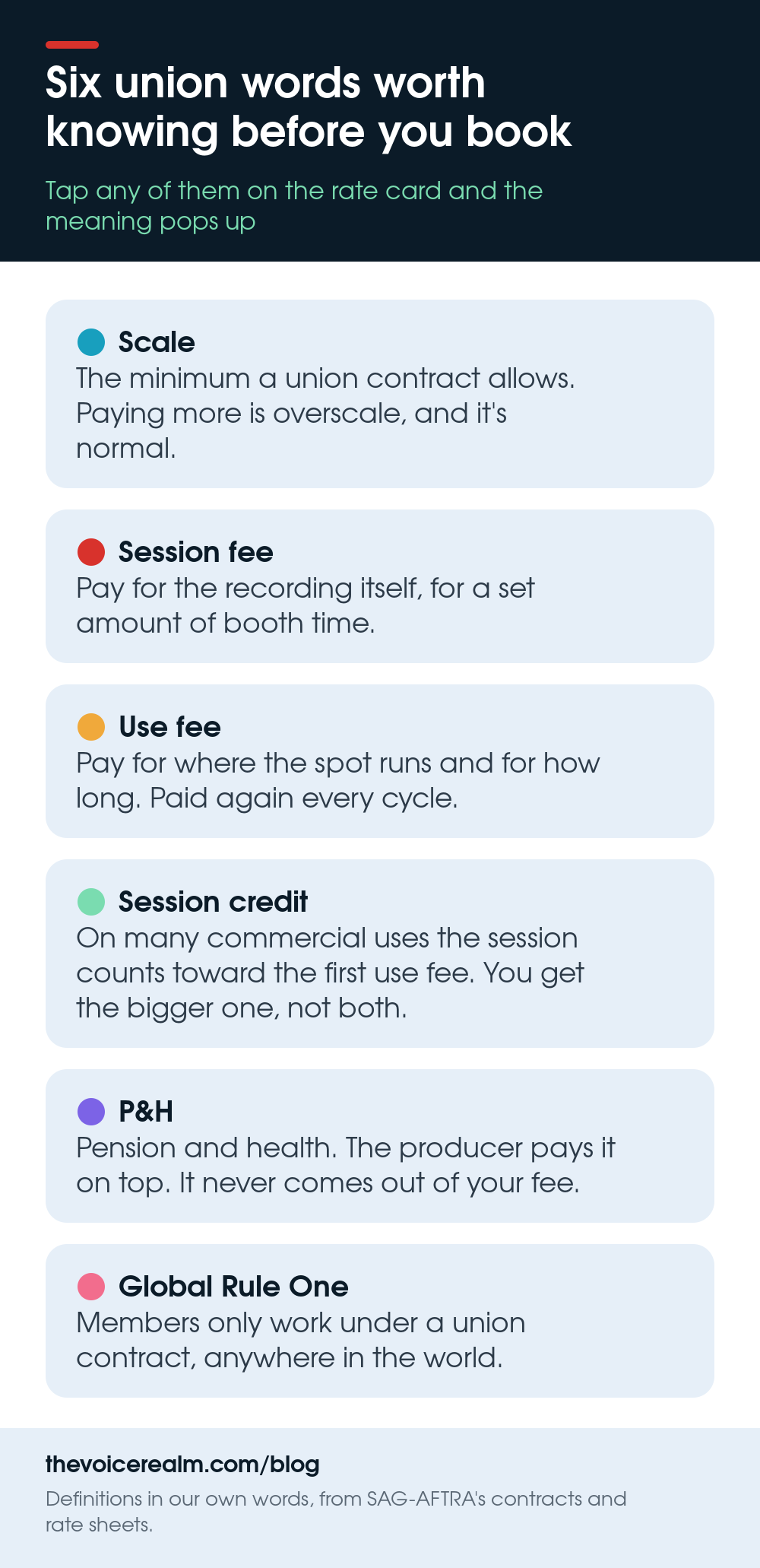
Union rates are half numbers and half vocabulary, so the rate card treats the words as seriously as the figures. Any dotted word on the page, from scale and cycle to wild spot, unit, Class A, Audio Flex, digital replica and Global Rule One, opens a short definition when you tap it. Nineteen of the terms that trip people up are collected in one glossary at the bottom, written the way you’d explain them to a friend over coffee.
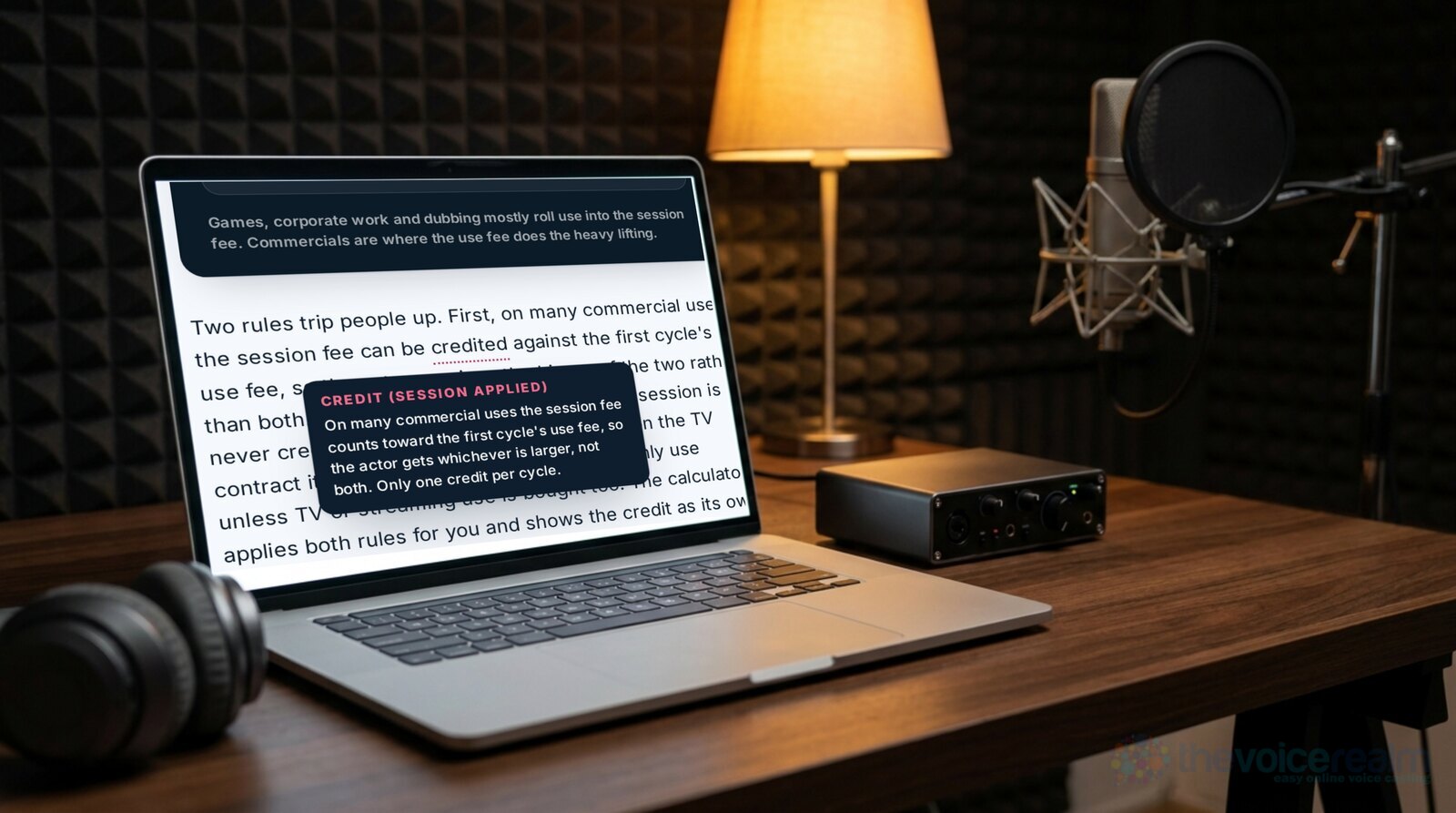
Tap a dotted word and the meaning pops up, right where you're reading.
Scale, for example, is the minimum a union contract allows for a job. Paying more is called overscale, and it’s normal for experienced actors. That one sentence clears up a misunderstanding that costs people money: the union rate is the floor, not the price. Plenty of work pays more, and nothing stops anyone from asking.
Share a result, settle an argument
Every answer the rate card gives has its own web address. Work out a 13 week national radio spot, press “Copy a link to this result”, and whoever opens that link lands on exactly the same receipt. Send it to your agent before a call. Drop it in a group chat when someone swears the session fee is all you get. Paste it into a reply to a producer who’s offering less than scale for a union job. Or press “Copy the numbers” and paste the whole breakdown into an email as text.
We think that’s what makes this tool spread. A rate table is something you read alone. A link to a worked answer is something you send.
Union and non-union: what the rate card tells you either way
Most voice actors work both sides of the line at some point, so it’s worth saying what the SAG-AFTRA rates mean if you’re not a member. Union minimums are the most public, most carefully negotiated benchmark the industry has for what voice work is worth. Even if the job in front of you is non-union, knowing that a national radio spot carries a union minimum of $1,741.71 for 13 weeks gives you a footing when someone offers a flat fee for “radio and online, forever”.
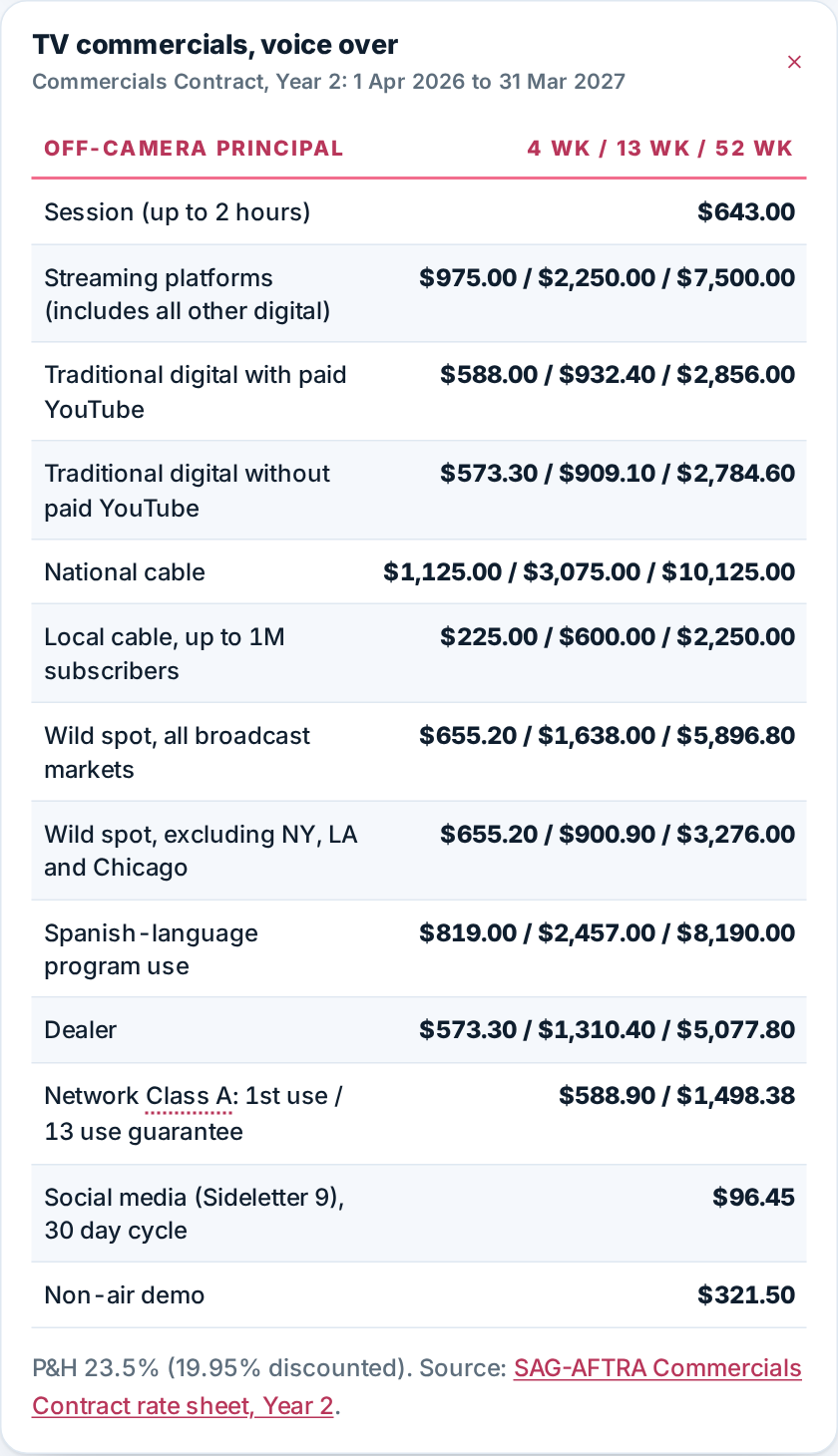
Every contract's voice over lines sit in a table you can open, with the official sheet linked underneath.
If you are a member, the rate card’s checklist before you say yes is the short version of staying out of trouble: check the producer is a signatory, get the usage in writing, know your minimum, and keep every booking email and pay stub. Under Global Rule One, members only work under a union contract, wherever in the world the job comes from. For the bigger picture of what voice work earns across the board, our guide to how much voice actors make and our walk-through of getting into commercial voice over fill in the rest. And when you’re ready to put a number into practice, the latest voice over jobs are a click away.
Is there anything else like it?
Before we wrote this, we went looking. SAG-AFTRA publishes three calculators: one for commercials, aimed at producers, which sends off-camera performers to the phone; one for Audio Flex radio and online audio ads, which goes deeper than ours on tags and bundles for that single contract; and one for influencer P&H. Payroll companies publish rate lists for productions. A few voice actors keep union rate pages on their own sites, many of them years out of date. Static tables are easy to find.
What we couldn’t find anywhere was one calculator that covers every kind of union voice work, is written for the performer, shows the full receipt with the session credit as its own line, explains its own jargon, and gives every answer a link you can share. That’s the gap the SAG-AFTRA rates 2026 calculator fills.
Keeping it current
Union rates change on fixed dates, and a rate guide is only as good as its last update. The rate card shows the period in force above every result, and the dates it changes next are already on our list: the video game rates step up on 1 November 2026, audio and TV commercials move to Year 3 on 1 April 2027, dubbing on 1 July 2027, and promos on 4 July 2027. TV animation updates the day SAG-AFTRA publishes the new sheet.
The usual small print applies, and the page says it plainly: these are minimums for one solo voice, SAG-AFTRA’s agreements and staff always have the final word, and nothing on the page is legal, tax or financial advice. But for the first time, the answer to “what does this union job pay?” is four taps away instead of four PDFs.
Try it on the next job that lands in your inbox. Then send the link to the friend who still thinks the session fee is all you get.
Sources: SAG-AFTRA, “Voiceover”; SAG-AFTRA, “Calculators”; SAG-AFTRA, “Commercial Payment Calculator”; SAG-AFTRA, “Audio Commercials Contract Rate Sheet, Year 2”; SAG-AFTRA, “Commercials Contract Rate Sheet, Year 2”; SAG-AFTRA, “Interactive Media Agreement Wage Table”; SAG-AFTRA, “Corporate/Educational Rate Sheet”; SAG-AFTRA, “Audiobooks”. Figures checked 30 September 2026. SAG-AFTRA is a trademark of the Screen Actors Guild-American Federation of Television and Radio Artists; The Voice Realm is not affiliated with or endorsed by SAG-AFTRA. The hero and studio pictures are composite images: The Voice Realm.
Ready to get booked?
See the jobs open right nowAbout Sarah Robbins
Sarah Robbins writes for The Voice Realm about finding voice over work, home studios, casting and the business side of voice acting.