Blog
Blog
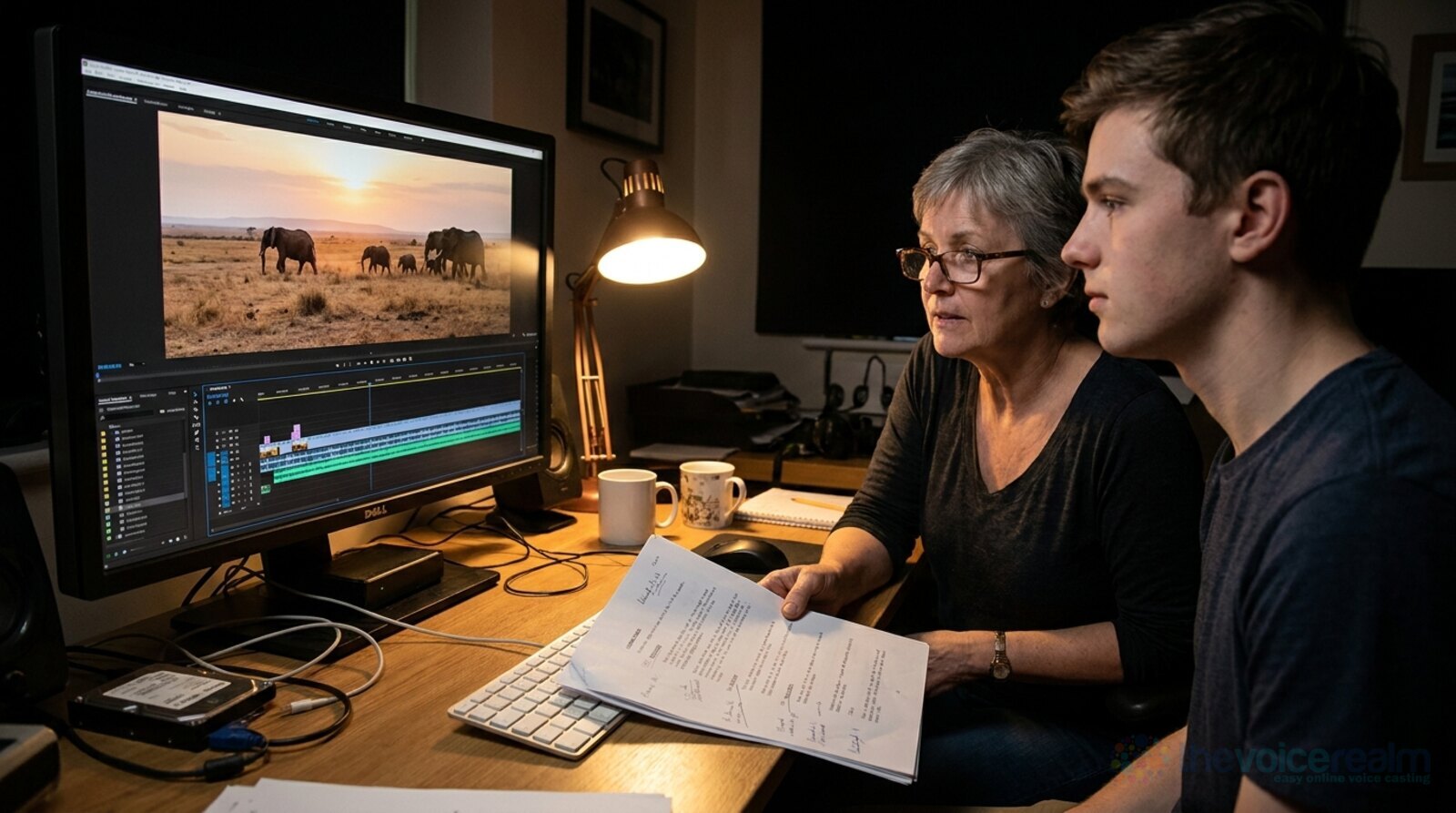
Documentary narration looks like the easiest job in voice over. No character, no hard sell, just read what’s on the page over some lovely pictures. Then you hear yourself back over the edit and it sounds like a museum audio guide having a bad day. This guide is for voice actors who’ve landed a documentary job, or want one on their demo, and need to know what the read actually is.
We’ve gathered what working narrators, directors and editors have said about the craft, and turned it into things you can do in the booth.
What the narrator is really there for
In most documentaries, the narration is the glue. It tells the viewer what the pictures can’t: a date, a name, a cause, what happened just before the camera started rolling. It isn’t there to describe what everyone can already see.
David Attenborough has been doing this longer than almost anyone, and he keeps coming back to the same rule. Talking to BBC Wildlife Magazine about Planet Earth III, he said “a picture is more powerful than a spoken word, and if you give people the two things, the thing that they remember is the picture.” He also said the first job after writing a commentary is “to carefully see what you can get rid of.”
Documentary editor and teacher Karen Everett has a phrase for the most common mistake in narration scripts: “Avoid “say cow, see cow”, that is, saying in narration exactly what we’re seeing on screen. Let pictures add to the exposition, and vice versa.” That’s mostly the writer’s problem. But it shapes the read, because when a line does land on a picture, it should feel like it’s adding something, not pointing at it.
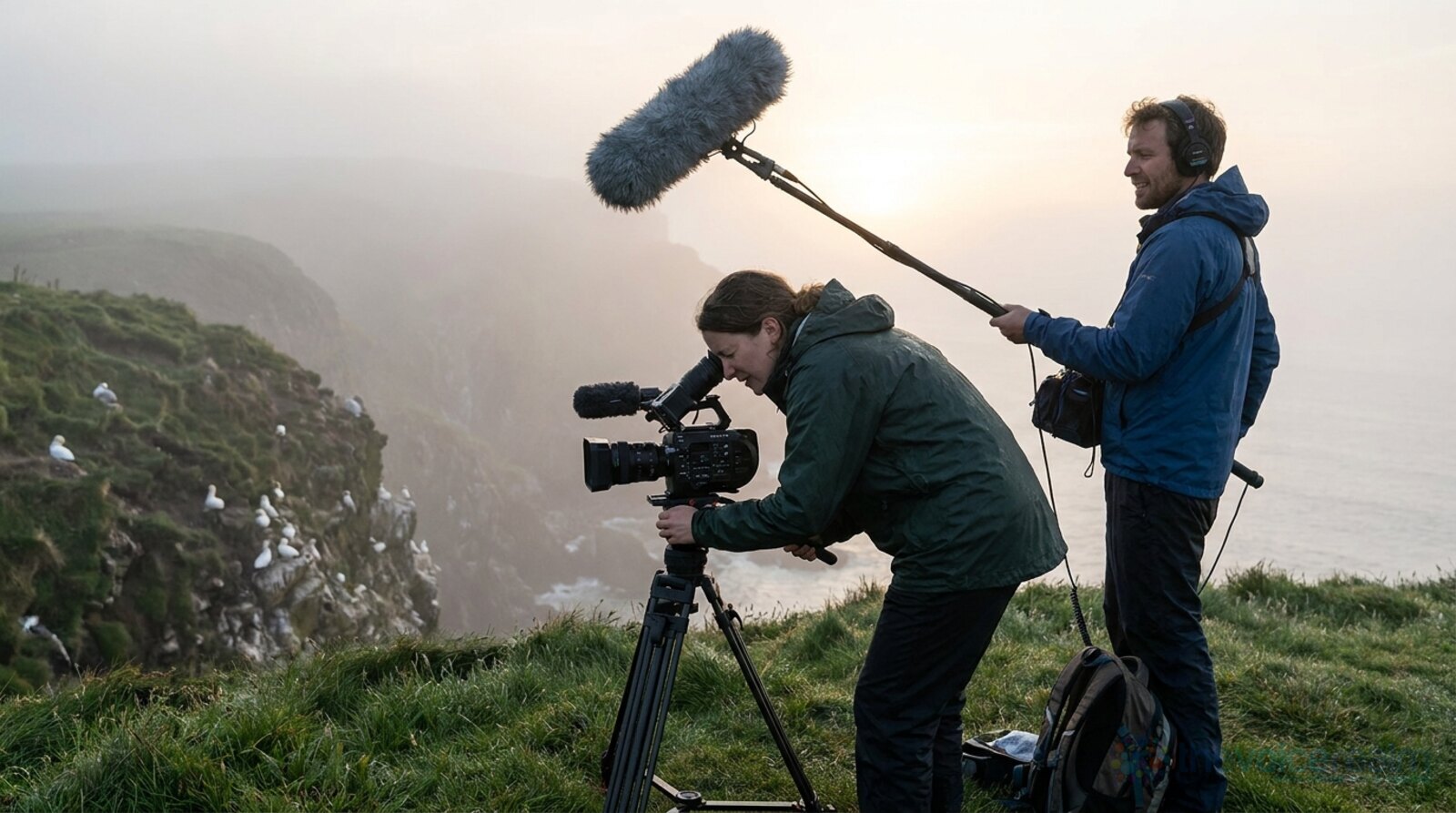
The pictures carry most of the story. Narration fills in what the camera can't show. © The Voice Realm
Leave room for the viewer to feel something
Here’s the part that trips up actors who come from commercials. In an ad, you sell the feeling. In a documentary, you hold it back.
Peter Coyote has narrated many of Ken Burns’ series, and he put it beautifully in an interview with Variety: “My feeling is that if I put a lot of emotion into the text, I’m displacing the space that you have in which to experience your own emotion. So I put a lot of trust into the words.” Talking about narrating The Vietnam War, a series that stirred up real anger in him, he said: “My job was to keep control of myself, and let the images do the work.”
That doesn’t mean flat. It means the feeling is underneath, not on top. A line about a death or a disaster is read with weight and care, then you get out of the way and let the picture and the music carry the rest.
Selling every line
Lifts at the end of sentences, a smile on every phrase, big emphasis on the dramatic words. It pushes the viewer towards a feeling, and they notice the pushing.
Trusting the words
Statements that land and settle, emphasis only where the meaning needs it, room after a hard line. The viewer gets there on their own, and that’s why it hits.
Describing how he reads a list of items, Coyote says of Burns: “He might not like a rising tone at the end of each line.” Listen for that in your own reads. An upward lift at the end of a statement sounds like a question, or like you’re trying to keep the listener interested. In documentary, a sentence that ends down and settled sounds like someone who knows what they’re talking about.
Read it like you’re telling one person
Everett’s advice to writers works just as well for narrators: “Narration should not sound like a college lecture or an ideologue’s sermon. Be colloquial.” Picture one curious friend on the sofa, and tell them. You’ll naturally slow down for the important bits and move through the connective tissue.
She also passes on a habit from PBS producer Jon Else, who used to mark narration scripts with “NTK?”, for “need to know?”. That’s a writer’s tool, but it’s a handy question for you too. If a line feels like padding when you say it out loud, flag it politely. Directors usually welcome a narrator who notices a sentence that’s fighting the picture.
Before the session, mark up the script the way you would any long read: breaths, the word in each sentence that carries the meaning, and every name or place you need to check. If you haven’t got a system yet, our walkthrough on marking up a script before you say a word is a good place to start, and documentary scripts are full of names worth looking up rather than guessing.
Use your own voice, not a “documentary voice”
There’s a pull towards dropping your pitch, slowing right down and putting on the Voice of Nature. Resist it. Directors cast you for the sound you made in the audition, and a put-on voice tires quickly and drifts over a long session.
Sit in the middle of your natural range, where you could talk for hours. Work a touch closer to the mic than you would for a commercial and bring the volume down, so the read feels like it’s for one listener rather than a hall. Then let the pace come from the meaning. Dates and connecting lines can move along; the line the whole scene hangs on gets its time. Slow everything down and the film drags. Speed everything up and nothing lands.
Timing: to timecode, to picture, or with some give
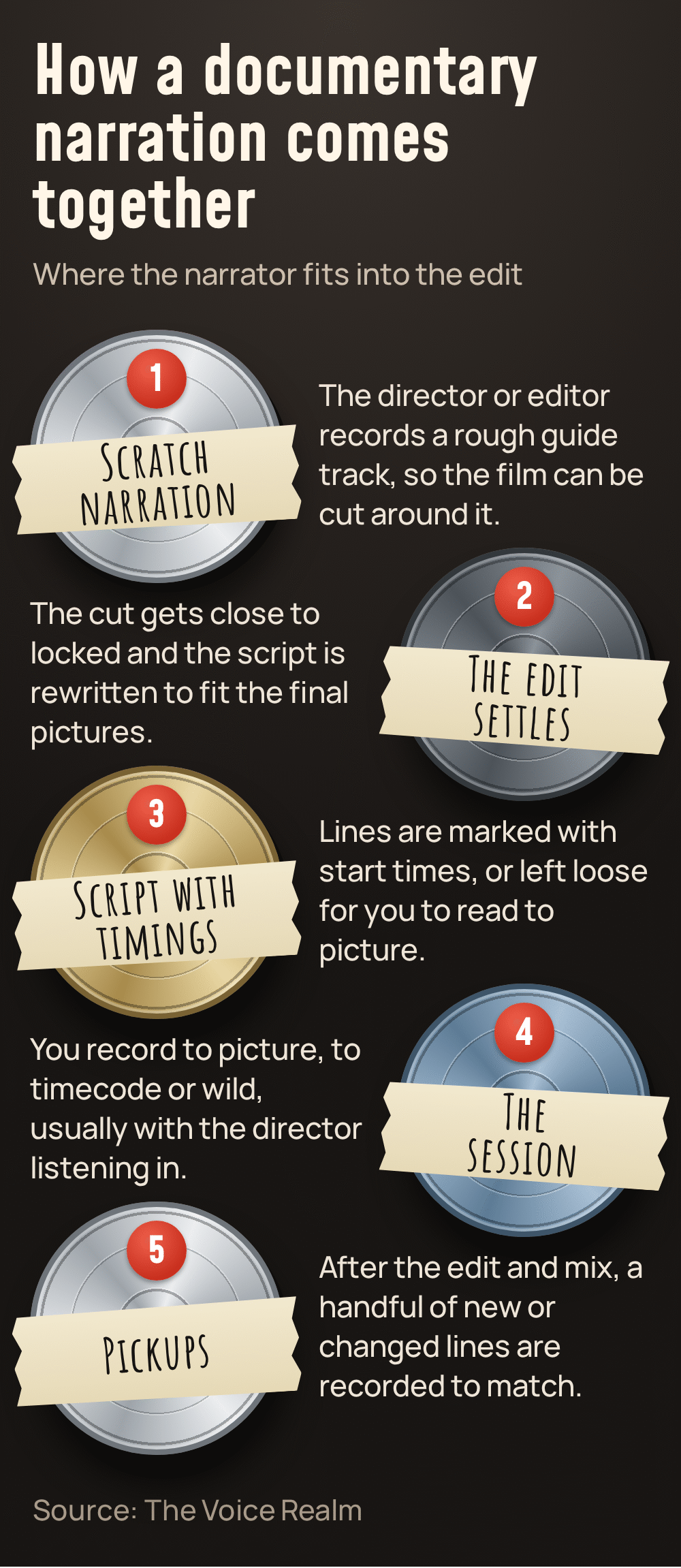
Documentary narration has to fit the edit. How tightly depends on the production, and you’ll meet three set-ups.
Reading to timecode. The script lists where each line starts, and you hit those marks. Mike Gunton, creative director of the BBC’s Natural History Unit, described Attenborough’s sessions to The Ringer: “David sits there, and we play the footage. And he’s got the time codes, and he reads against those time codes.”
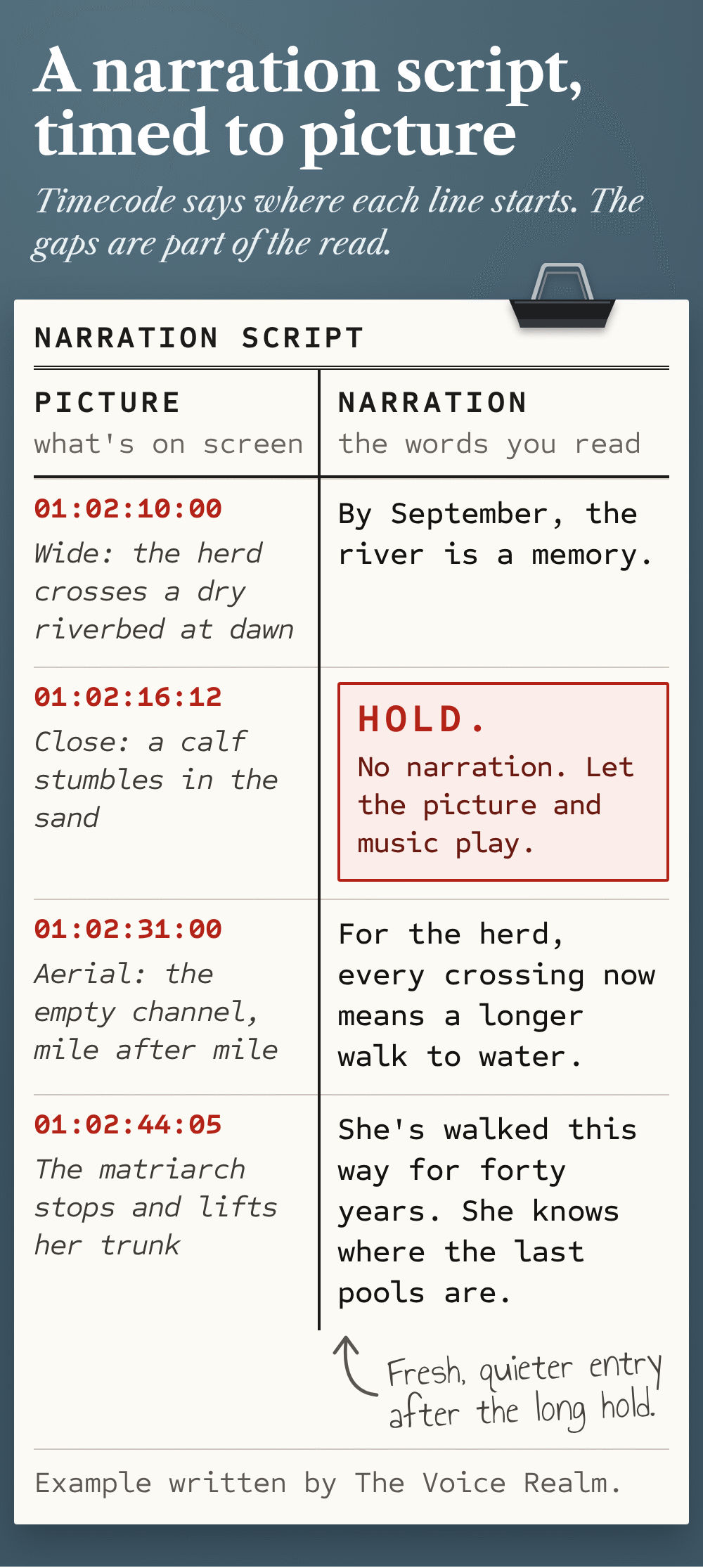
What a timed narration script can look like. The empty cue matters as much as the full ones. © The Voice Realm
Reading to picture with some elastic. You watch the cut as you read, and the editor trims around you afterwards. Coyote says of his sessions with Burns: “But we never do timings. He never tells me that I have to bring a line in at 28.9 seconds. So I know that there’s some elastic in there.”
Reading wild. No picture at all. You read the script top to bottom, leave a clear pause between paragraphs so the editor can lift each one cleanly, and the editor lays it in later. Many smaller and corporate documentaries work this way.
 VOICEMASTERACADEMYTwenty modules, one at a time.Breath controlHome studioCommercial techniqueAuditionsStart module oneNo experience needed.
Whichever it is, the silences matter as much as the words. Attenborough, quoted in the same Ringer piece, explains that the gap before a line changes how you start it: “If the last sentence ended 10 seconds ago rather than one minute ago, you start in a different kind of way.” A line after a long musical passage often wants a fresh, quieter entry, as if you’re picking the story back up. If you’re asked to fit a line into a tight slot, our guide to how many words fit in a few seconds will help you judge whether it’s a pace problem or a script problem.
© The Voice Realm
The long session: stamina and sameness
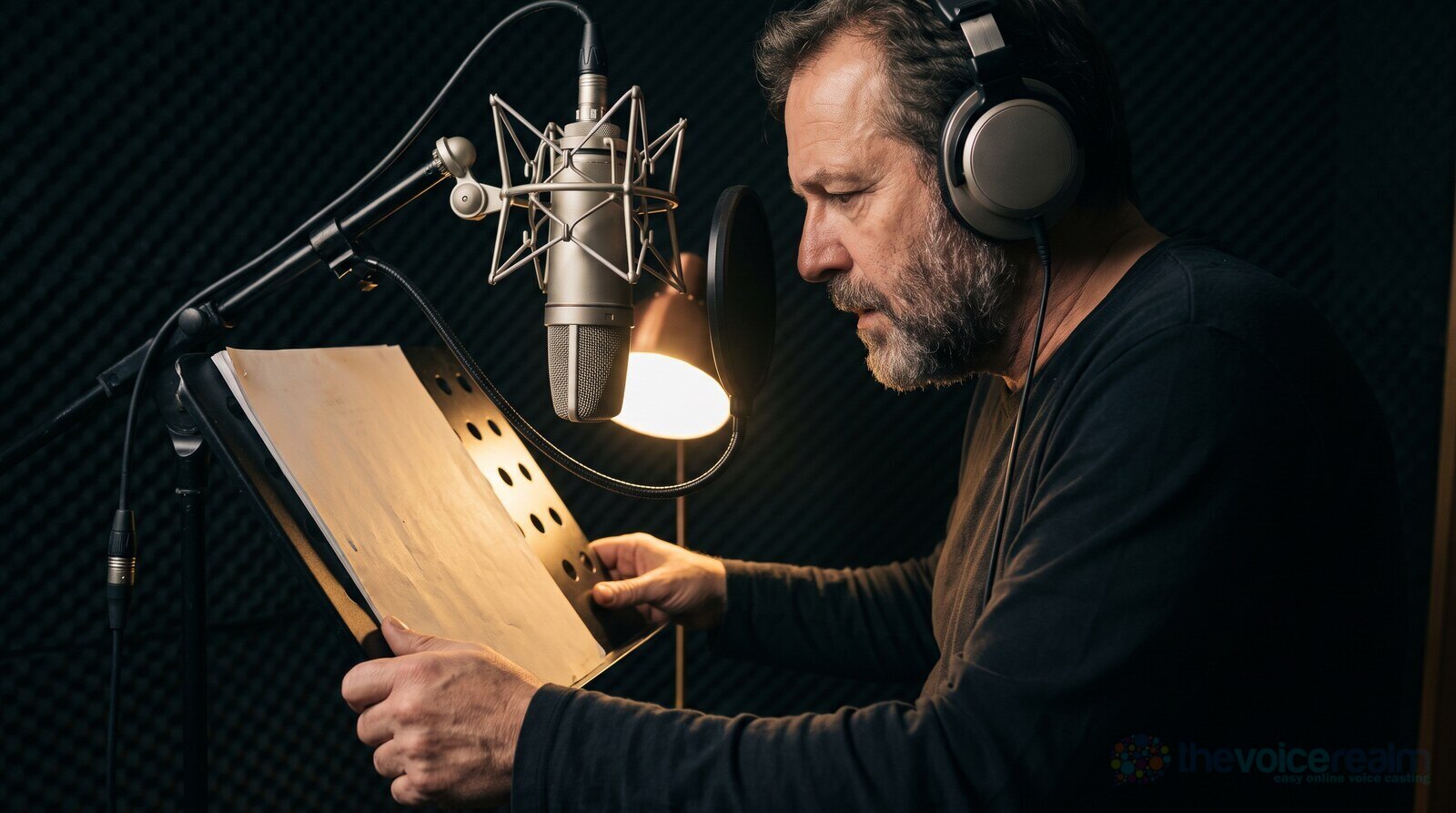
A feature documentary can mean a full day behind the mic, and every line has to sound like it came from the same person in the same room. Ken Burns told interviewer Max Raskin: “Recording narration is the hardest thing that we do.” He added: “Most people come in and read an hour of film in an hour and a half.”
That pace only works if you’re prepared. Read the whole script aloud at home first. Know your pronunciations cold. Then protect your consistency on the day:
- Keep the same distance from the mic all session. Mark your spot if you have to.
- Match your energy to the takes from the morning, not to how you feel at four in the afternoon. Ask to hear a line from earlier if you’re unsure.
- Sip water steadily and take short breaks before you need them. A tired voice drops in pitch and loses its edges, and it shows when the edit cuts between morning and afternoon lines.
- Note any line you changed, so pickups weeks later can match it.
Long reads live or die on consistency: same distance, same energy, morning to evening. © The Voice Realm
Pickups are part of the job. Edits change after narration, so expect to come back and record a handful of new or rewritten lines. Keep a note of your set-up, mic position and a reference file from the original session, so the new lines drop in without anyone noticing.
Different documentaries, different reads
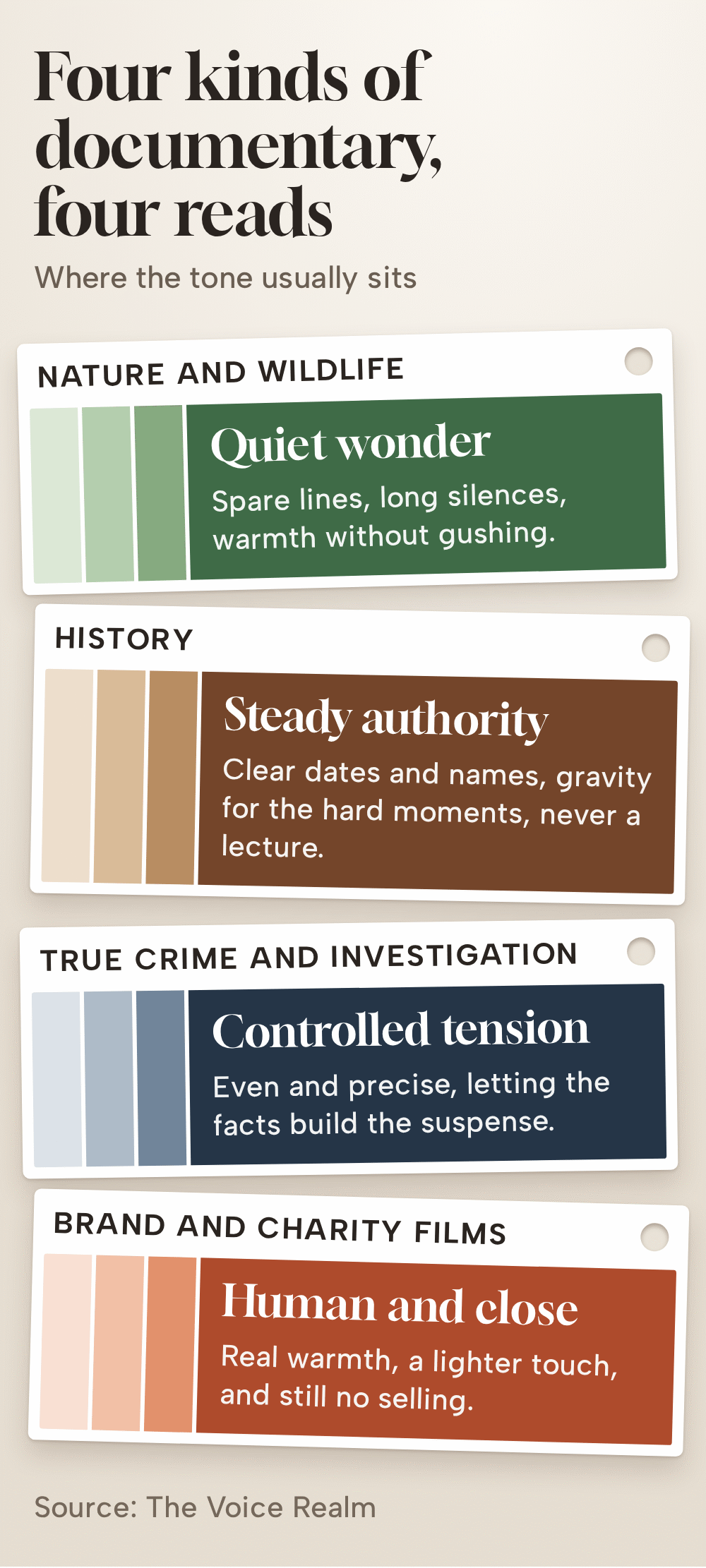
“Documentary” covers a lot of ground, and the read shifts with the subject. A good director will tell you what they want. A good narrator walks in already knowing which kind of film it is and with a sense of where the tone sits.
© The Voice Realm
Listen widely before a job. Watch the opening ten minutes of three films in the same style, with your eyes closed, and pay attention to how much the narrator does and doesn’t do. You’ll usually find it’s far less than you’d guess.
How to get documentary work
Most narrators don’t start with a big network series. They start with museum and gallery films, company histories, charity films, training documentaries and local history projects. Those jobs ask for exactly the same skills, and they’re where you build the recordings that get you the next one.
Put a short documentary clip on your narration demo: twenty or thirty seconds, a real-sounding script, a calm and certain read with room in it. Write the script so it adds to an imagined picture rather than describing it, and the restraint will come through. When you’re ready, keep an eye on the voice over jobs board, where narration castings turn up regularly.
Documentary auditions often come with a page of the real script. Read it as if the pictures were already there: imagine the shot under each line, and leave a breath where a cut might go. That small act of imagination is audible, and it’s often the difference between a read that sounds like narration and one that sounds like reading.
And when you finally get the call, remember Coyote’s line about the job. Keep control of yourself. Let the images do the work.
Sources: “Peter Coyote on ‘Country Music’ and Challenging and Admiring Ken Burns”, Variety, September 2019; “David Attenborough and the Voice That Revealed a Planet”, The Ringer, May 2026; “Sir David Attenborough worries about being ‘too wordy’ in new ‘Planet Earth III'”, MiNDFOOD, October 2023, reporting his interview with BBC Wildlife Magazine; “Interview with Ken Burns”, Max Raskin; “Ten Tips for Writing Documentary Narration”, Karen Everett, New Doc Editing.
Ready to get booked?
See the jobs open right nowAbout Sarah Robbins
Sarah Robbins writes for The Voice Realm about finding voice over work, home studios, casting and the business side of voice acting.