Blog
Blog

If you make a living with your voice in Australia, there is a small piece of Melbourne radio news worth five minutes of your morning. It is not about a scandal or a software launch. It is about who sits behind a microphone at breakfast, how they got there, and what that says about the sound people want to wake up to. This is for working voice over artists, for anyone thinking of becoming one, and for the people who book them.
Here is the short version. ARN has named a new breakfast line-up for KIIS 101.1 in Melbourne, found partly through social media and a podcast, with a promise of local voices. Everything that follows is our read on what it means for people who record for a living.
What actually happened in Melbourne
On 30 September 2026, B&T reported that ARN had revealed the new KIIS Melbourne breakfast show. It is called KIIS Breakfast with Ash, Issie & Elliot, hosted by Ash London, former AFL player Isaac Smith and stylist Elliot Garnaut, with Georgia Love on news. It starts on Monday 26 October.
The announcement covers a change of direction. TV Blackbox says the earlier plan to put a Sydney show into the Melbourne breakfast slot ended with that run being cut short, and now the station is back to a line-up built around its own city. ARN chief executive Michael Stephenson put it this way: “We’ve brought together big stars, fresh new talent and distinctive local voices to create shows that reflect the character and energy of their cities.”
Ash London told TV Blackbox what the job means to her personally: “To be hosting breakfast radio on that same station in my hometown 30 years later is an absolute dream.” Hometown is the word doing the work there. Nobody is pretending the show could come from anywhere else.

© The Voice Realm
Why a local sound is worth the fuss
Radio has always known something that the rest of the audio world keeps rediscovering: people trust a voice that sounds like their street. A listener on the Sandringham line can hear within two words whether the person talking has ever stood on that platform in July. They may not be able to say what gave it away. It is the vowels, the speed, the way a joke lands, the suburb names said without a thought.
That matters well beyond breakfast hosts. It matters to the person who voices the furniture sale ad at 7.40, the bank’s phone menu, the footy club’s promo and the council’s public notice. When a client in Melbourne wants a voice that feels like Melbourne, they are asking for the same thing ARN has just spent a lot of effort on. If you are looking for Melbourne voice over artists, the thing you are really hiring is ear for the place as much as a nice tone.
For artists, the lesson is plain. A neutral broadcast accent used to be the safe bet. These days a specific, believable local voice is often the stronger pitch, because the brand is talking to a specific, believable local audience.
Say it like the locals
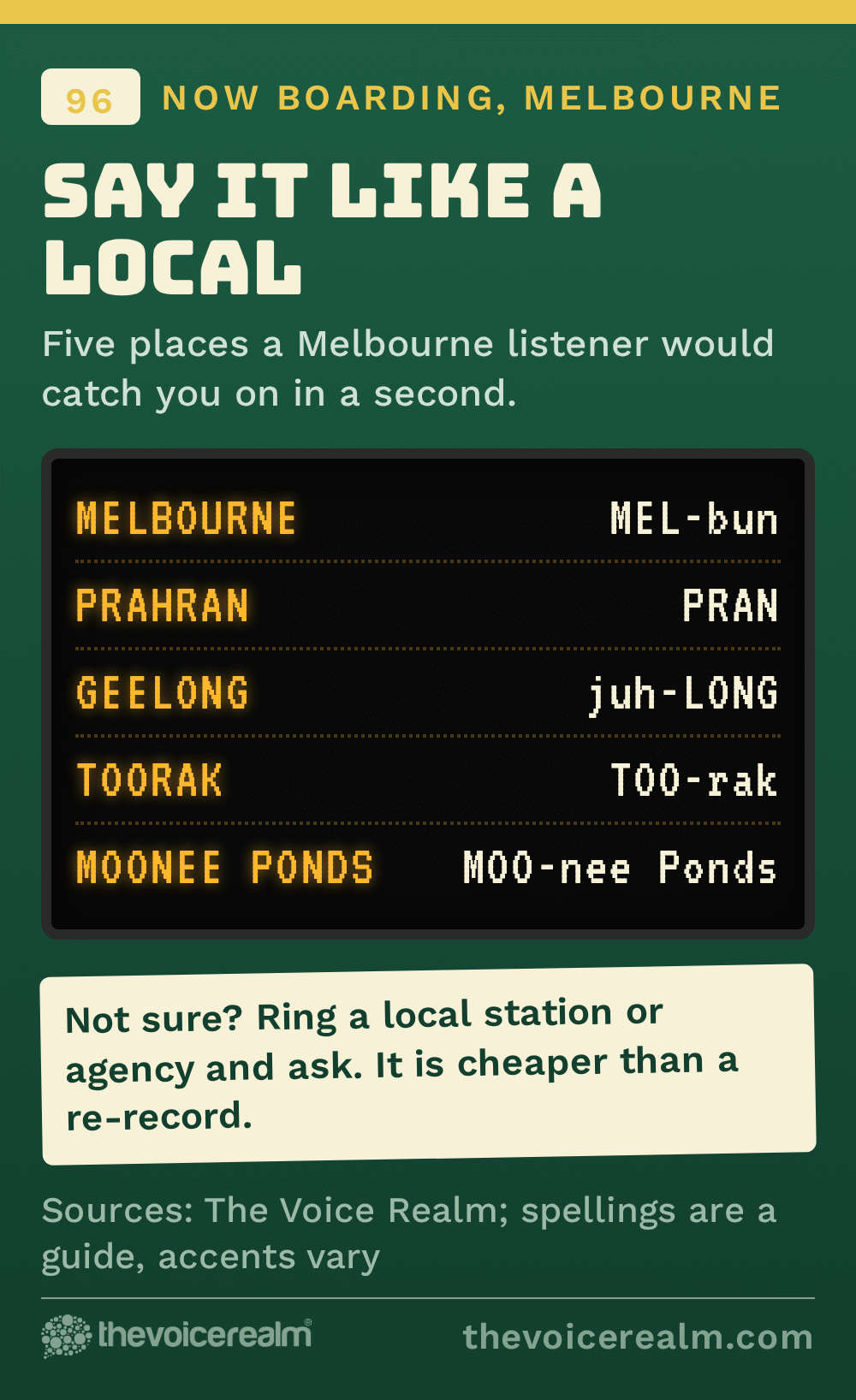
The small things give you away first. Place names are the usual trap, and a Melbourne listener will catch a wrong one in a heartbeat. Prahran is not said the way it is spelt. Geelong ends on a long vowel that outsiders flatten. Hear those wrong in a radio ad and the whole spot sounds like it was recorded by someone in a hotel room in another country.
If you ever record for a market you do not live in, treat pronunciation as part of the job, not an afterthought. Ask for a guide or a phonetic list from the client. If they do not have one, say a name out loud to a local before you record it, and note it on your script. A thirty second call is cheaper than a re-record, and it protects your name with the client.
The same applies to accent. If you are going for an Australian read and you are not from the area, our guide to learning an accent from the vowels up shows how to build it properly instead of imitating the sound of the surface.
© The Voice Realm
Where the voice work sits in a breakfast hour
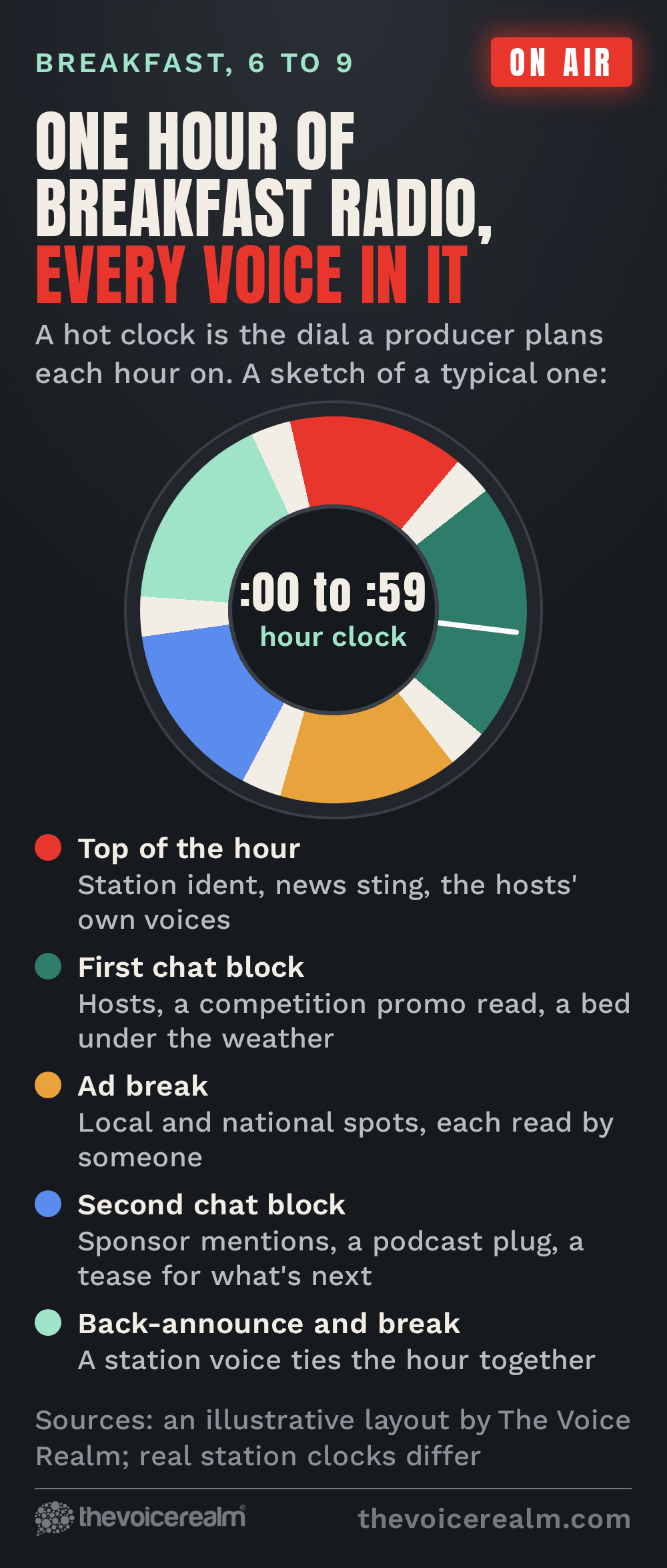
It is easy to think of breakfast radio as hosts and nothing else. Look at a hot clock, the dial that producers plan each hour on, and it is a different picture. A single hour holds a station ident, a news sting, promo reads, weather beds, sponsor mentions, a spot break and a back-announce. Some of those are the hosts. A fair few are not.
The ad break is the part most voice over artists will touch directly. Local businesses buy time on local stations, and the person reading the script is rarely one of the hosts. That is where voices for radio ads matter most, because a thirty second spot has to sound like it belongs between the song before and the song after. Station imaging, the stings and idents that glue the hour together, is its own craft, and we have written about what radio imaging does for a station if you want to see how those little voices are built.
The takeaway for artists: a new breakfast line-up does not only mean new hosts. A show with a fresh identity tends to bring fresh promos, fresh sponsors and fresh ad copy, all of which need voices that fit the new tone.
© The Voice Realm
Social feeds and podcasts are the new demo reel
The most interesting part of the story is how the line-up came together. ARN’s director of content for metro radio, Dave Cameron, told Mediaweek that Ash London’s online content reached the team before any formal show discussions began: “We’ve all been infiltrated by Ash’s amazing content online in our social feeds.” He also noted that she will be “one of the only Metro female anchors of a show that will do her own buttons”, meaning she works her own panel as well as presenting.
 VOICEMASTERACADEMYTwenty modules, one at a time.Breath controlHome studioCommercial techniqueAuditionsStart module oneNo experience needed.
Cameron described meeting Isaac Smith and Elliot Garnaut in a similar way. He joined a podcast meeting expecting a coffee and a catch-up, started talking about their podcast, No Utes in the Valet, and the conversation drifted towards radio.
Read that again as a voice over artist. A programme director found two of the three people in this show through content they were already making. Not a showreel emailed to a station. Not an audition. A feed and a podcast people actually liked.
That should change how you think about being found. Your demo is still the main thing a client plays. But a client who comes across your voice somewhere else, in a short video, in a podcast guest spot, in a clean read posted for a local cause, arrives warm. If you have not tried it, the work behind podcast voices is a good place to practise being yourself on the microphone, because podcasts reward exactly that.
© The Voice Realm
Five things to take from this
Before the practical steps, here is the whole thing in a few lines you can keep.
- Local beats generic. A voice that sounds like the place is a stronger pitch than a voice that sounds like nowhere.
- Names are part of the read. Suburbs, streets and clubs said wrongly cost the client’s trust in one second.
- Breakfast is more than hosts. Promos, beds, idents and ad breaks all need voices.
- Being found has moved. Feeds and podcasts are now a way into the room, next to the demo.
- New identity, new copy. A refreshed show means refreshed promos and sponsors, which is work.
What to do this week
None of this needs a new microphone. It needs a small amount of attention.
Start with your own accent map. Write down where you sound most at home, the city, the region, the kind of person you naturally sound like, and be honest about it. Then record a thirty second read in that voice and put it somewhere easy to find. A real, specific voice is easier to book than a vague one.
Next, make a short list of the place names in your area that outsiders get wrong, and learn to say them without thinking. Add the five or six you would most likely meet in a script. This takes ten minutes and it is one of the few things a client can hear immediately.
Then look at where you already show up online. If a client searched your name, what would they find? A tidy profile, a demo, and one or two other signs of you being yourself on a microphone is plenty. It does not have to be polished. Cameron’s comments are about content that landed with people, and people respond to ease.
Finally, if you work with radio or ad clients, ask about the next promo cycle. When a station changes breakfast hosts, they often refresh the surrounding sound too. You do not have to chase it, but a short note to a producer you already work with, reminding them you are available, costs nothing.
For clients who book voices: if you are writing a spot for a Melbourne audience, a Brisbane audience or anyone else’s, ask for a local read and say so in the brief. Send the place names in a list. You will save a round of revisions, and the spot will sound like it was made by someone who lives there.
© The Voice Realm
Our take
It would be easy to treat this as radio gossip. We think it is more useful than that. A large network has just looked at its own breakfast show and decided that a recognisable local sound, found through the content people were already enjoying, was worth rebuilding the slot around. That is a clear statement about what audiences respond to.
For voice over artists it points one way: be specific. The market for a voice that could be from anywhere is crowded and getting more so. The market for a voice that is clearly from somewhere, and knows its patch, is smaller, warmer and tends to book more loyally.
We would also say, quietly, that nothing here is a promise. Breakfast shows rise and fall on their own numbers, and a new line-up has to earn its audience like any other. What it does show is the direction of travel in the choices of the people who hire. They are listening for place, personality and proof that someone is already good at being heard.
That is the kind of voice we like to hear. If you are one of them, keep recording.
Sources: B&T, “ARN reveals new KIIS Melbourne breakfast line-up”, 30 September 2026; Mediaweek, “Ash London’s social feed caught ARN’s eye”, 30 September 2026; TV Blackbox, “CONFIRMED | Ash, Issie & Elliot take on KIIS Melbourne Breakfast”, 1 October 2026.
Ready to get booked?
See the jobs open right nowAbout Sarah Robbins
Sarah Robbins writes for The Voice Realm about finding voice over work, home studios, casting and the business side of voice acting.