Blog

You’ve landed your first long job, maybe a ten hour audiobook or a full e-learning course, and the deadline looks friendly until you do the sums. How many hours a day can you actually record before your voice, or your concentration, gives out? This guide is for narrators and voice actors planning long recording days. It covers what working narrators do, what voice research says about tired voices, how to build breaks into the day, and the signs that tell you to stop.
The short answer: about four to six hours, for most people
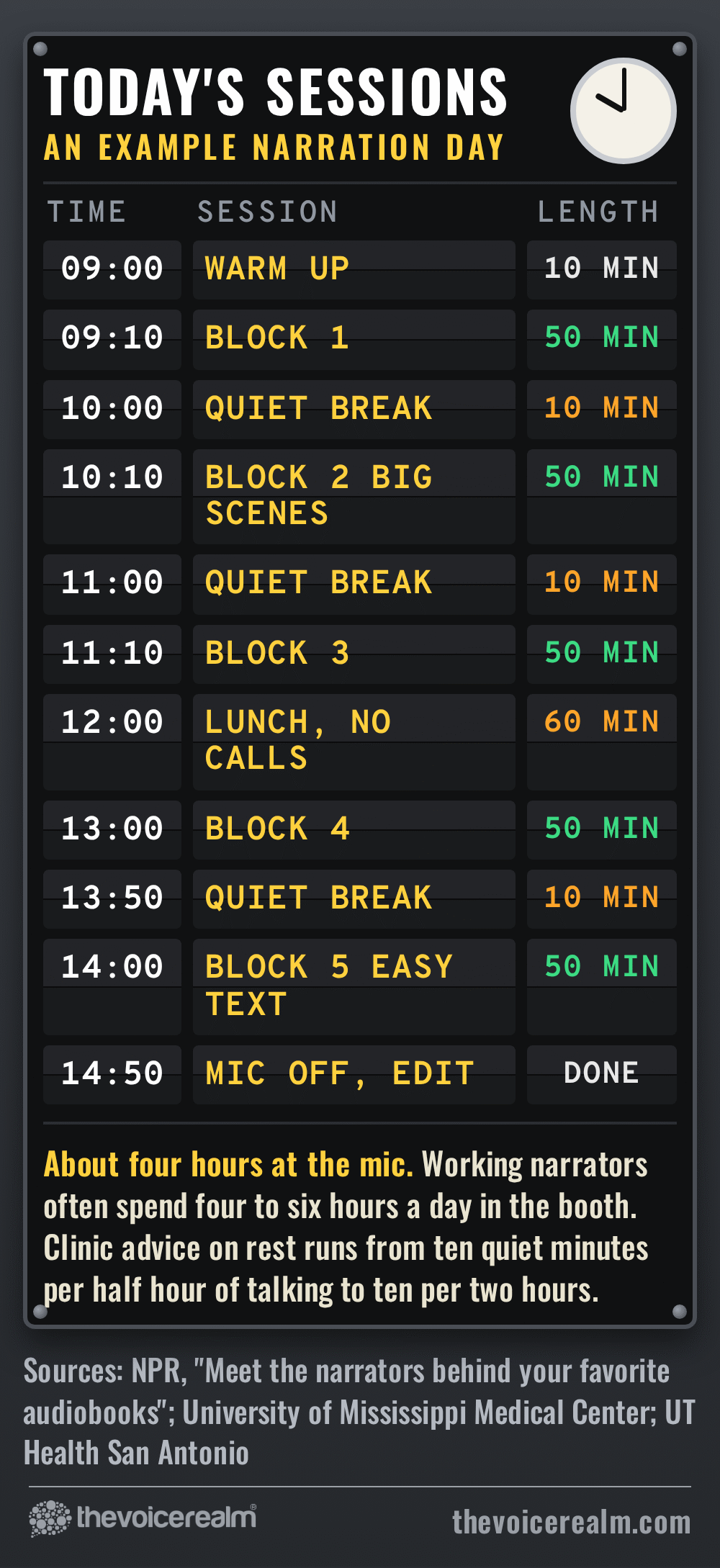
There’s no law, and voices differ a lot. But the people who do this every day tend to land in the same place. In a 2024 NPR feature on Michael Kramer and Kate Reading, the narrators behind some of the longest fantasy audiobooks around, reporter Andrew Limbong describes their home set-up, two recording booths in the basement, “where they spend roughly four to six hours a day locked into the story.”
That’s time at the microphone, not time at work. Narration comes with prep, editing and admin around it. ACX, the audiobook platform run by Audible, explained the split in its own blog: “Your narrator is usually spending two hours reading in the booth and another two to three hours editing, mixing and mastering for each finished hour of audio.”
Put those together and a sensible narration day of four hours in the booth turns into roughly two finished hours of audio, before editing. A ten hour book is about five recording days, not two heroic ones. Plan from that and the deadline stops being a surprise.
Commercial, promo and e-learning sessions are shorter and spikier, but the same idea holds. The question isn’t how long you can keep talking. It’s how long you can keep sounding like the first take.
What two hours of reading aloud does to a voice
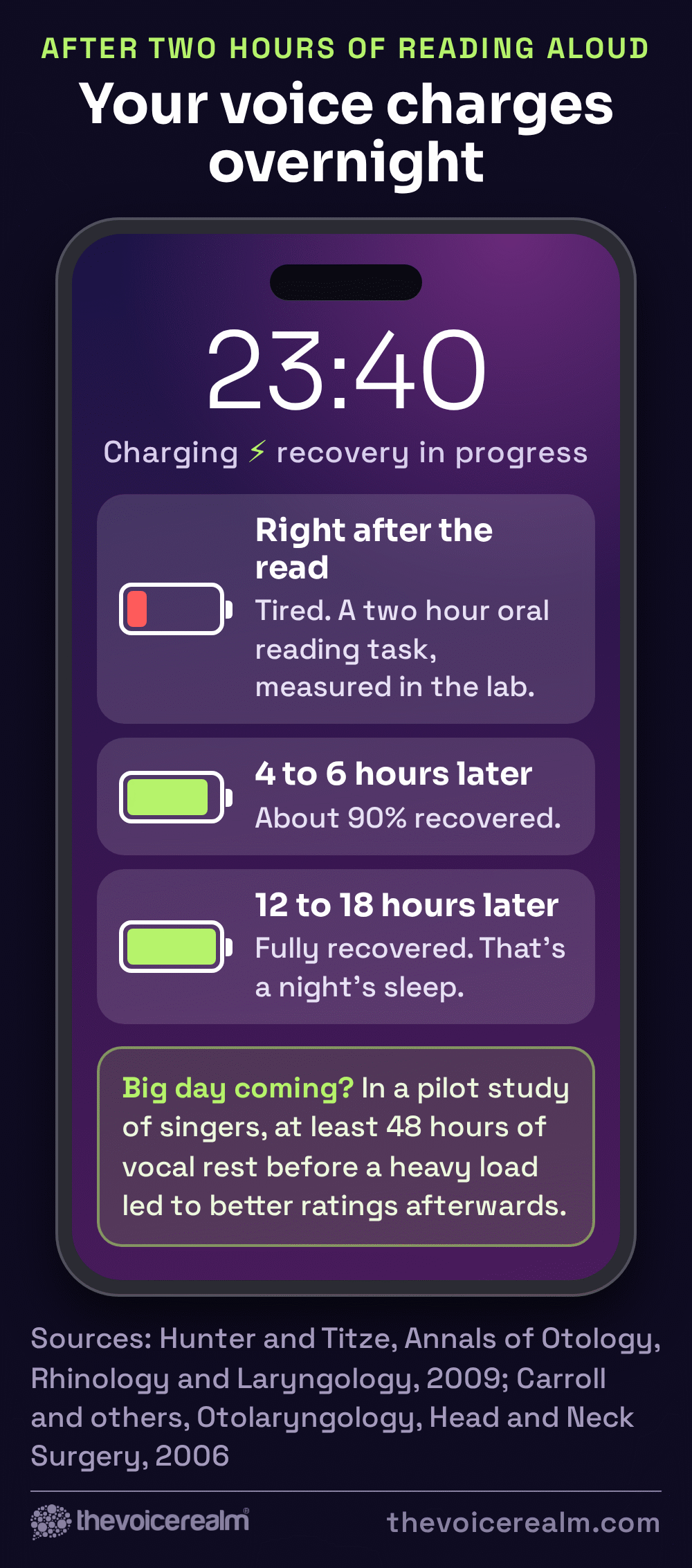
Voice scientists call heavy use “vocal loading”, and they’ve measured it directly on the task narrators do. Eric Hunter and Ingo Titze, of the National Center for Voice and Speech, studied what happens after a long read: “We quantified the recovery of voice following a 2-hour vocal loading exercise (oral reading).”
The voice did bounce back, but not instantly. “Short-term recovery was apparent, with 90% recovery within 4 to 6 hours and full recovery at 12 to 18 hours.” In plain terms, two straight hours of reading aloud left people’s voices tired for most of the rest of the day, and it took a night’s sleep to get all the way back.
That has two practical lessons. Long unbroken blocks cost more than the same minutes spread out with rests. And the voice you bring to tomorrow’s session depends on how hard you pushed today.
The voice team at UT Southwestern Medical Center describes what you feel when you’ve overdone it: “Vocal fatigue is when your voice sounds and feels tired over a period of time, and it can happen to anyone.” Professional voice users aren’t immune. If anything, they hit it sooner, because they use their voices more.
How long a break, and how often?
Here the clinics give a range rather than one rule, so pick the end that suits the work. The University of Mississippi Medical Center’s vocal hygiene handout is the strictest: “If talking for 30 minutes try to be absolutely quiet for 10 minutes.” UT Health San Antonio’s voice care programme is gentler: “Rest your voice 10 minutes for every 2 hours of talking.”
For narration, most people settle somewhere between the two. Record in blocks of 45 minutes to an hour, then take ten minutes properly off. After two or three blocks, take a longer break with food. Character-heavy chapters, shouting, crying scenes and anything with a gravelly voice deserve shorter blocks, closer to the 30 minute end.
A break means quiet. A phone call to your producer, a chat in the kitchen or singing along to the radio is still voice use. Step out of the booth, drink some water, walk around, look at something far away, and say nothing for a bit.
UT Southwestern’s Dr. Lesley Childs has a name for building rest into a busy schedule: “When your schedule allows, pencil in a rest break for your voice. I call this ‘vocal pacing.’” Literally put it in the calendar. If it’s not written down, the next chapter will always seem more important.

© The Voice Realm
Plan the day around your voice, not the deadline
Once you know your number of good hours, you can shape the day around them. A few habits help most narrators.
Warm up before the first take, every day. Our five minute vocal warm-up is enough. A cold voice tires faster, and the first chapter won’t match the third.
Put the hardest material where your voice is best. For a lot of people that’s late morning, once the voice has woken up but before it’s tired. Big emotional scenes, dense technical paragraphs and the main character’s longest speeches go there. Narrative description and easy dialogue can sit in the afternoon.
Keep loud and rough work short. Screams, battle efforts and monster voices load the voice much harder than steady narration. Unions treat them as their own category for exactly that reason, and our guide to screaming safely explains the two hour cap the actors’ union puts on that kind of session in games. Don’t schedule a screaming session on the same day as a long narration block if you can help it.
Stop at the same time each day, even when it’s going well. The day you push to seven hours because you’re in the zone is often the day that costs you the next morning.
© The Voice Realm
Your concentration usually goes before your voice does
Here’s the part nobody warns beginners about. On long days, your voice may be fine while your reading quietly falls apart. You start skipping small words, reading “the” for “a”, missing a character switch, or sounding flat and samey.
Michael Kramer told NPR this is the real limit for him: “And to get in the moment, takes immense concentration. And that’s the first thing that usually goes. So it’s not your voice, generally.” And he’s clear about what to do next: “And when you get tired, that’s when you lose the sense of exploration, sense of play, inventiveness, all of that. Just goes. And that’s when you should stop.”
 VOICEMASTERACADEMYLearn the craft in order.Module one is freeStart module oneTwenty modules, start to finish.
That’s useful advice because tired reading is expensive. Every misread becomes a pickup later, and a flat hour of narration is an hour you’ll want to re-record. Four sharp hours beat six foggy ones on any sensible maths.
Breaks help the mind as much as the throat. Get out of the booth, go outside if you can, and come back to a quick listen of your last few minutes. If they sound flat to you, they’ll sound flat to the listener.

© The Voice Realm
The signs that tell you to stop for the day
Your voice gives warnings before it gets hurt. Stop recording, or switch to editing, when you notice any of these:
- Hoarseness or a rough edge that wasn’t there in the morning, or that you’re having to push through.
- Effort. Talking feels like work, or your throat or neck feels tight.
- Range loss. High notes or soft, quiet lines get harder to hit cleanly, or your voice cracks.
- A dry, scratchy throat that water doesn’t settle.
- Pain. Any actual pain is a stop, not a warning.
One bad afternoon is normal. A voice that stays rough is not. UT Southwestern’s advice is firm: “If you are persistently hoarse for two weeks or more, you should visit a laryngologist to make sure there is no damage or vocal fold injuries.” A laryngologist is an ear, nose and throat doctor who specialises in the voice, and seeing one early is far cheaper than losing months of work.
© The Voice Realm
Recovery, and what back-to-back days do
That recovery study suggests your voice needs the night. That’s why long jobs go better as steady days than as a sprint. Sleep, eat properly and keep your evening quiet if tomorrow is a big recording day. A loud dinner out or a long phone call at night eats into the recovery the research describes.
Heavy days also echo. In a pilot study of classical singers wearing a voice dosimeter, a team including Titze and Hunter found heavy loads showed up as worse ratings the same day and for days afterwards, and also that “When at least 48 hours of vocal rest occurred before a vocal load, improved subjective evaluations were seen after the load.” Singers aren’t narrators, but the pattern is a useful hint. If you have one very big session coming, keep the day or two before it light.
Drink water all day, not just in the booth. The Mississippi handout says “Drink continuously throughout the day not all at once,” which is the same advice we cover in more depth in water, steam and the dry mouth. Breathing in steam from a bowl of warm water after a long day feels good to many voice users too, and it’s easy to do while you wind down.

© The Voice Realm
Building stamina without breaking anything
Like any athletic skill, recording stamina grows with steady practice. If you’ve never narrated for more than an hour, don’t book a job that needs five hours a day next week. Start with two hours, with proper breaks, and add half an hour every few sessions while your voice and focus keep up.
Good technique buys you hours. Breath support, a relaxed jaw and neck, a comfortable volume and a decent mic distance all reduce strain, so the same day costs you less. If you’re new to long-form work, our guide to becoming an audiobook narrator covers the rest of the craft, and a coach can spot habits you can’t hear yourself.
- Count booth hours, not work hours. Around four to six at the mic is where many working narrators land.
- Break before you need to. Somewhere between ten quiet minutes every half hour and ten every two hours, depending on how hard the material is.
- Watch your focus, not only your throat. Misreads and flat reading are the first signs of a finished day.
- Let the night do its work. Plan steady days in a row rather than one huge one, and keep the evening quiet.
Above all, listen to your own voice like a producer would. The narrators who last for decades aren’t the ones who can talk the longest. They’re the ones who stop while they still sound good.
Sources: Andrew Limbong, NPR, “Meet the narrators behind your favorite audiobooks”, December 2024; Scott Jacobi, ACX, “Money Talks: Paying, and Getting Paid, For Your Audiobook”; Hunter E.J. and Titze I.R., “Quantifying vocal fatigue recovery: dynamic vocal recovery trajectories after a vocal loading exercise”, Annals of Otology, Rhinology and Laryngology, 2009; Carroll T. and others, “Objective measurement of vocal fatigue in classical singers: a vocal dosimetry pilot study”, Otolaryngology, Head and Neck Surgery, 2006; Lesley Childs, UT Southwestern Medical Center, “Hoarse? Lost your voice? Here’s what to do”; University of Mississippi Medical Center, “Vocal Hygiene Tips”; UT Health San Antonio, “Healthy Voice Care Program”.
Ready to get booked?
See the jobs open right nowAbout Sarah Robbins
Sarah Robbins writes for The Voice Realm about finding voice over work, home studios, casting and the business side of voice acting.