Blog

A guided meditation looks like the easiest script you’ll ever get. Short sentences, gentle words, no tongue twisters, no brand names. Then you record it and play it back, and it sounds like someone reading a relaxing script rather than someone helping you relax. The listener can tell the difference in about four seconds.
This guide is for voice actors who’ve been asked to voice a guided meditation, a sleep story or a breathing exercise for an app, a wellness brand, a yoga teacher or a company’s staff wellbeing programme. It covers the voice to use, how slowly to go, how to handle the silences, how to breathe without being heard, and how to record and edit audio that has more quiet in it than almost anything else you’ll make.
The calm you hear is your own voice, slowed down
The first mistake is reaching for a “meditation voice”: breathy, sing-song, every line ending on the same soft fall. It sounds soothing for a sentence and then it sounds fake.
The people who teach meditation say the same thing. The Mindfulness in Schools Project, which trains teachers to guide practices in classrooms, heads its first tip “No need for ‘floaty’ voices” and tells them to celebrate their own accent and dialect rather than copy the voices on adult meditation apps. “Please don’t feel that you need to copy them,” it says, because “your authenticity will shine through!”
The Boundless Love Project’s tips for leading guided meditations put it as plainly: “Use a calm, relaxed, and authentic voice.” And then the part that matters most for a performer: “Let your tone of your voice model the peace, serenity, and calmness that you want those meditating to feel.”
That’s the job. You’re showing them what calm sounds like, so they can borrow yours. Your natural voice, a little lower in energy, a little closer to the mic, is almost always the right starting place. If the client wants something more stylised, they’ll tell you.
© The Voice Realm
Slow down, but keep the thread
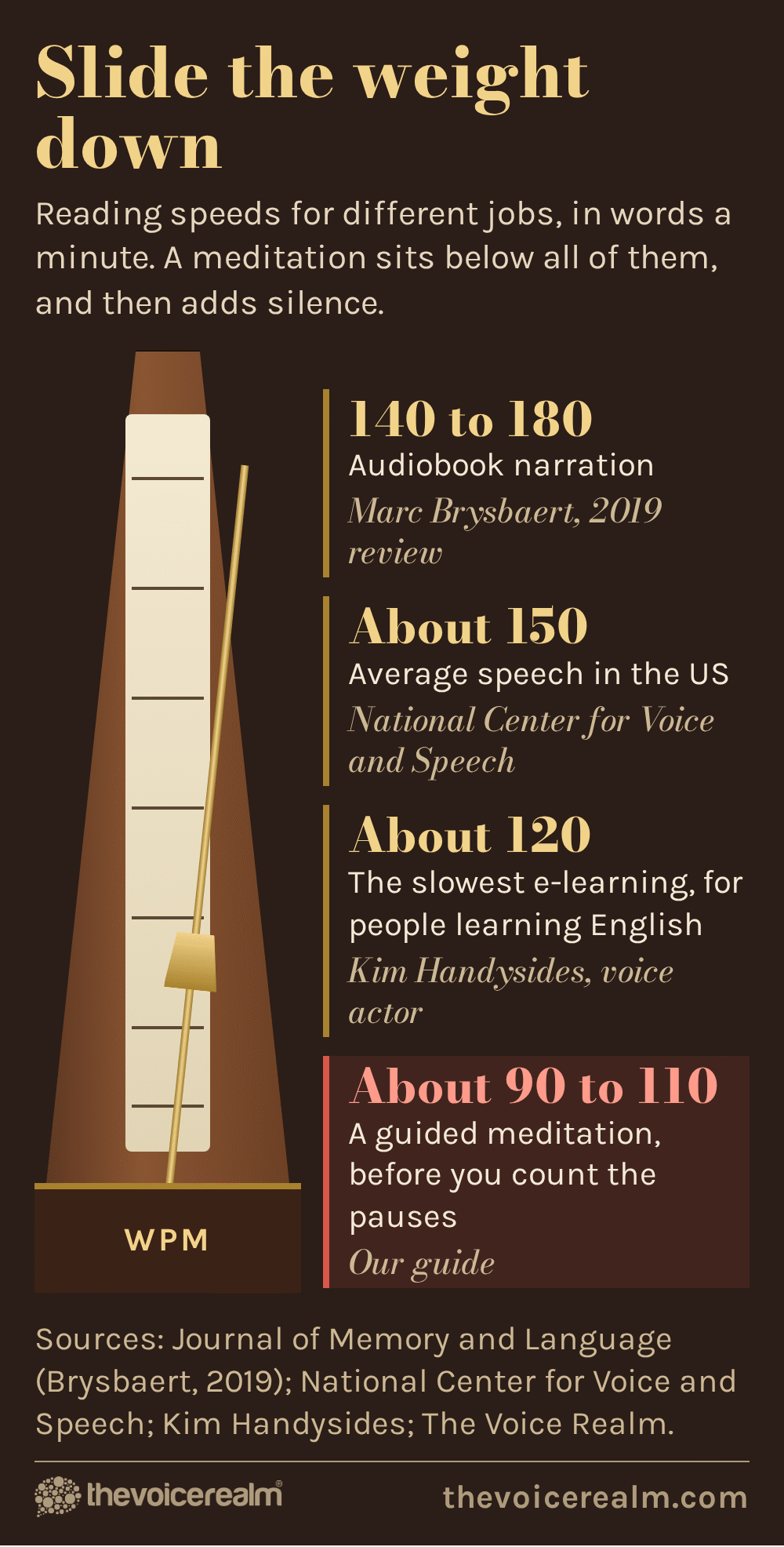
Speed is where most first takes go wrong, in both directions. Read at your usual pace and it sounds like a briefing. Slow every word to a crawl and the listener loses the sentence before you’ve finished it.
Boundless Love’s advice is to “Speak in a slower than normal pace that is natural for you,” and it gives the reason: “You don’t want to speak too fast, as this can prevent some of your listeners from understanding you.” The trick is to slow the gaps more than the words. Keep each phrase flowing at a gentle, almost conversational speed, then let the space after it stretch.
A good test: read a line, close your eyes and actually do what it asks. If the script says “notice your shoulders,” notice yours. If you’ve moved on before you’ve felt them, so has your listener, and they’ll feel rushed. If you’re ready to go well before the next line comes, the pause is too long.
For timing the whole script, our guide to words per minute and script timing explains how to estimate running time. Just remember that a meditation’s length is mostly silence, so a word count on its own will badly underestimate it.
© The Voice Realm
Silence is part of the script
In most voice over, a long pause is a mistake. In a meditation, it’s the point. “Take frequent pauses,” Boundless Love says. “These pauses give people time to try to follow your instructions.” It adds a detail worth passing on to any client who wants a script for beginners: the more experienced the listeners, “the longer the pauses should be and the less you should talk.”
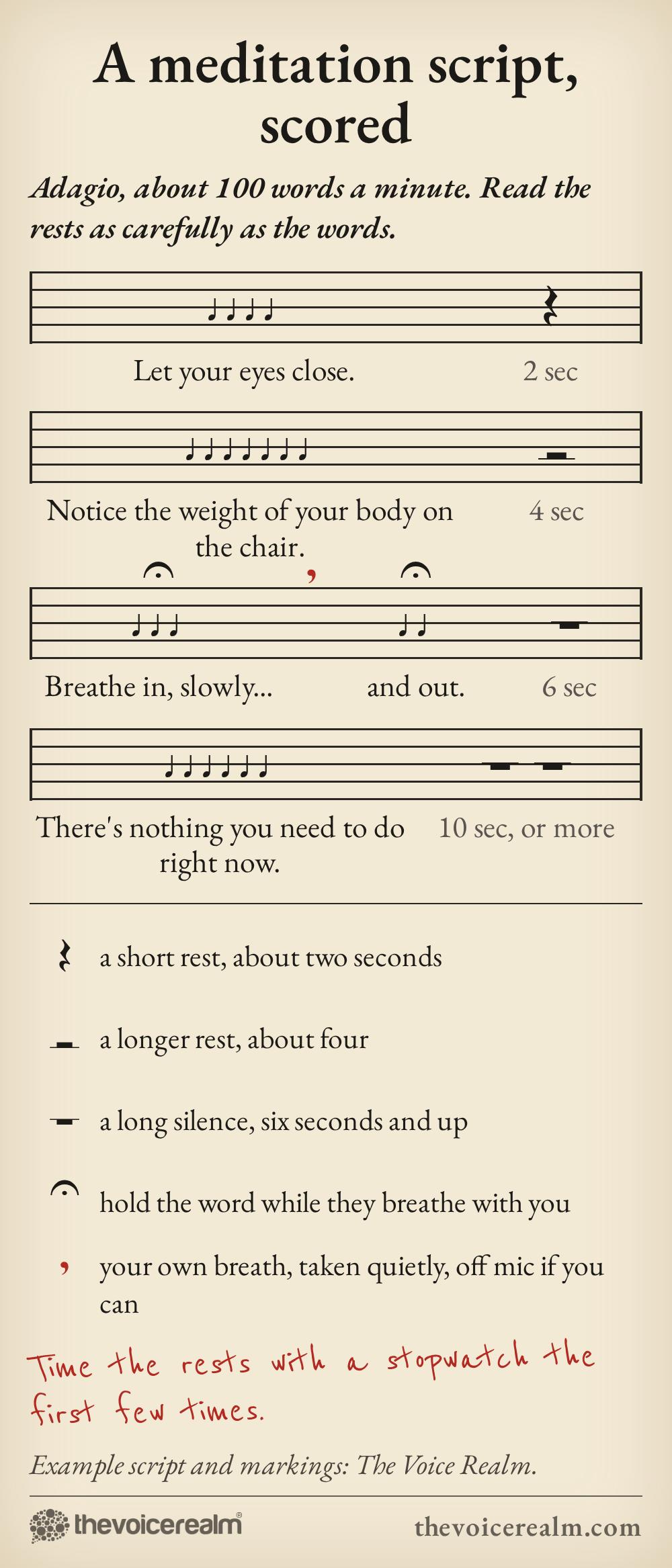
Mark your pauses before you record, and mark how long they are. A slash or a bracket isn’t enough, because “pause” means half a second to a commercial voice and twenty seconds to a meditation teacher. Write the seconds in the margin. If the client’s script has no pauses marked, ask them. Some apps add the silence in the edit, and others want it recorded in real time so the breathing feels natural.
Time the first few with a stopwatch. Silence feels much longer from behind the mic than it does from the cushion, and almost everyone cuts their pauses short the first time. The Boundless Love tips warn that people left too long without guidance may spend a silent meditation “mostly lost in their thoughts and feelings,” so the opposite is a problem too. That balance is why timing the silences is part of the creative work.
© The Voice Realm
Breathe the way you’re asking them to breathe
Breathing exercises are in nearly every meditation script, and the listener will try to follow your timing exactly. If you say “breathe in” and move on after a second, they’re left gasping.
Count it out for real. The NHS’s breathing exercise for stress, a good benchmark for what a gentle guided breath sounds like, asks people to “count steadily from 1 to 5” on the way in, let it flow out “counting from 1 to 5 again,” and “Repeat for at least 5 minutes.” When you guide a breath, take it yourself, silently, at the speed you’re asking for. Your next line will land exactly when the listener is ready for it.
Your own breaths need care too. In a commercial, a quick catch breath is fine. In a meditation, a sharp intake right next to the mic undoes all the calm you’ve built. Turn your head a little off the mic to breathe, breathe through your nose where you can, and take the breath in the pause rather than rushing it just before a line.
 VOICEMASTERACADEMYLearn the craft in order.Module one is freeStart module oneTwenty modules, start to finish.
Prepare yourself before you start, too. The Mindfulness in Schools Project suggests teachers ground themselves before guiding, and says “having a couple of deep breaths can be a helpful preparation to start the guiding.” For a recording session, that’s a minute of quiet before the first take, not a quick sip of water and straight in. If you need more on breath control, our article on breathing techniques for voice actors has exercises that help.
The listener follows you
Instructions, breathing cues and long pauses. The listener is awake and doing something, so your timing has to match what you ask of them. Warm and present, never sleepy.
The listener drifts away
A gentle story with no instructions and few silences. The voice is the thing they fall asleep to, so it stays even, low and unhurried from start to finish, with nothing that might startle.
Nerves speed you up, and the listener hears it
Here’s a problem that’s easy to miss. You’re recording a calm script, but you might not be calm. A new client, a long file and a session clock are enough to make anyone a bit tense.
The Boundless Love tips name it exactly: “Fear and anxiety can show up in the tone and rate of your voice.” They also note that adrenaline “may cause you to speak with more force, intensity, and speed than is helpful.” The Mindfulness in Schools Project goes further: “Any pressure or striving you are experiencing will affect your ability to guide these practices.”
So treat your own state as part of the prep. Do the meditation yourself once before you record it, all the way through. You’ll learn where the script is awkward, where the pauses want to be longer, and you’ll start the real take a little calmer than you were. If a take feels pushed, stop, take a minute and go again. Pushing through rarely works with this kind of script.
A quiet room matters more than usual
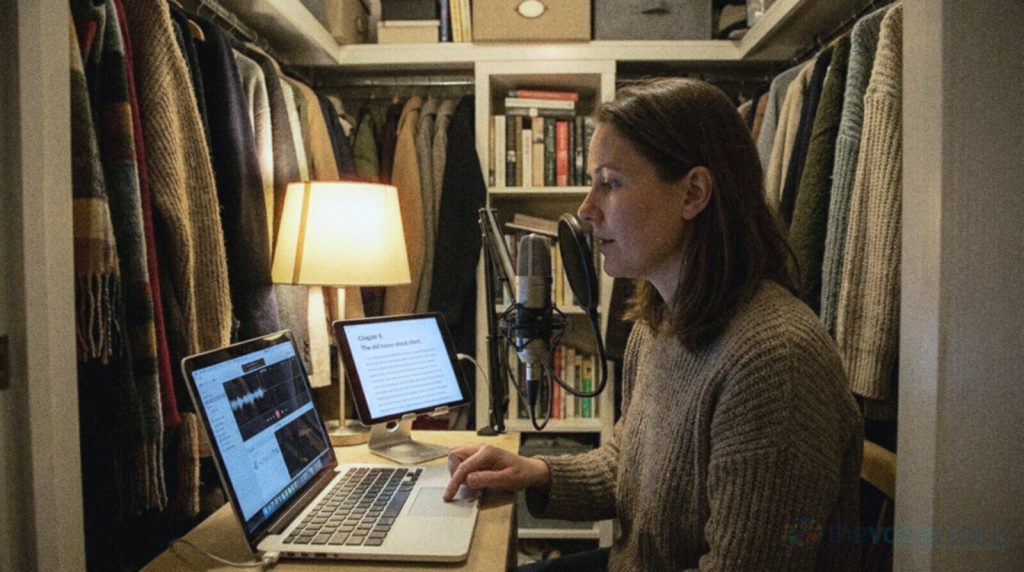
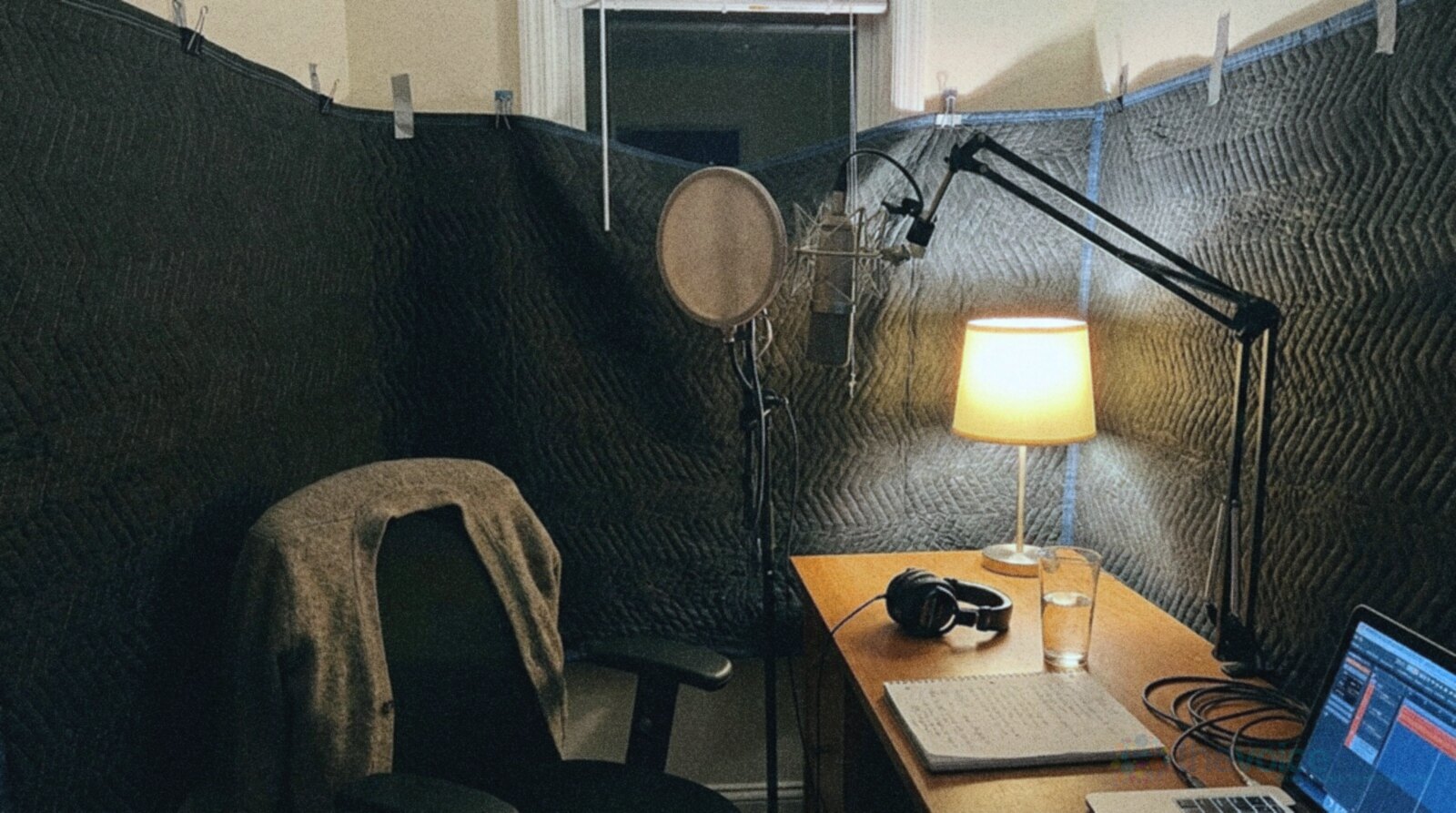
Most scripts keep your noise floor hidden under words. A meditation spends half its running time in silence, and every bit of that silence is your room. Fridge hum, a laptop fan, traffic or a ticking clock that you’d never notice under a commercial read becomes the loudest thing in the file.
Before you take on meditation work, measure your room. Voice Edit Suite’s free Home Studio Analysis will tell you how noisy and how echoey your space is. Treat what it finds, then measure again. If you’re starting from a bare room, our guide on treating a room for voice over covers fixes at every budget.
Mouth noise is the other enemy. A soft, close read picks up every click and smack. Stay hydrated, keep a green apple or a glass of water nearby, and work a little further off the mic than you might for an intimate read, so the warmth comes from your voice rather than from proximity.
© The Voice Realm
Editing a meditation without breaking it
Editing follows different rules here. The habits that tighten a commercial will wreck a meditation.
- Don’t shorten the pauses. Unless the client asks, the silences you timed are part of the performance. Check them against your marked script after editing.
- Never fill a gap with digital silence. Dead silence next to room tone sounds like the audio has switched off. If you need to replace a noisy gap, use clean room tone from the same session.
- Go easy on noise reduction. Heavy processing leaves a watery shimmer that’s very obvious in quiet passages. A quiet room beats a clever plugin every time.
- Keep the breaths that belong. Remove sharp or loud breaths, but a soft breath before “and now breathe in” can sound reassuring. Ask what the client prefers.
- Ask about music. Many apps lay music or nature sounds underneath. Deliver your voice dry unless they ask for a mix, and leave any fades to them.
Long meditations make long files, so check the client’s specs before you start. Some want one file, some want each section separate so they can rearrange them.

© The Voice Realm
Where meditation and wellness work comes from
This work comes from meditation and sleep apps, yoga and fitness platforms, therapists and coaches who want recordings for clients, hospitals and charities, and companies building wellbeing programmes for their staff. It also appears on our voice over jobs board, often described as “calm,” “soothing” or “reassuring,” and it overlaps with healthcare and e-learning narration.
If you want to be cast for it, add a short calm piece to your narration demo: twenty or thirty seconds of a guided breath, with a real pause in it. Casting is listening for the silence as much as the voice, and one honest pause tells them you know the difference.
Then record one for yourself. Close your eyes, press play and listen as the person on the cushion would. If you find yourself breathing along, you’ve done it.
Sources: Mindfulness in Schools Project, “Top Tips: Five tips for guiding practices”; Boundless Love Project, “Twelve Tips to Peer-Leading Guided Meditations”; NHS, “Breathing exercises for stress”.
Ready to get booked?
See the jobs open right nowAbout Sarah Robbins
Sarah Robbins writes for The Voice Realm about finding voice over work, home studios, casting and the business side of voice acting.