Blog

Two pieces of radio news landed in the same week, and together they say something cheerful for anyone who earns a living talking into a microphone in Britain. The latest RAJAR figures show more people listening to UK radio than ever before, and the Christmas pop-up stations are switching on one after another, some of them before the clocks had even gone back.
This is our read on what record listening and a dial full of tinsel mean for British voiceover artists, and what to do about it while the season is still young.
The numbers behind the headline
RAJAR’s third quarter results for 2026, reported by RadioToday, put total weekly listening at 51 million people. That’s up two per cent on a year ago and a new record for the medium. Radiocentre’s chief executive Matt Payton put it simply: “Radio’s record-breaking reach proves that audio remains an essential part of daily life for millions of people across the UK.”
The headline number is nice. The shape underneath it is more useful. Listening keeps moving online and onto smart speakers, and a whole crop of digital spin-off stations is growing fast. Radio X Chilled grew its weekly reach by 46 per cent. Classic FM Calm, Heart 10s and Smooth 70s all posted their highest audiences yet. Hits Radio 90s and 00s did the same, and so did Absolute Radio 00s.
Every one of those brands is a station with its own personality, and a station with its own personality needs its own sound. Idents, sweepers, promos, competition reads, the line that tells you what you’re listening to between two songs. That’s voice work, and a lot of it.
Christmas has already started on the dial
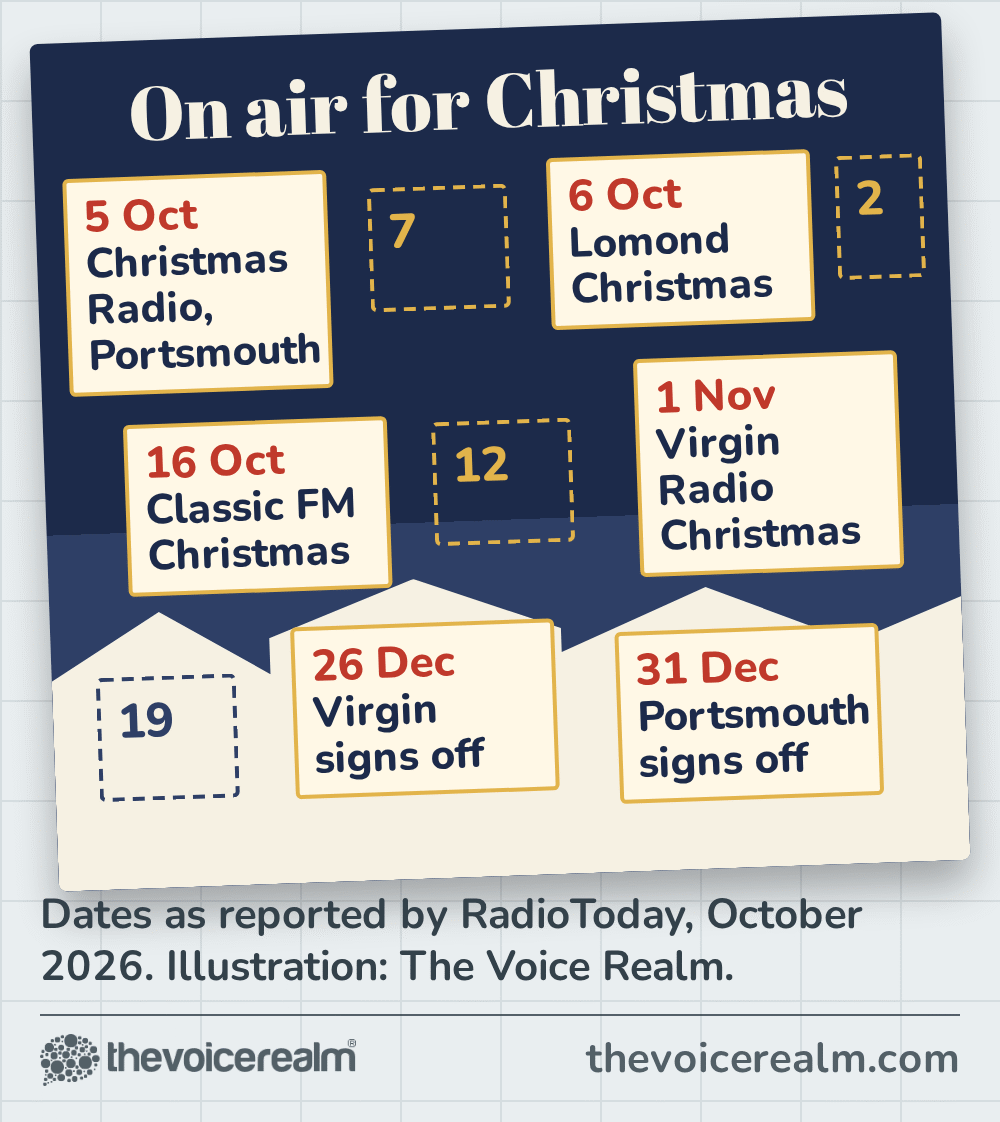
If you thought it was early for mince pies, the radio industry disagrees. Christmas Radio returned to DAB in Portsmouth in the first week of October. Lomond Christmas came back on DAB across parts of western Scotland a day later, run by the same volunteer team behind Lomond Radio. Global launched Classic FM Christmas, its first classical Christmas station, alongside the return of Smooth Christmas. Classic FM managing editor Joseph Zubier called it “the most natural next step for our brand.”
Virgin Radio Christmas follows on Sunday 1 November for its second year, playing festive music round the clock with The Chris Evans Breakfast Show still in the mornings.
Here’s why that matters. A pop-up Christmas station is a brand that exists for eight weeks, and it still has to sound like a proper station from the first minute. It needs a name read, a handful of seasonal idents, a few promos, perhaps a sponsor tag or two. Big groups have imaging teams and voices on contract for this. Smaller and volunteer-run services often don’t, and a warm, clear voice that can make “the home of Christmas music” sound like it means it is exactly what they’re after.

© The Voice Realm
Why advertisers are listening too
The other half of the story is money moving into audio. At Radiocentre’s Tuning In 2026 conference earlier this month, Matt Payton presented analysis forecasting commercial audio listening to grow by 20 per cent over the next decade, with advertising revenues set to rise with it.
The research shown on the day was all about why. Andrew Tindall of System1 drew on a study of Effie-winning campaigns and said: “Campaigns that include audio as a touchpoint are more likely to increase penetration.” According to RadioToday’s write-up, the same research found emotional campaigns using audio were twice as likely to report extra profit as emotional campaigns without it.
Emotion in audio is our department. A radio script is only words on a page until somebody makes a listener feel something about a sofa sale or a building society. Brands that are shifting spend into radio and podcasts this winter will need the right voice for a radio or TV ad, and the Christmas run is the busiest stretch of the advertising year.
© The Voice Realm
Where the growth really is
The RAJAR breakdown is full of small stories that add up to a big one. Nation Broadcasting’s weekly reach rose sharply, and Nation Radio Wales climbed to 204,000 listeners across Wales. STV Radio, which only launched in January, reported that its listeners spend an average of 11 hours a week with it, the most loyal audience among the top ten commercial stations. Its managing director Graham Bryce said: “This tells us that listeners aren’t just trying the station, they’re coming back and making us part of their routine.”
Loyal listeners hear the same imaging dozens of times a week, which is why stations care so much about getting the voice right. It’s also why local sound wins. A Scottish station or a Scottish brand will often want a voice its own listeners recognise as one of theirs, and the pool of voiceover artists from Glasgow is a natural place to look for that sort of read. The same goes for Welsh, Northern and West Country stations, where an accent can carry a brand further than any slogan.
The spin-off stations are worth a closer look, too. A station built around one decade or one mood has a very particular sound in mind. A nineties station wants a voice with a bit of swagger and a wink. A calm station wants someone who can slow a listener’s breathing with one line. If your range covers more than one of those, it’s worth saying so on your profile and in your demo, because the people who run these brands are often hiring for several of them at once.

© The Voice Realm
Writing for the smart speaker in the kitchen
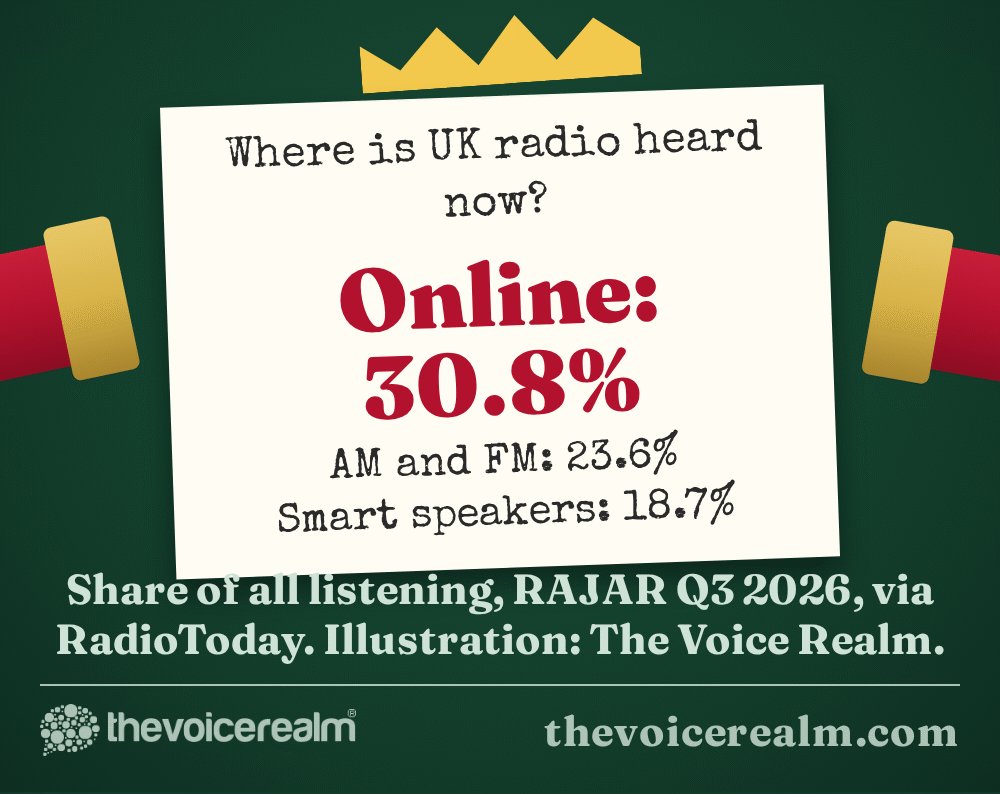
According to RAJAR, smart speakers now account for 18.7 per cent of all radio listening. Think about where those speakers live: on a kitchen worktop, next to the kettle, on a bedside table. That’s an intimate place to be heard, and it rewards a closer, more conversational read than the big, booming voice of old radio.
 VOICEMASTERACADEMYLearn the craft in order.Module one is freeStart module oneTwenty modules, start to finish.
Podcast people already know this. Comedian Katherine Ryan told the Tuning In audience that podcasts bring host and listener into a very close relationship: “It’s a really cool, intimate relationship.” The more radio is heard on the same devices as podcasts, the more those two styles meet in the middle. If you also work as a voice for podcasts, the intros, ad reads and sponsor credits you already do are good practice for the way radio is being heard now.
None of that means shouting is dead. Hits stations still want energy, and a Christmas sale ad still needs to pop. It means knowing which one the brief is asking for, and having both ready.
What to do this month
The season is short, so the work comes in fast and leaves fast. A few practical things to sort out now, before the busiest weeks.
Record a short seasonal showreel. Thirty seconds is plenty: a festive ident, a warm Christmas ad read, an energetic sale read, a calm late-night line. Keep it separate from your main demo and take it down in January. Stations and agencies booking at speed want to hear exactly the thing they’re buying.
Short, branded, heard a hundred times
A few words that must sound good on the hundredth listen. Consistency matters more than surprise, so match your own past takes closely, and expect to record lots of small variations in one session.
Thirty seconds, one feeling
A story, an offer and a tag. The emotion carries the spot, so find the one feeling the script wants and let the words ride on it. Time it, then time it again.
Get your timing tight. Christmas ads are often rewritten at the last minute with an extra line about delivery dates, and the read still has to land in thirty seconds. If a producer hands you a script with fifteen extra words and the same running time, the honest answer is often to cut a line, not to talk faster. Suggest the cut politely and offer a take both ways. Our guide to how many words fit in a radio script is worth a second look before the rush.
Check your availability and turnaround. A lot of seasonal work is booked for same-day or next-day delivery. If you’re going to be away over a weekend in December, say so early. And it’s worth remembering what makes a radio ad stand out to the judges and the listeners alike; we looked at that when we wrote about the Radiocentre audio ad award.
© The Voice Realm
For the stations and brands booking voices
If you run a pop-up station or a seasonal campaign, book the voice before you need it. The best seasonal voices fill up early, and a rushed booking in the second week of December is how stations end up with an ident that doesn’t sound like them.
Send a clear brief: the station or brand name exactly as it should be said, the feel you’re after, and a reference if you have one. Ask for two or three takes of the key line at different energies. And think about where your listeners are. If most of them hear you on a smart speaker in the kitchen, a voice that sounds like a friend in the room will do more than one that sounds like a trailer.
© The Voice Realm
Our take
It’s easy to write radio off. People have been doing it for decades, and the medium keeps posting record numbers anyway. What’s changed is where it’s heard and how many brands it’s made of, and both of those changes are good news for voiceover artists.
More stations means more imaging. More digital listening means more intimate reads. More advertising money moving into audio means more scripts that need a human voice to make people feel something. And for eight weeks a year, a whole extra layer of Christmas stations appears out of nowhere and needs to sound like it has always been there.
So get the seasonal reel up, tighten your timing and keep your diary honest. Radio has never had a bigger audience. It would be a shame not to be on it.
Sources: RadioToday, “RAJAR Q3 2026: UK radio listening hits all-time high”; RadioToday, “What happened at Radiocentre’s Tuning In 2026?”; RadioToday, “Virgin Radio Christmas returns for second year”; RadioToday, “Global launches Classic FM Christmas radio station”; RadioToday, “Lomond Christmas returns with ad free festive music”; RadioToday, “Christmas Radio returns to Portsmouth DAB for 2026”.
Ready to get booked?
See the jobs open right nowAbout Sarah Robbins
Sarah Robbins writes for The Voice Realm about finding voice over work, home studios, casting and the business side of voice acting.