Blog

This one’s for the voice actor whose throat feels tight by the third hour, whose voice goes thin and scratchy after a run of auditions, and who keeps telling themselves it’s just a long week. Sometimes it is. Sometimes it’s a pattern with a name, muscle tension dysphonia, and the good news is that it’s one of the most fixable voice problems there is.
Below is what it is, how it shows up in a working voice, why people who talk into a microphone for a living are so prone to it, when to stop guessing and get checked, and what treatment really looks like. None of it replaces a doctor. All of it should help you know when you need one.
What muscle tension dysphonia actually is
Cleveland Clinic puts it in one plain line: “Muscle tension dysphonia (MTD) is when the muscles surrounding your larynx are too tight.” Your voice box sits inside a sling of small muscles in the neck. When those muscles grip harder than they need to, the folds can’t vibrate freely, so the sound comes out strained, rough or weak, and talking starts to feel like work.
Doctors split it into two kinds. Weill Cornell Medicine’s voice team describes primary MTD as having an often unclear cause, while “in secondary MTD, the voice is produced with excessive muscle tension as a means of compensating” for something else, such as swelling or a lesion on the folds. That second kind matters to voice actors. A nodule, a cold that lingered, a bout of reflux: the body works around the problem by squeezing, and the squeeze can outlast the thing that started it.
Duke Health adds the detail that surprises most people. The strain can happen “even when there is no damage to your vocal cords.” Nothing is torn or swollen. The muscles have simply learned a bad habit.
The signs a working voice notices first
The clinics list hoarseness, strain and fatigue, but in a booth it rarely announces itself that clearly. It tends to creep in through the work.
You notice your voice is fine at nine and tired by eleven. Your lower notes drop out, or your upper range goes missing when a character needs it. Takes that used to be easy now need a run-up. Your throat feels sore or tight after a session with no cold to blame. Cleveland Clinic also mentions “feeling like there’s a lump in your throat after talking,” which a lot of voice actors describe without knowing it’s a recognised symptom.
“Until you find out what’s causing it, you run the risk of unknowingly making things worse.”
Cleveland Clinic, on muscle tension dysphoniaPost this quote
The University of Rochester Medical Center’s list adds “breaks or spasms in the voice” and “a hoarse or raspy voice that requires effort to produce.” That last phrase is the key one. Effort is the giveaway. A healthy voice that’s simply tired sounds tired. A voice with too much muscle in it sounds pushed, and you can feel the pushing in your neck.
One more clue: listen back. If your reads have started to sound tight and slightly higher than you mean them to, or your sibilants and plosives seem harsher than they did last month with the same mic, the tension may already be audible to a client before you feel it.
Why voice actors are set up for it
The Rochester clinicians note that MTD “is frequently associated with stress, anxiety, high vocal demands, and feeling overwhelmed.” Read that list again with a voice actor’s week in mind. Five auditions before lunch, a client on the line with notes, a deadline at six. It’s practically the job description.
Then there’s the way we stand and sit at the mic. A script on a screen set too low pulls the chin forward and down. Leaning in to stay on axis with the capsule puts the neck at an angle it was never meant to hold for hours. Character work invites pressed, gravelly or squeezed sounds, and doing them by gripping the throat instead of shaping the sound with breath and resonance is exactly the habit MTD feeds on.
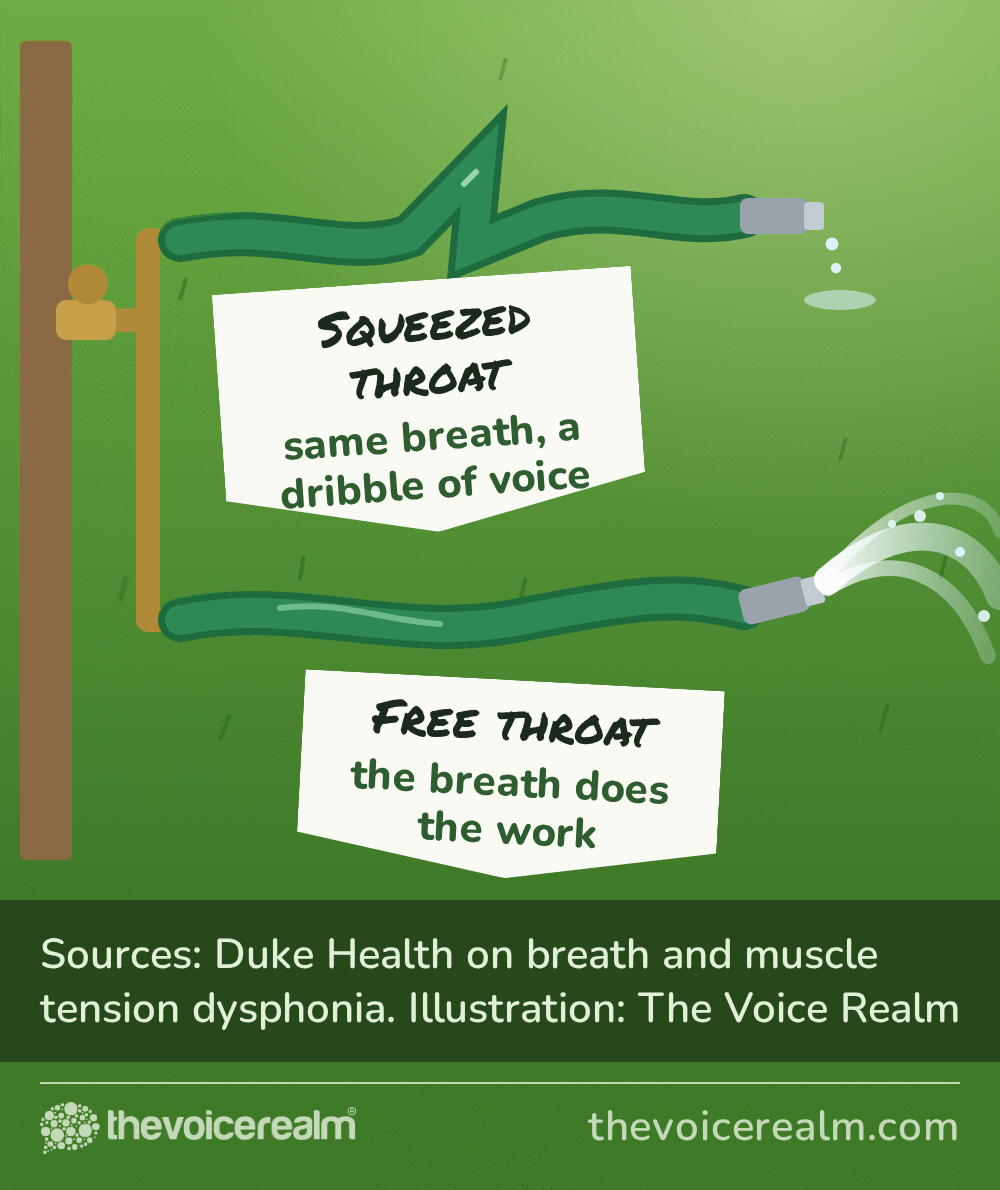
Duke Health is blunt about the mechanics: MTD “is caused by not using the power of your breath to energize your voice” and by “forcing your throat muscles to work too hard when you speak.” It also lists “excessive talking, loud talking or yelling” as contributing factors. Long narration days, shouty game sessions and promo reads that ask for punch all qualify.
Nobody needs to give up any of that work. It just means the voice needs managing like an athlete’s body does, which is the whole idea behind looking after the only instrument you own.
© The Voice Realm
Your vocal folds can look perfect and still be the problem
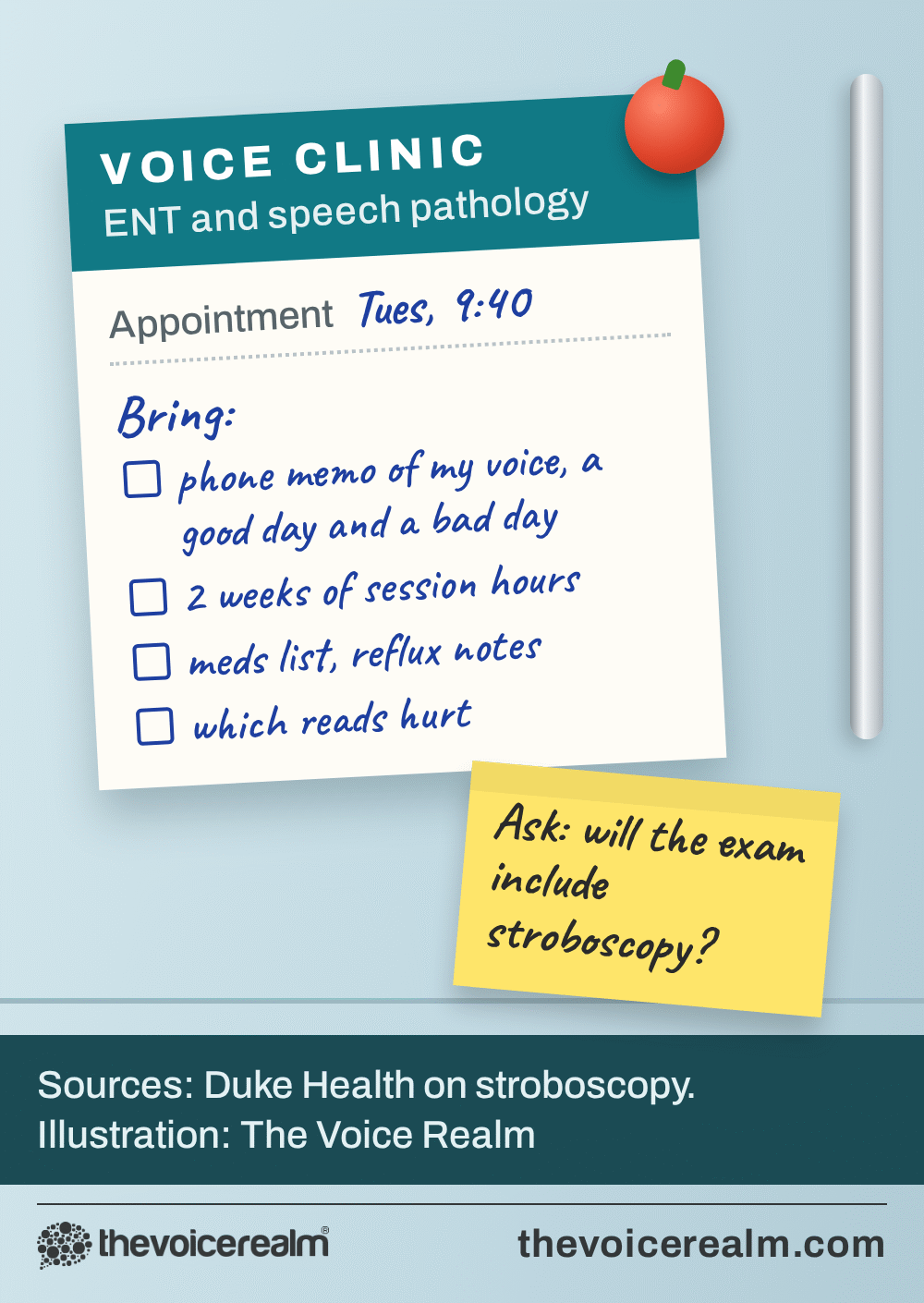
Here’s the bit that sends people round in circles. A quick look at the throat can come back clear. Duke Health explains: “Often with muscle tension dysphonia, the vocal cords may appear normal,” and “only detailed examination using videolaryngostroboscopy can identify minor muscle inefficiencies.”
Stroboscopy uses a flashing light timed to your voice so the doctor can watch the folds vibrate in what looks like slow motion. It shows how the folds close, how the structures above them squeeze in, and whether the whole system is working harder than it should. A standard look with a mirror or a basic scope can’t show that movement in the same detail.
So if you’ve been told “your cords look fine” but your voice still feels wrong, that’s not the end of the story. Ask whether the exam included stroboscopy, or ask for a referral to a voice clinic, where an ENT doctor with voice training and a speech-language pathologist usually work side by side.
Weill Cornell lists one more sign a clinician looks for: “Tenderness to touch of the muscles surrounding the larynx.” If pressing gently either side of your Adam’s apple feels sore, mention it.

© The Voice Realm
When to stop guessing and book an appointment
ENT Health, the patient site of the American Academy of Otolaryngology, Head and Neck Surgery, gives clear markers. See an ear, nose and throat specialist for “hoarseness that lasts more than four weeks, especially if you smoke,” or “severe changes in voice lasting more than a few days.” It also lists “vocal professionals (singer, teacher, public speaker) who cannot do their job” as a reason to go. A voice actor who can’t get through a booked session belongs in that list.
 VOICEMASTERACADEMYFirst read to first booking.Twenty modules. The first one is free.Start free
Our advice is to go sooner than the four weeks if the voice is your income. Every week of pushing through a tight voice is another week of practising the wrong habit, and that’s what Cleveland Clinic is warning about when it says, “Using muscles the wrong way repeatedly only makes things worse.”
Pain when you speak or swallow, or anything else about your voice that worries you, is a reason to go now, not later.
© The Voice Realm
What voice therapy actually involves
Every clinic we read lands in the same place. Cleveland Clinic: “Voice therapy is the main treatment for MTD.” Weill Cornell calls it “behavioral treatment,” which is a good word for it. It’s retraining, not repair.
Duke Health describes what happens in the room. “Voice therapy helps you learn to relax your throat muscles, use your breath to power your voice efficiently,” working with a speech pathologist who guides you through exercises. Some sessions are hands on: “Targeted manual therapy performed by a speech pathologist can reduce excess muscle strain involved with voice use.” That can mean gentle stretching or massage around the head, neck and upper body, and “you may also learn stretches and self-massage techniques to use at home.”
Rochester’s program notes include learning “techniques for producing a healthy voice while eliminating overuse or abuse,” which for a voice actor often turns into very practical work: how to get a gravelly character without gripping, how to hit a hard sell without shouting, how to breathe between lines on a long narration so the last paragraph sounds like the first.
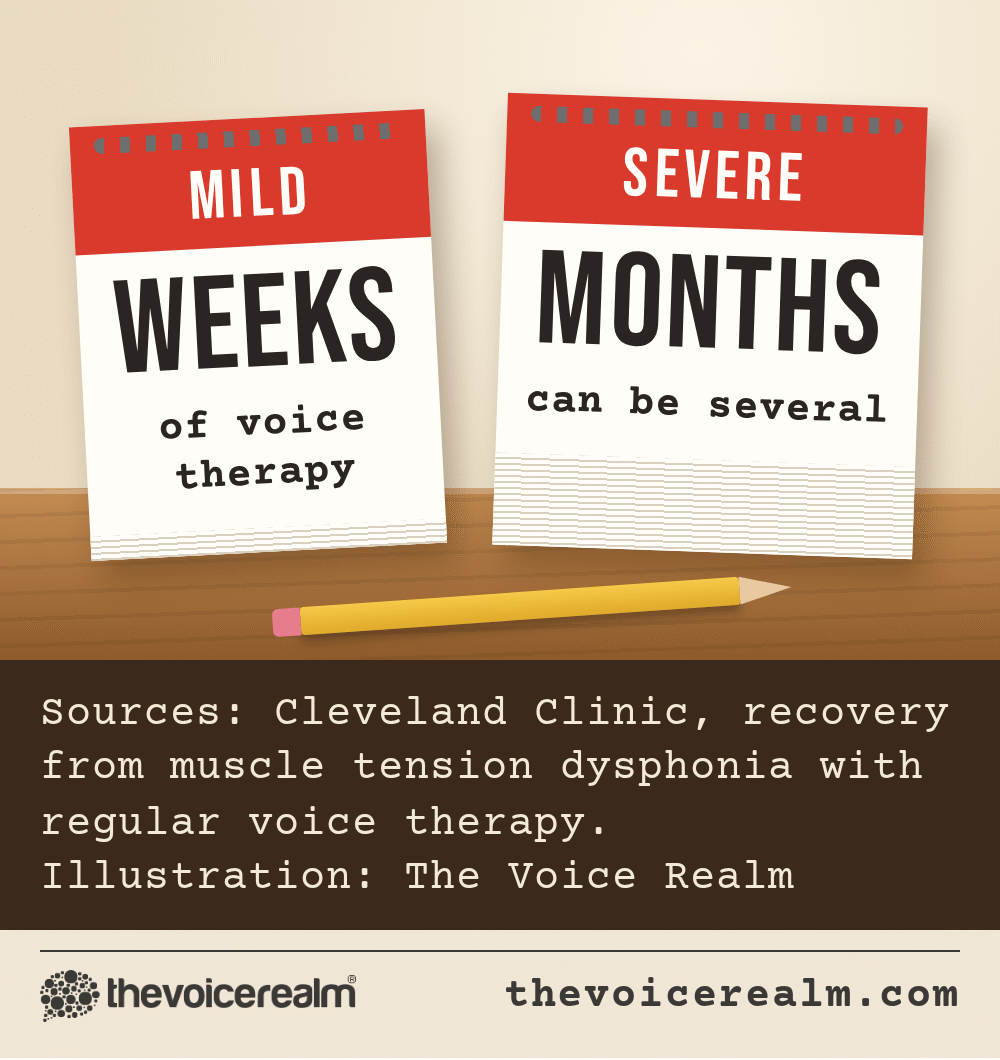
How long does it take? Cleveland Clinic says mild cases can come right within weeks, while more severe ones can take months. Duke Health says that “people often experience dramatic relief of discomfort and throat strain” after the hands-on treatments, even if the new habit takes longer to stick.

© The Voice Realm
Small habits in the booth that keep the squeeze away
None of this is treatment. It’s the everyday stuff that makes it harder for tension to build up in the first place, and it’s worth doing whether your voice feels fine or not.
Bring the script up to your eyes. A tablet or monitor at eye height keeps your chin level. If you catch your head craning forward to read, move the screen, not your neck. Our piece on whether to sit or stand when you record goes deeper on posture at the mic.
Check your jaw between takes. Let it hang, teeth apart, tongue resting behind your bottom teeth. If your back teeth are touching while you read the next line, you’re bracing.
Let the breath do the lifting. Big energy should come from more air and more intention, not from the throat. If a line needs to land harder, take a fuller breath before it rather than pushing on the word.
Build character voices with resonance, not grip. Gravel, growl and squeeze can be shaped in the mouth and throat space with a relaxed neck. If a voice hurts to hold for a page, it’s built wrong, and a coach can help you rebuild it.
Put real breaks in a long day. Ten quiet minutes every hour is a better habit than one long lunch. We looked at how many hours a day a voice can record if you want the numbers behind that.
Wind down after a session. Gentle hums, a few slides through your range and a minute of shoulder rolls tell the muscles the work is done. There’s a simple routine in our post-session cool-down.
Stop clearing your throat. It feels like it helps, but each one slams the folds together and adds to the squeeze. Sip water or swallow instead.
© The Voice Realm
If your voice feels tight right now
Rest it today, drink some water, skip the extra audition you were going to squeeze in tonight, and notice how it feels tomorrow morning. If the strain is back by mid-session for days on end, or it’s been weeks, book the appointment and ask for a voice specialist.
Muscle tension dysphonia sounds alarming, but it’s a habit, and habits can be unlearned. A few appointments now cost a lot less than a month of sessions with a voice that won’t behave.
Sources: Cleveland Clinic, “Muscle Tension Dysphonia (MTD)”; Duke Health, “Muscle Tension Dysphonia”; Weill Cornell Medicine, Sean Parker Institute for the Voice, “Muscle Tension Dysphonia”; University of Rochester Medical Center, “Muscle Tension Dysphonia (Functional Voice Disorders)”; American Academy of Otolaryngology, Head and Neck Surgery, ENT Health, “Hoarseness”.
Ready to get booked?
See the jobs open right nowAbout Sarah Robbins
Sarah Robbins writes for The Voice Realm about finding voice over work, home studios, casting and the business side of voice acting.