Blog
This guide is for voice actors who’ve been told, kindly or otherwise, to be “crisper”. Maybe your endings fade out, maybe a client asked twice what a product name was, or maybe you hear yourself back and the words feel soft round the edges. It’s also for anyone who fixed that once by hitting every consonant like a typewriter and ended up sounding like a robot reading a train timetable.
Good diction for voice over sits between those two. Below is what articulation actually is, how to loosen the parts that do the work, the drills that build control, and how to take it to the mic without sounding studied.
Clear isn’t the same as crisp
The first thing to know is that nobody wants to hear your diction. They want to hear the words. Over-articulated reads are just as distracting as mumbled ones, and in a booth a few inches from a sensitive mic, they’re often worse.
Jeannette Nelson, Head of Voice at the National Theatre in London, described this in an interview for the Open University about a production of Medea. The composer, she said, “didn’t want them to over articulate, to make it sound that they are all singing together, hitting the final consonant together, she wanted it much more natural.” That’s a chorus in a huge theatre, and still the brief was natural. For a voice in someone’s earbuds, natural matters even more.
Nelson’s book, The Voice Exercise Book, starts from the same place: “A healthy, expressive voice is not achieved by affecting a way of speaking or copying someone else. It is achieved by developing the voice you have.” So the aim isn’t a new, posh voice. It’s your own voice with every word arriving whole.
© The Voice Realm
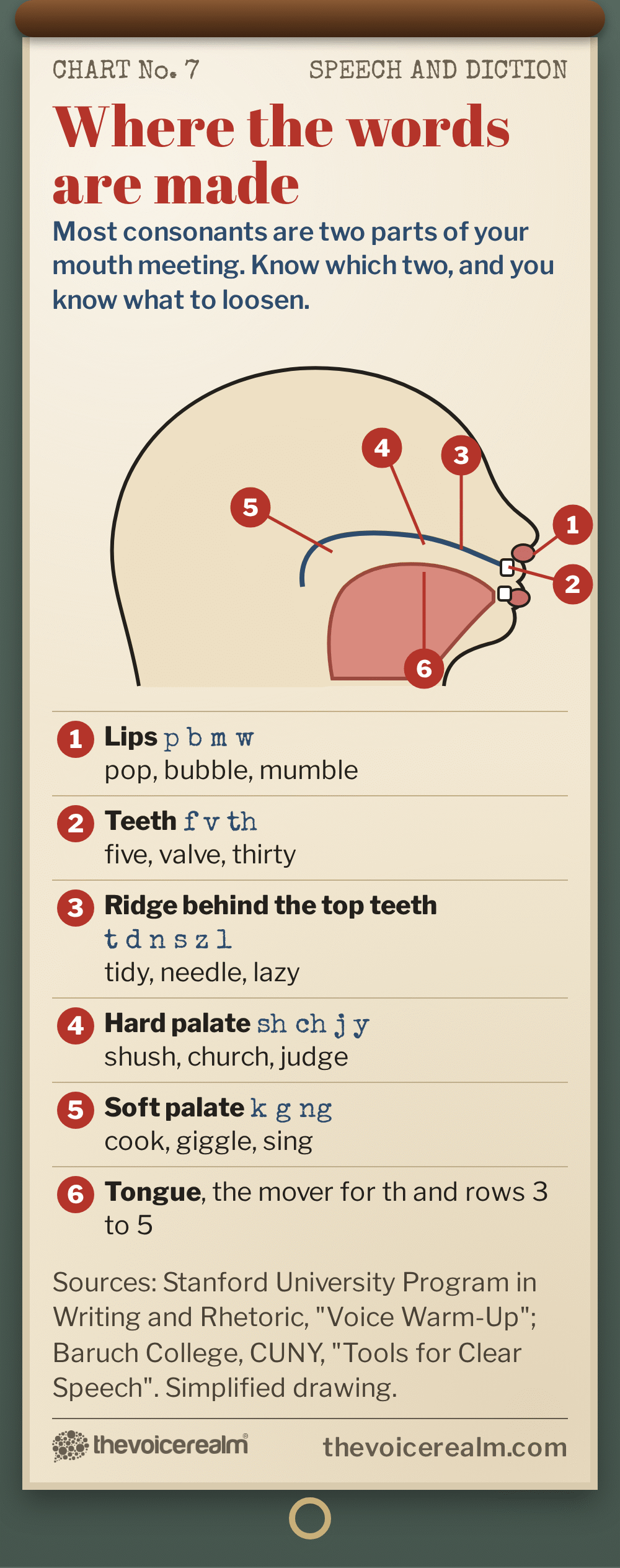
Where the words are made
Tom Freeland, who teaches voice in Stanford University’s Program in Writing and Rhetoric, puts it in one sentence: “Articulation is principally about consonants; a vowel is a flow of vocal sound, interrupted and shaped by the intervention of consonants.” Your vowels carry the tune and the feeling. Your consonants carry the meaning, and they’re made by two parts of your mouth meeting and letting go.
That’s useful, because it tells you where to look when something’s unclear. If the p and b in “probably” smear together, it’s your lips. If “didn’t” turns into “dint”, it’s the tip of your tongue not quite reaching the ridge behind your top teeth. If the k at the end of “back” never lands, it’s the back of the tongue and the soft palate. Once you know which two parts meet, you know what to loosen and what to drill.
© The Voice Realm
Loosen first: jaw, tongue and lips
Tension is what kills clear speech. A tight jaw barely moves, a stiff tongue can’t get to where it’s going in time, and the words come out blurred. The University of Iowa’s Voice Academy guide for theatre voice directors says it outright: “All unnecessary tension in the body is the enemy of a free and natural voice”.
“It is achieved by developing the voice you have.”
Jeannette Nelson, Head of Voice, National TheatrePost this quote
Start with the jaw. The same guide’s advice: “The lower jaw should only drop straight down, and not be manipulated from side to side. As a gentle warm-up, say ‘fah, fah, fah'”. Let it hang loose and drop on each fah, no pushing.
Then the lips. Jessica Hansen, a voice coach who works with NPR reporters, uses the lip trill, which she describes on NPR’s podcast for students: “So you put your lips together, and then they flutter, and you blow like a horse.” Slide the trill up and down your range for a minute. It loosens the lips and gets the breath moving at the same time.
Finally the tongue. Stick it out and point it up, down and side to side, then sweep it round the outside of your teeth behind closed lips, slowly, both directions. It looks daft. Nobody’s watching. If you want the full routine your voice needs before a session, our guide to warming up before you record covers breath and range too.
The drawl drill: slow, huge, then let it go
The single most useful diction exercise is also the least glamorous. Take the script you’re about to record and read it far too slowly, with every sound exaggerated. George Bodarky, who coaches hosts and reporters for NPR, calls it the dramatic drawl: “Have them read the script slowly and over-articulated, finishing each word before moving to the next. Then, deliver it naturally.” His reason: “It brings awareness to pacing and helps build rhythm and control.”
Freeland at Stanford makes the same point about practice: “Magnifying the physical business of articulation is the key concern here: moving the face a bit more and slowing down.” The exaggeration is the practice, never the performance. You go big in rehearsal so that your mouth knows the route. Then you read it at normal size and the clarity stays, without the effort showing.
Two passes is often enough. One drawl, one natural read. You’ll notice the second take sounds more confident as well as clearer, because you’re no longer discovering the words as you say them. That’s also the fix for a read that sounds like reading, which we dig into in why you sound like you’re reading.
© The Voice Realm
Tongue twisters, used properly
Tongue twisters get a bad name because people use them wrong: as a race. Said fast and sloppy, they train you to be fast and sloppy. The Iowa guide gives them a job and a warning: “Tongue twisters gain flexibility, but remember to breathe first!”
The method from Baruch College’s Tools for Clear Speech, a pronunciation resource from the City University of New York, is the right one: “Record yourself repeating each tongue twister. Try it slowly first, and then gradually increase to a fluid, natural-feeling pace.” Listen back to each speed. The moment the endings start to go is your current limit, and the speed just under it is where to practise.
 VoiceEditSuiteIt edits like you would, and it gets better every file.Every fix you make in the editor teaches Auto Clean Up more, so each file comes back sounding like you edited it yourself.See how it worksLearns from numbers, never your audio. Never used to train AI.
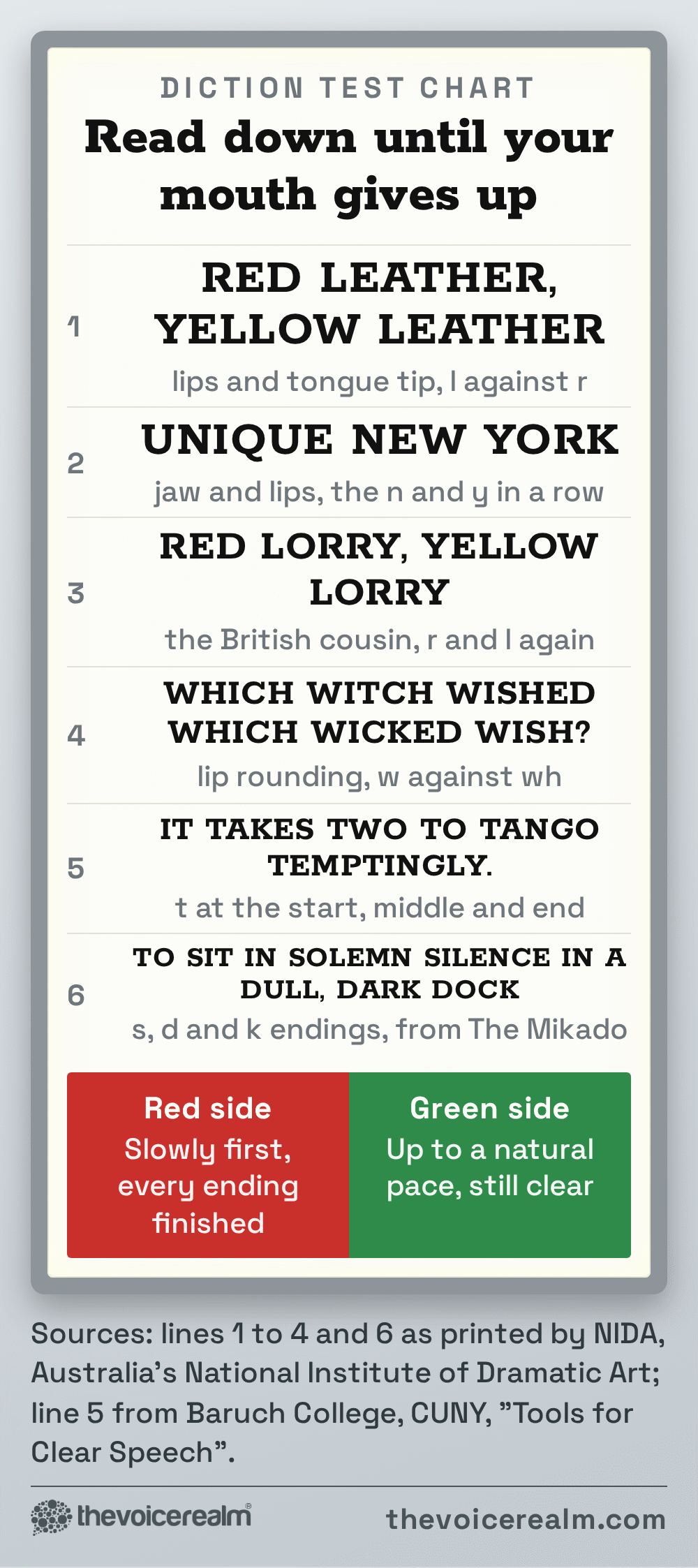
Pick twisters that hit the sounds you trip on, not the ones that are fun to say. If your r and l blur, use one built on them. If final consonants vanish, use one full of endings. The chart below is a good starter set, one problem per line, from the tongue twisters Australia’s National Institute of Dramatic Art gives its students and Baruch’s own drill for t.
© The Voice Realm
The cork: worth a few minutes, not a habit
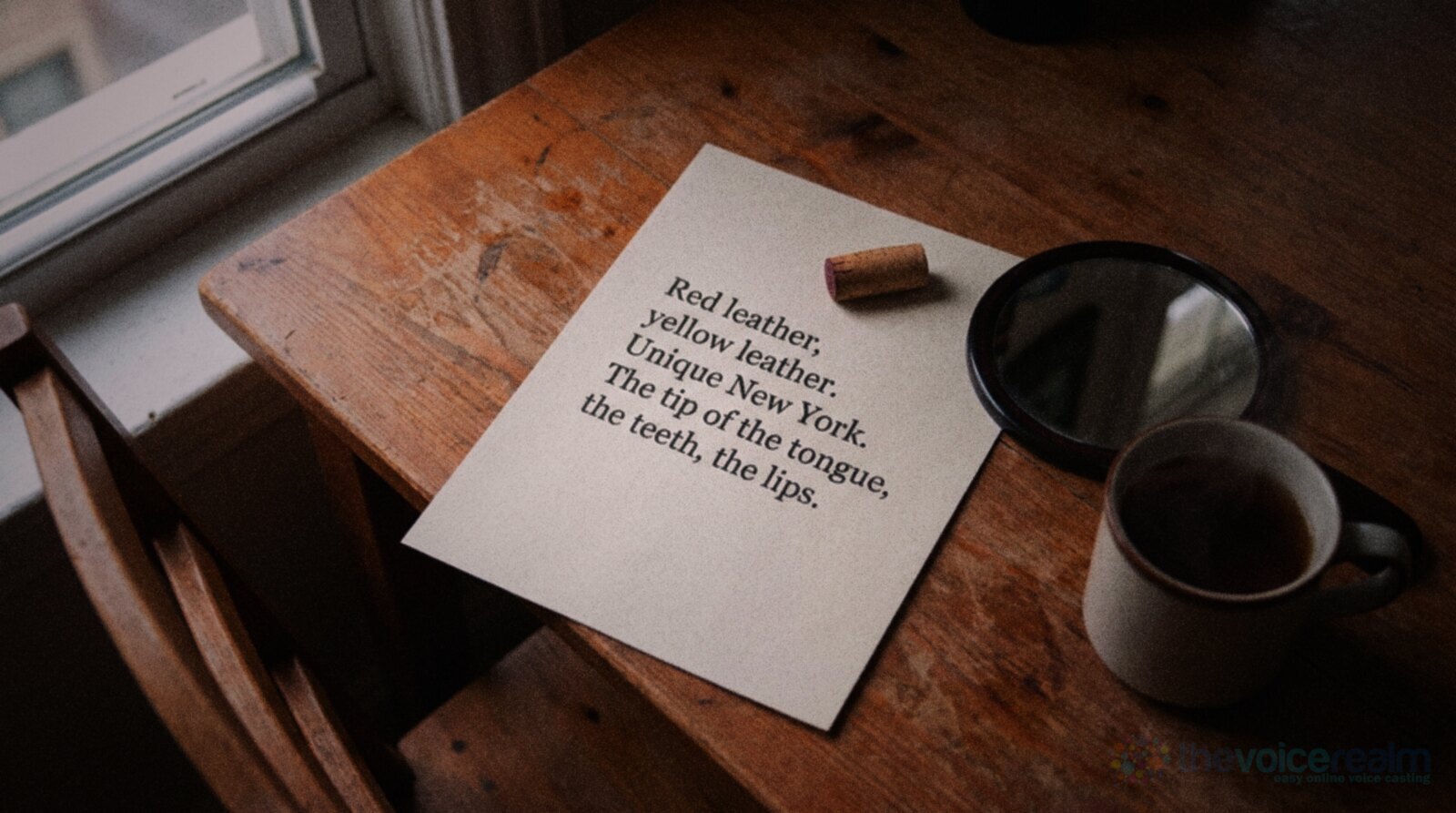
You’ll see the cork exercise in every voice forum. You hold a wine cork lightly between your front teeth and read a passage aloud, then take it out and read the passage again. Accent coach Hadar Shemesh explains the point: “This will force you to work harder to pronounce every sound.” She’s also honest about what it sounds like: “At the same time, let’s agree that it’s not going to sound clear, so don’t worry about it. Remember that it’s an exercise for the tongue and for your mouth.”
Used like that, a minute or two, it can work. The read after you take the cork out usually feels lighter and more precise. But keep it short, keep the cork at the front of your teeth where it can’t slip back, and never clench on it, because a tight jaw is the thing you were trying to get rid of. If it makes your jaw ache, skip it. The drawl drill does the same job with no props.
Finish your endings, gently
Most unclear voice over isn’t about the start of words. It’s the ends. The t in “don’t”, the d in “around”, the k in “network” all tend to vanish when you’re relaxed and moving quickly, and the listener’s brain has to fill in the gap.
Baruch College describes how a t is made: “To make /t/, place the tip of your tongue on the ridge behind your upper teeth (but do not touch the teeth). As you push air out of your mouth, briefly stop it behind your tongue before releasing it.” That small stop and release is what a listener hears. You don’t need a big puff of air. You need the tongue to actually get there.
This is where the mic changes everything. On stage, endings have to reach the back row. A few inches from a condenser, a gentle touch is plenty, and a hard one turns into a spit or a click that the editor has to clean. If your t and s sounds are already loud, look at taming the sizzle before you push any harder. Land the ending, don’t punch it.
Practise where your voice actually works
Diction drills only count if they change your reads, so practise in the conditions you record in. Read real scripts, out loud, at your normal level. Record them. A phone is fine for practice; you’re listening for words, not sound quality.
Watch your speed. The National Center for Voice and Speech notes that “The average rate of speech for English speakers in the United States is about 150 words per minute”. Clarity usually falls apart when you go well past your own comfortable pace, so if a script is too long for its slot, the fix is a conversation with the client about cutting words, not a sprint. And names deserve extra care: a mumbled product name costs a client more than a mumbled “and”.
Dead time is good practice time. A parked car, a walk, the ten minutes before a session. Read a paragraph, play it back, notice one thing, read it again.

© The Voice Realm
A ten minute routine you can keep
Here’s a daily routine that fits before any session:
- Two minutes loose. Jaw drops on fah, lip trills up and down, tongue stretches and circles.
- Three minutes of twisters. Two or three lines that hit your weak sounds, slow first, then a little faster, recorded.
- Three minutes of drawl. The first paragraph of today’s script, slow and huge, every ending finished.
- Two minutes natural. The same paragraph at normal size. Play it back. If every word arrives and nothing sounds performed, you’re ready.
Do it for a month and the change doesn’t happen in the drills. It happens in the takes, when a client stops asking you to be crisper because they never notice your mouth at all. If you’re new to all this and want someone to hear you and point out the habits you can’t hear yourself, the beginner courses at Voice Master Academy are a friendly place to start. Then send those clean reads where they’ll be heard: here are the casting sites worth your best takes.
Sources: Jeannette Nelson, interview with Chrissy Combes for the Open University, “Practitioners’ Voices in Classical Studies”, August 2014; Jeannette Nelson, “The Voice Exercise Book”, National Theatre Publishing, 2015; Tom Freeland, Stanford University Program in Writing and Rhetoric, “Voice Warm-Up”; Judy Leigh-Johnson and Julie Ostrem, University of Iowa Voice Academy, “Tips and tools to vocal freedom: A theatre vocal director’s guide”; NPR, “Try These Vocal Exercises To Find Your Podcast Voice”, February 2020; George Bodarky, NPR Training, “The art of coaching vocal performance”, September 2025; Baruch College, CUNY, “Tools for Clear Speech: /t/”; National Institute of Dramatic Art, “Tongue Twisters”; Hadar Shemesh, “Exercises for English pronunciation and articulation”, July 2020; National Center for Voice and Speech, “Voice Qualities”.
Ready to get booked?
See the jobs open right nowAbout Sarah Robbins
Sarah Robbins writes for The Voice Realm about finding voice over work, home studios, casting and the business side of voice acting.