Blog
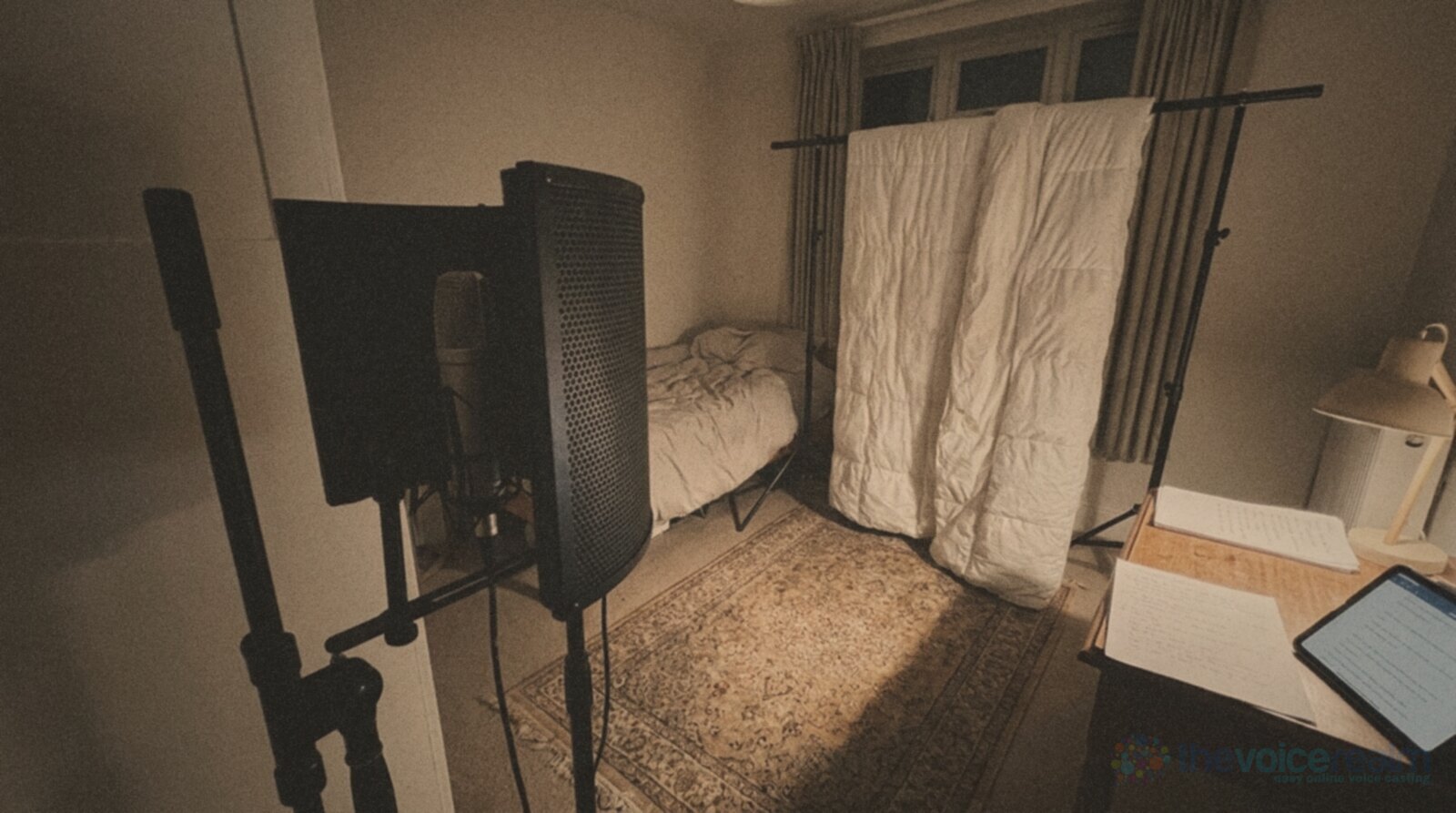
If you’ve shopped for a home studio, you’ve seen them: a curved shield of metal and foam that clamps onto your mic stand and wraps around the back of the microphone. They’re sold as a vocal booth in a box, and they turn up in nearly every starter bundle. So do reflection filters work? The honest answer is “a bit, for some things, in some rooms.” This guide is for voice actors recording at home who want to know which things, which rooms, and whether the money is better spent somewhere else.
What a reflection filter is meant to do
A reflection filter is a small, curved acoustic absorber that sits behind and around your microphone. Most are a perforated metal or plastic shell with foam or wool inside. You mount it on the same stand as the mic, and your mic sits in the curve, facing you.
When Paul White reviewed the original design for Sound On Sound, he described it as “designed primarily to reduce the amount of room ambience picked up by a microphone during recording.” That’s the job in a sentence. It’s trying to make your voice sound drier, with less of the room’s echo and boxiness wrapped around it.
What it isn’t is soundproofing. It won’t stop a lawnmower outside, a neighbour’s television or the hum of your laptop fan. If noise is your problem rather than echo, our guide to hunting down background noise is the better place to start.
Your mic is listening to the wall behind you
To understand what a filter can and can’t fix, you need to know how most voice over mics hear. Most are cardioid: most sensitive at the front, a little less at the sides, and least sensitive at the back. The front of the mic points at you. So what’s directly behind you is right in its line of hearing.
Hugh Robjohns, Sound On Sound’s technical editor, explained this in a 2012 answer to a reader with a bedroom studio. “Any sound that bounces off the wall behind the performer (and, to a slightly lesser degree, the side walls) will reach the microphone at its most sensitive frontal axis and slightly less sensitive sides,” he wrote, “and those are the reflections that are the most important to remove, because they are the ones that make the recording sound coloured and boxy.”
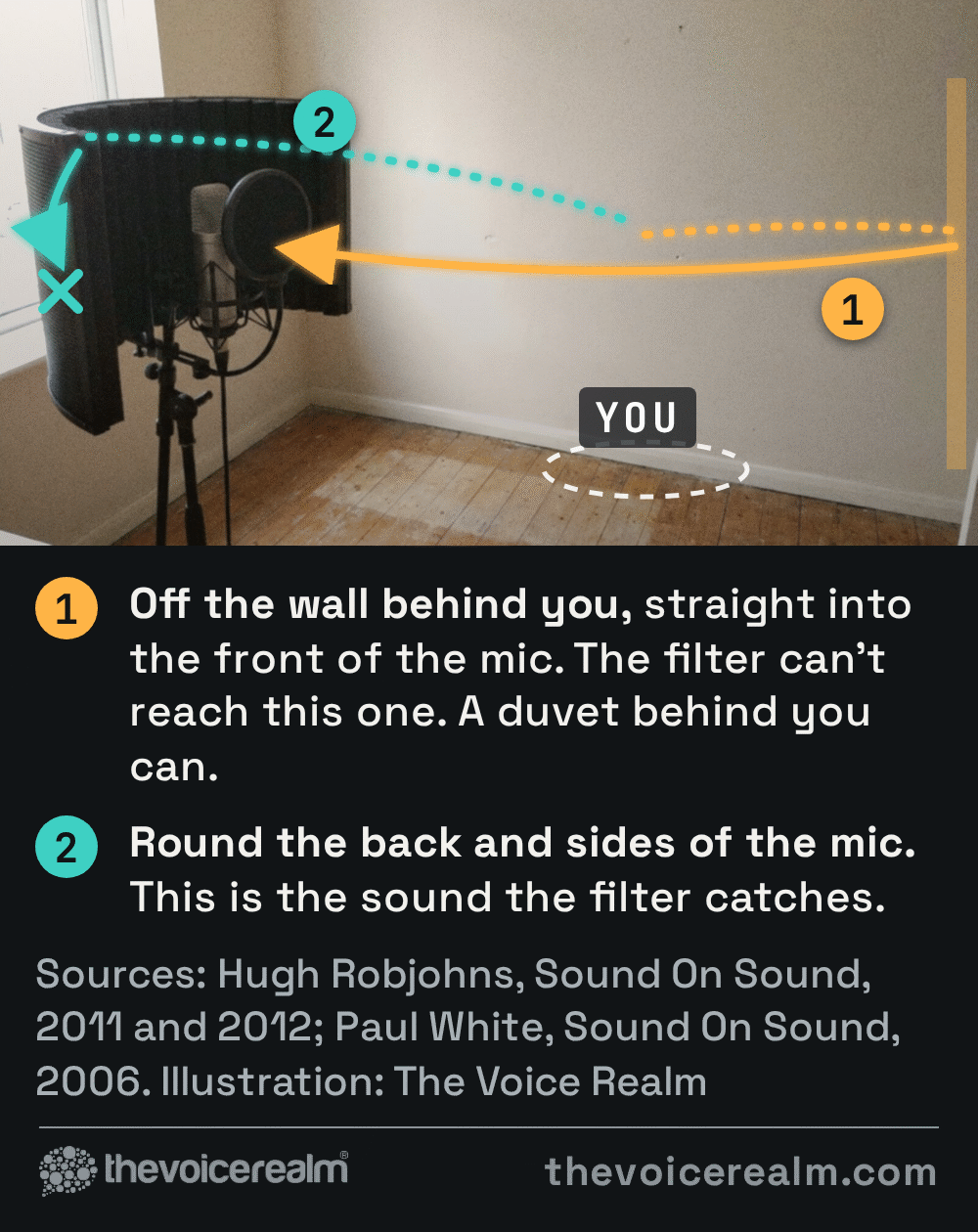
Now look at where a reflection filter sits. It’s behind the mic, covering the side the mic hears least. The picture below follows the two routes your voice takes back to the microphone, and shows which one the filter can actually catch.
© The Voice Realm
That’s why the standard advice from audio engineers has been the same for years: deal with the wall behind you first. Our guide on how to treat a room for voice over walks through it at every budget, starting with a duvet.
What a filter genuinely does well
That doesn’t make the filter useless. It has two real jobs, and White’s review spells out both. First, when you work close to it, some of your voice goes into the foam instead of out into the room, so there’s less sound bouncing around to come back later. Second, “even cardioid mics pick up a significant amount of sound from the sides,” so the curve helps keep out reflections arriving from left and right.
You can hear the first effect for yourself. Steve Levine, a record producer who tried one for voiceover links on a BBC Radio 2 series, wrote in the same review: “if you move your head toward the filter panels whilst speaking, you can hear the immediate effect of ‘drying out’ all of the room sound.”
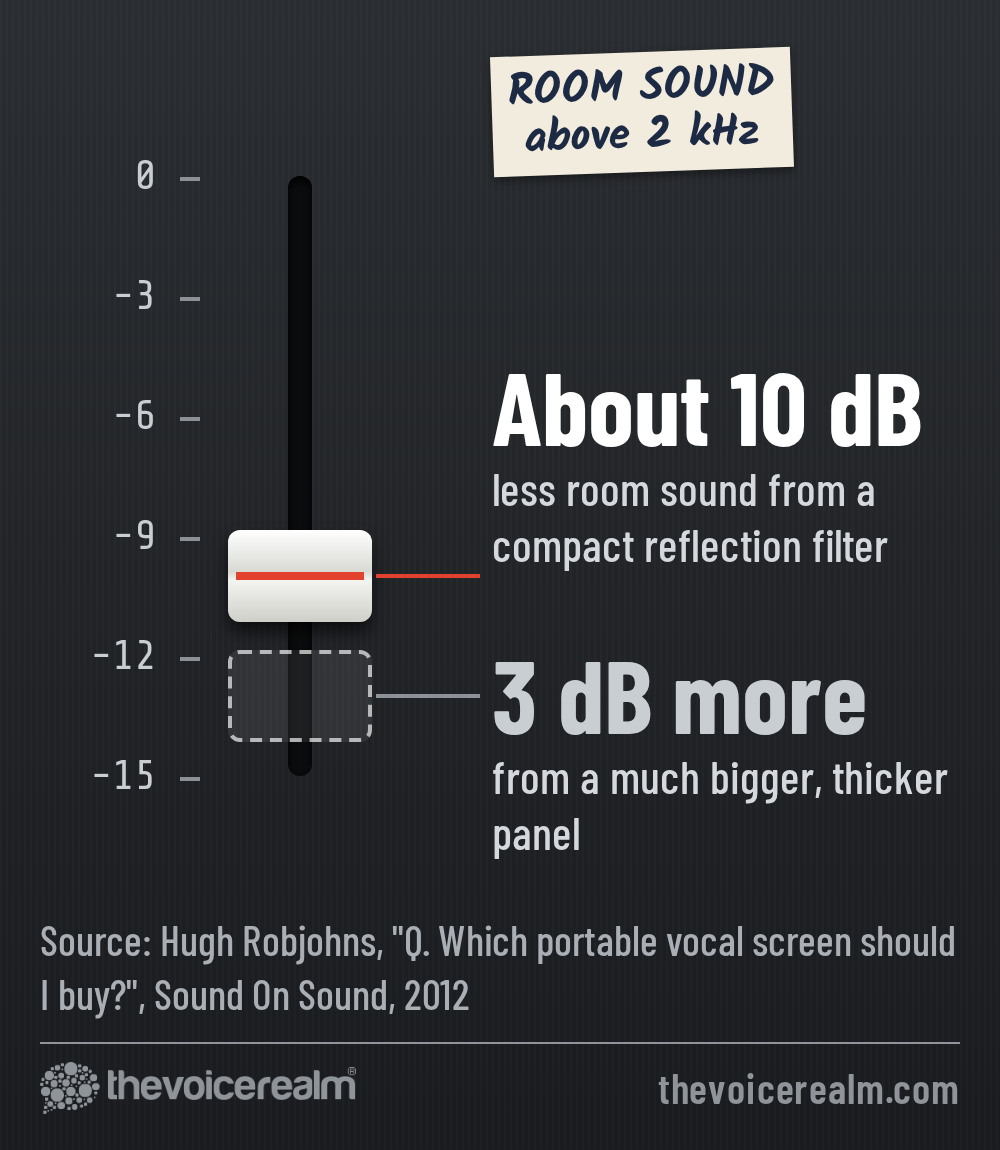
How much does it take out? Robjohns put a number on it and compared it with a far bigger, thicker portable panel. The fader below shows the gap, and it’s smaller than you might expect from the size difference. Above about 2 kHz, where a lot of the “roomy” edge on a voice lives, a well-made filter does real work.
© The Voice Realm
Where it does less is down low. Thin absorbers struggle with low frequencies, and Robjohns notes that the differences between filter designs “really come down to the usual compromises of size, weight, cost and the efficiency of their low-frequency absorption.” Bigger and thicker absorb lower. A small foam clip-on does very little below the upper mids, which is why a boomy room still sounds boomy with one in place.
What it can’t fix on its own
The same SOS answer is blunt about the limits. “The bottom line is that neither of those devices will do what you need on their own,” Robjohns wrote, talking about both a reflection filter and a larger portable vocal booth. In his words, they’re “a useful addition but are not adequate on their own to ‘cure’ poor room acoustics.”
He then compares them with the cheapest fix there is. Thick polyester duvets hung behind you, he wrote, are “orders of magnitude more effective in improving the recording room acoustics than any kind of reflection filter or portable booth.”
White came to the same view in his review. He thought the filter worked best with “some improvised absorption behind the singer,” and added that “additional absorptive material (even if it’s only a duvet or heavy blanket) behind the singer should still be considered mandatory.” Mandatory is a strong word from a reviewer who liked the product.
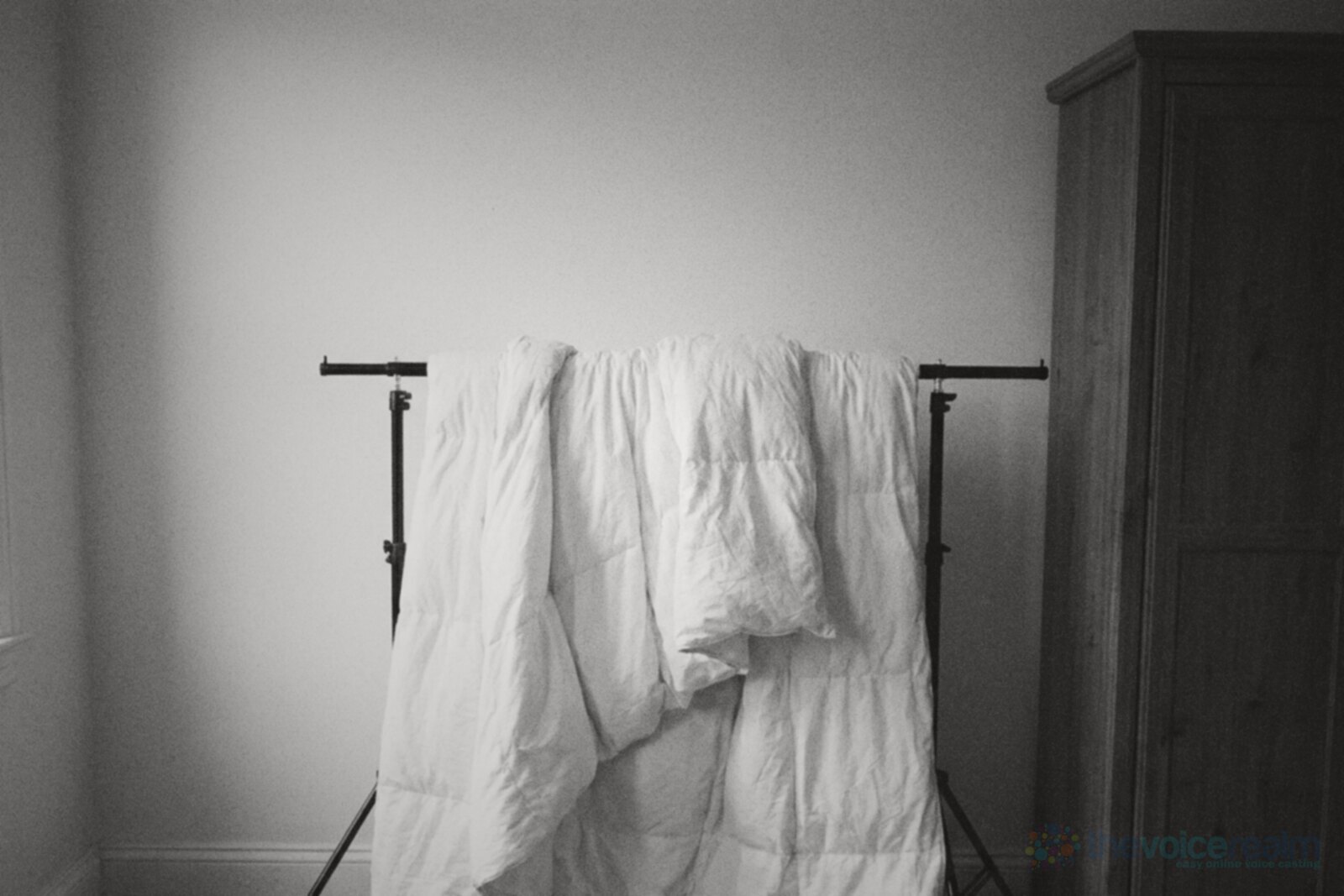
The cheapest treatment there is, and the one to hang first. © The Voice Realm
So the order of work is clear. Something soft and thick behind your head first. Then, if the room still sounds hollow, a filter behind the mic to catch what’s left.
One engineer measured his and stopped using it
Steven Liddle, who records voice alarm and information messages, wrote up a test of his own filter for ProSoundTraining in 2017. He’d noticed something odd: “I found that those messages recorded without the filter actually sound more neutral.”
So he measured it, with a speaker playing into an omni measurement mic and his own cardioid condenser, with and without the filter. With the filter, he found a small lift in the low end and a ripple in the frequency response around 1 kHz. Part of the cause was the filter itself: one early reflection in his readings came from its own plastic shell, bouncing straight back into the mic.
 VOICEMASTERACADEMYTwenty modules, one at a time.Breath controlHome studioCommercial techniqueAuditionsStart module oneNo experience needed.
With the cardioid mic and no filter at all, the reflections from the wall were already 6 to 8 dB lower than they’d been with the omni mic, because the cardioid’s back was ignoring them. His conclusion for his set-up was blunt: “If you use a microphone with a cardioid pick-up pattern the answer is a resounding no.”
Two things are worth keeping in mind. He tested one budget model, and said himself that some more expensive filters with more open shells would probably do better. And his test measured reflections from behind the mic, which is exactly the area a cardioid mic already ignores. It doesn’t change the bigger point from the SOS answers: the wall behind you matters far more than the wall behind the mic.
Comb filtering, and where the mic should sit
Liddle’s ripple has a name. Any hard surface close to a mic reflects a little sound straight back into it, a fraction of a second late. That late copy adds to and cancels parts of your voice at regular steps up the frequency range, which is called comb filtering. It can make a voice sound slightly hollow or phasey.
Placement is how you avoid it. Robjohns says the effect “is very dependent on the placement of the microphone, but it is easily avoided,” and gives the rule: “Essentially, the mic capsule has to be placed slightly forward of the front edges of the Filter.” White makes the same point from the other direction: “So long as you don’t set back cardioid mics more than an inch or so from the mouth of the Reflexion Filter, the amount of coloration is minimal.”
In practice:
- Line the capsule up with the middle of the filter, top to bottom.
- Bring the mic forward so the capsule sits at or just in front of the filter’s front edges, not buried deep in the curve.
- Put your headphones on, speak, and slide the mic a little forward and back. Stop where your voice sounds most like you.
The type of mic matters too. Both White and Liddle found filters help more with mics that hear a lot from behind, such as omni or figure-eight patterns. Most voice actors use cardioids, so you’re starting in the position where a filter has the least to add. Our guide to choosing between a dynamic and a condenser mic covers why a tight pattern matters so much in an untreated room.
Test it in your own room before you decide
Every room is different, so the only result that counts is the one from yours. You don’t need a measurement rig. You need ten minutes and your ears.
Record the same paragraph twice at the same distance and the same gain, once with the filter and once without. Pick a paragraph with a few hard stops at the end of sentences, because that’s where you’ll hear the room. Match the two files’ loudness, then listen on closed headphones. Listen to the tail after each sentence ends. Does it stop dead, or is there a faint ring of room after it? And listen to the voice itself. Does one sound more like you, or does one sound slightly hollow?
Record the same paragraph with and without the filter, then compare the tails. © The Voice Realm
If you’d rather have numbers than ears alone, the free Home Studio Analysis from Voice Edit Suite will check a recording for room echo and noise. The best habit is to measure before, treat, and measure again, whether the treatment is a filter, a duvet or both.
So, should you buy one?
Here’s how it shakes out, based on what the testers above found.
Probably worth it if your room is bare and echoey, you’ve already hung something thick behind where you stand, and you still hear the room. It’s also handy if you record in different places, such as hotel rooms or a rented office, where you can’t treat the walls. And if you use an omni or figure-eight mic, it has more to do.
Probably not the next thing to buy if you haven’t dealt with the wall behind you yet. Spend nothing, hang a duvet, and listen again. The same goes if your room is already treated and you use a cardioid mic: you may hear very little change, or a slightly coloured sound like Liddle did.
“Ironically, the Reflexion Filter makes the biggest difference in the worst rooms.”
Paul White, Sound On Sound reviewPost this quote
Don’t expect a filter to turn a bad room into a booth, to block noise, or to fix boominess. It can take the edge off a hollow sound. It can’t replace treatment behind you.
If budget is tight, a wardrobe full of clothes does some of the same work for free. Hanging coats and jumpers around you absorb the reflections from the sides and behind. It’s a classic first booth for a reason.
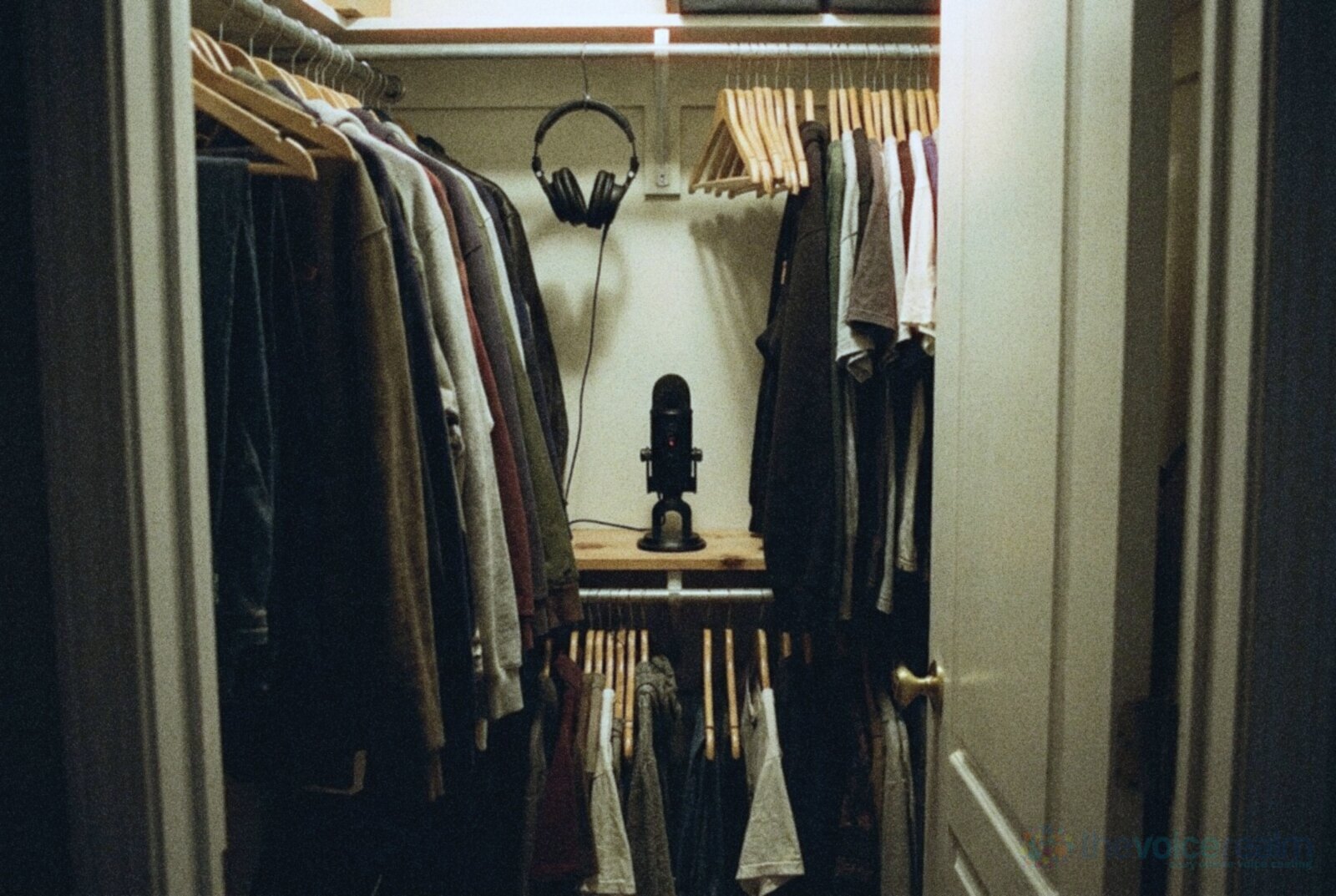
A wardrobe full of clothes does some of a filter's job for nothing. © The Voice Realm
The short version
Reflection filters do something real. They catch some of your voice before it gets into the room and block reflections from the sides, and in a bad room you’ll hear the difference. But they cover the side of the mic that matters least, they do little for low end or outside noise, and badly placed they can colour your sound.
Treat behind you first, then decide whether you need anything behind the mic. And whatever you buy, record with it and without it, and trust what you hear.
Sources: Paul White (with a second opinion from Steve Levine), “sE Electronics Reflexion Filter”, Sound On Sound, June 2006; Hugh Robjohns, “Q. Which portable vocal screen should I buy?”, Sound On Sound, October 2012; Hugh Robjohns, “Q. Is a ‘reflection filter’ worth the money?”, Sound On Sound, August 2011; Steven Liddle, “Do microphone reflection filters really work?”, ProSoundTraining, 21 September 2017.
Ready to get booked?
See the jobs open right nowAbout Sarah Robbins
Sarah Robbins writes for The Voice Realm about finding voice over work, home studios, casting and the business side of voice acting.