Blog

Is this just another trendy corporate buzzword coined by a zealous motivational speaker to create a wave of followers? Not really. It’s been practiced for decades by the Fortune 500 lot, and it was the X factor that made them successful. X, meaning unknown then, until the pundits on strategic management and marketing analyzed further what made the likes of Nike, Pixar, Lego, Coke and Google sustain their claim in their respective markets. The secret lies in how these corporate giants packaged themselves.
What personal branding means
Personal branding, according to Wikipedia, is the practice of people and organizations marketing themselves as brands. The current term, whose antecedents were ‘all individual branding’ and ‘self-positioning’, was popularized by Tom Peters in a 1997 article in which he discussed his work. However, the idea of self-packaging was first written about and documented in 1937 by Napoleon Hill in his book Think and Grow Rich.
 VOICEMASTERACADEMYTwenty modules, one at a time.Breath controlHome studioCommercial techniqueAuditionsStart module oneNo experience needed.
Personal branding makes use of a positioning strategy to advance one’s career or create a good social media image of one’s organization. A positioning strategy focuses on the key areas where the organization or personality excels. “A firm’s positioning strategy targets how it will compete in the market. An effective positioning strategy considers the strengths and weaknesses of the organization, the needs of the customers and market and the position of competitors. The purpose of a positioning strategy is that it allows a company to spotlight specific areas where they can outshine and beat their competition.”
Why does your voice over business need personal branding?
Because individuals want to portray themselves a certain way to their social and business circle. Having a personal voice over brand or image has become more imperative to stay relevant and attuned to your clients or customers. Strategically, you would want to be recognizable amongst the thousands of voice over artists competing in your niche. Voice over artists need a platform, an identifying character or genre to work into their portfolio, so that casting directors can easily pick them out.
Building a brand strategy from the start
We are referencing here some points from a LinkedIn article, Why should I create a brand strategy when I’m in start-up mode by Lindsay Pedersen, brand strategist for Starbucks, T-Mobile and IMDb among others. Kick-starting one’s brand strategy at start-up gives your organization a defined plan to move your service, product or talent forward. It becomes a platform of your brand’s promises (think of the platforms politicians campaign on during elections; this is almost the same): what you can deliver and offer, and what you’re good at (highlight your strengths). It’s your sales pitch, it’s your audition, it’s your voice demo, which is a concrete sample of your voice over talent. Before you begin identifying your personal brand and brand strategy, you will need to understand a few points, which are:
- Your brand strategy homes in on your target market, niche or customer. Example: Your demo recording contains a voice over for an anime character or an explainer video.
- What solution are you offering your customers? What is your turnaround time? Example: A client needs you to do the voice over for an entire whiteboard video, which they aim to release in a month. This will work as your frame of reference to offer up your services. What will differentiate you from other voice over talents aside from cost? Will you be able to do it in less time, or just in time? And what about the quality of your voice?
- What is your brand’s promise? Here, a portfolio of your work will speak volumes for your pitch to the voice over job.
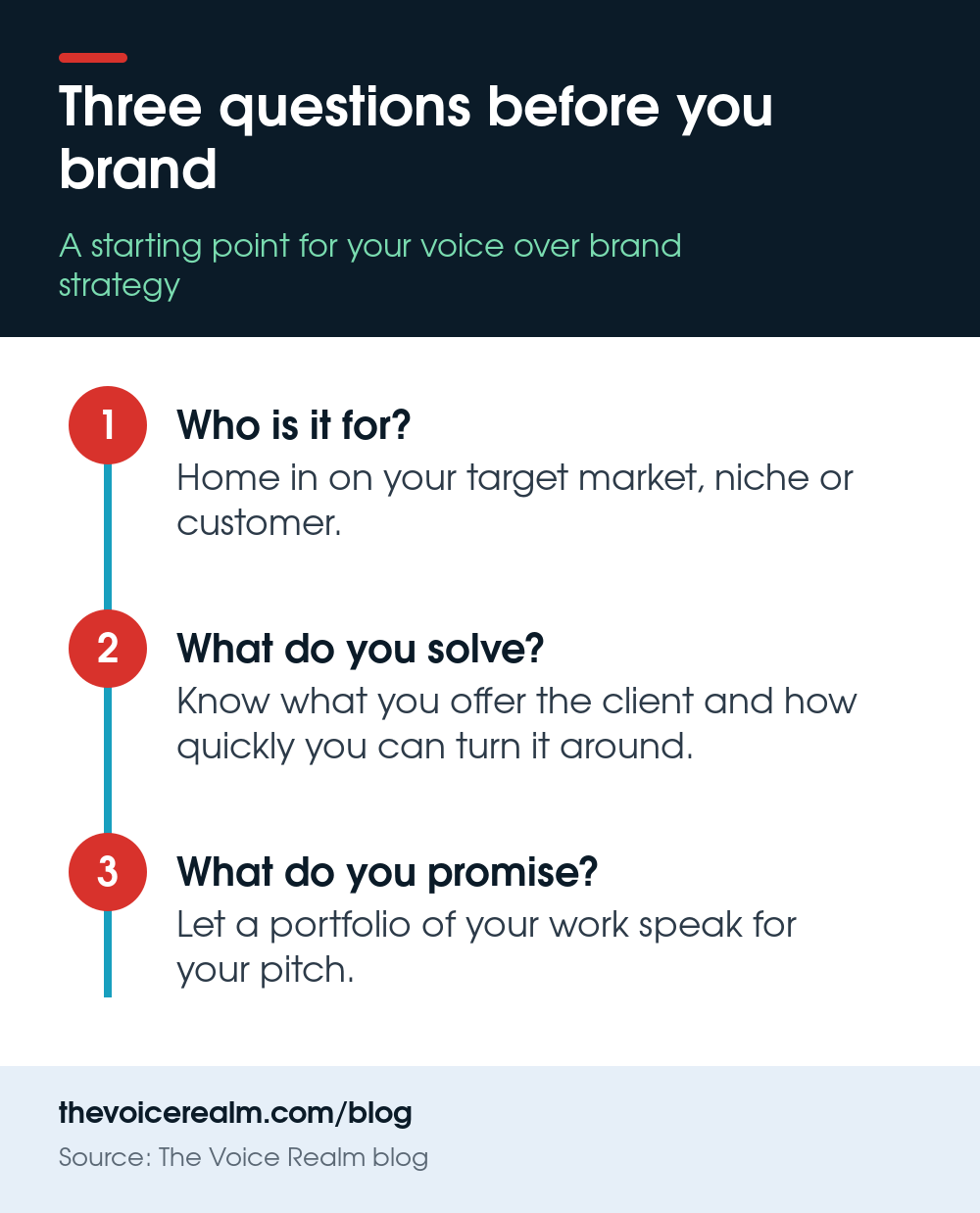
Three questions to answer before you build a brand © The Voice Realm
Summing it all up, your brand strategy is your tool to make your personal voice over brand more focused. These personalities are by far the most effective personal brands, measured by their following and longevity:
Nike: their Just Do It. slogan and Air Jordan series speak of an active lifestyle, performance and resilience.
Pixar: what comes to mind immediately are the words wizard, imagination and technology-savvy.
Lego: original thinking, creativity and imagination.
So, what does your Personal Brand say?
Sources: linkedin.com.
Ready to get booked?
See the jobs open right now