Blog
Blog

When creating video ads for your brand, one of the things to consider is whether to use a female or a male voice over. In some cases the answer can be obvious, like if the video is for football gear, a male voice is preferred since men would want to buy from a fellow man about a male dominant sport. Sometimes the obvious is not so obvious, though. For example, for a male deodorant, a female voice over extolling how good the deodorant works on a man’s body will get more response from the buying public. Perhaps it’s because men put on deodorant for the ladies and the ladies do most of the shopping anyway, including picking out a deodorant for their husbands.
What audience data says about women viewers
 According to Adweek, women are the dominant media voice during the Super Bowl in the 2014 statistics. They say this equates to “Women watch equally, buy + share in greater #s than men on Super Bowl Sunday. Ads with female appeal = best return on $4 million price-tag.” Another fact is that women made up the greater part of the audience for the 2014 Super Bowl and thus ads were created specifically to target them.
The YouTube trends map more often than not would also show females as the dominant audience worldwide on top viewed videos. So if an advertising agency were to create a video ad to pre-roll on YouTube, they know that women are the most likely viewers of their ads.
What polls say about male and female voices
In a blog posted last month by Simple Story Videos, they say that in a poll performed by Adweek/Harris Poll, 48% of viewers said that males sounded more forceful, and yet 49% said gender made no difference. Results became more definitive when the poll was made for explainer videos selling a car and selling computers where 28% of viewers felt that a male voiceover was more likely to sell them a car, and 23% said the same thing about selling a computer. The lines became murky when talking about explainer videos in general as 46% of respondents said females sounded more soothing, yet 46% said that gender made no difference. This was based on a factor where explainer videos aren’t usually created to seem dominant or aggressive; instead, they’re created to be helpful, nurturing and passive as it aims to explain a product’s features and remove any doubts a consumer might have about buying the brand of stove the explainer video was selling.
Letting your brand decide
So what conclusion do we have here? The American consumer does not seem to believe one type of voice is more or less likely to sell a certain product or service. It still veers to your brand’s personality, the goal of the video, and sometimes even personal preference and that of your target market as well. Especially now that most marketing is done globally, what might be fact in one country could be the exact opposite in another. Phil Shinn, a speech application developer and voice user interface designer, adds that in his opinion, “People want to identify with the voice, so you may want to use a female voice if your callers are mostly female,” when talking about the best voice to use for an IVR. He added that when an application calls for a caring, nurturing role, that is best left to a female voice, while technical issues are often better suited to a male voice.

 VoiceEditSuiteEleven tools. One browser tab.Auto Clean UpACX PrepStudio RescueSee the toolsBuilt for working voice actors.
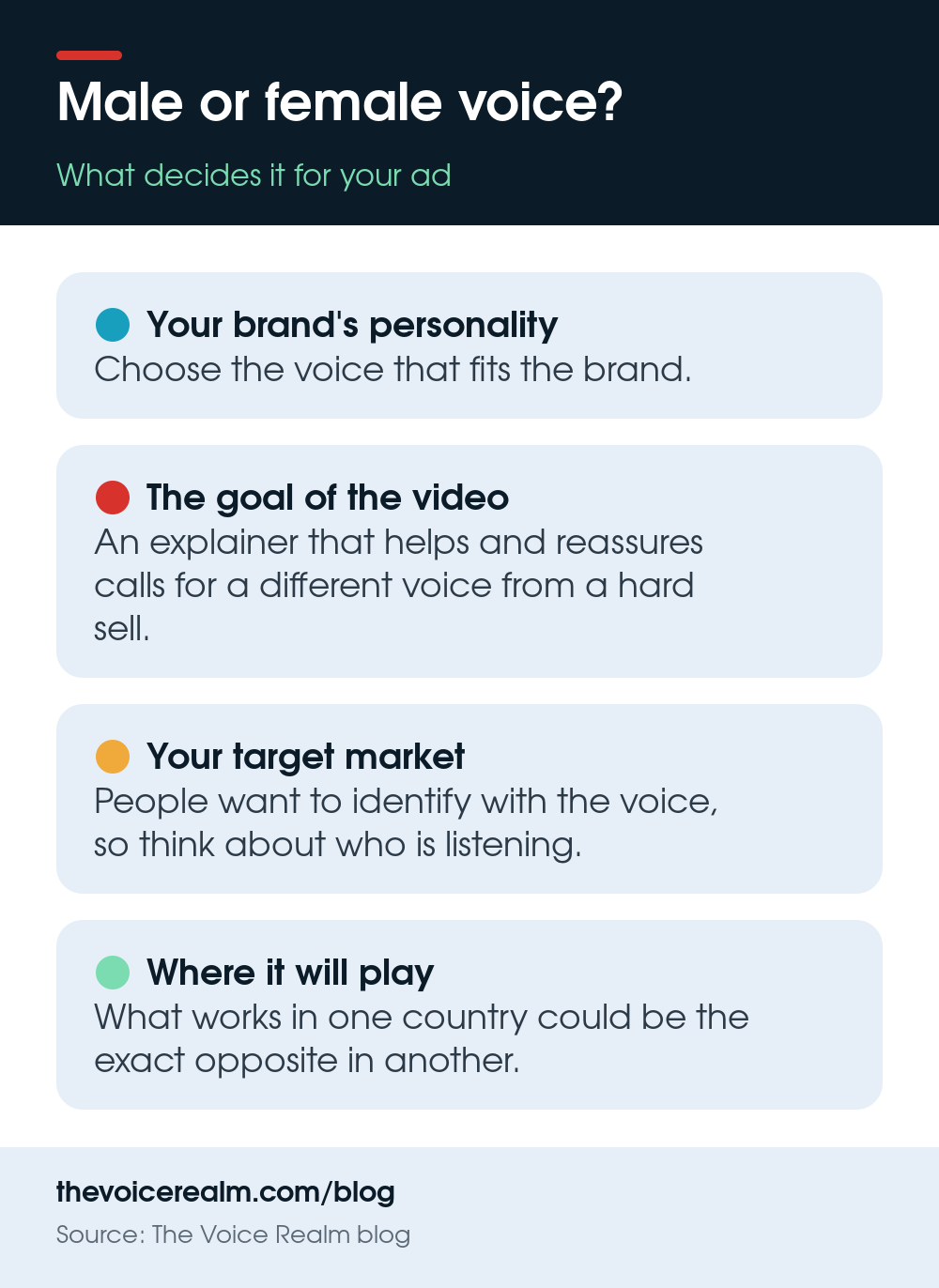
Four things that decide it © The Voice Realm
Susan Hura, a VUI designer and president of SpeechUsability, says, “It’s one of the persistent problems. It’s a question that (voice user interface) designers get a lot.” And it appears to still be a persistent problem.
Ready to get booked?
See the jobs open right now